The FAQs are AI-generated, and Fortune India is not responsible for its content or any associated copyright issues.
SUV surge drives India’s record FY26 PV sales, grabs a major slice of the sales pie
/ 2 min read
Utility vehicles cross 3.1 million units and 67% share, extending their dominance as the primary driver of India’s passenger vehicle growth
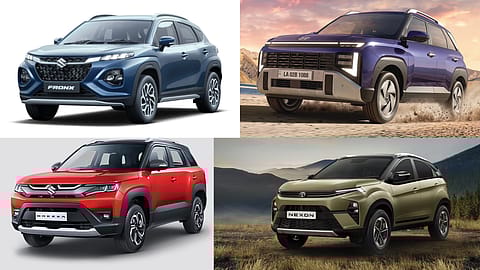
Compact SUVs accounted for 1.47 million units, or about 47% of UV sales, making it the largest sub-segment, even as midsize SUVs gain traction, as per industry observers.
India’s passenger vehicle (PV) industry scaled a record 4.64 million units in FY2026, with utility vehicles (UVs)—comprising SUVs and MPVs—tightening their grip on the market, according to data shared by the Society of Indian Automobile Manufacturers (SIAM). UVs accounted for 3.10 million units, or a 67% share of PV sales, up from 65% in FY2025 and 60% in FY2024, underscoring a structural shift toward SUVs.
The expansion is evident in volumes. UV sales have risen from just over 2 million units in FY2023 to 2.52 million in FY2024 and 2.79 million in FY2025, before breaching the 3-million mark. That translates to over 8,500 SUVs and MPVs sold daily in FY2026.
“UVs continued to be the primary growth engine, while passenger cars also saw a sharp revival on improved financing conditions,” SIAM Director General Rajesh Menon recently told reporters while declaring FY26 auto sales.
UV sales in Q3 FY26 rose 20.9% year-on-year to 852,498 units, marginally outpacing the growth in passenger cars. “SUVs are also driving incremental demand,” added Menon. Of the roughly 310,000 additional PV units sold during FY26, the bulk came from UVs, even as hatchbacks and sedans grew just 2% to 1.37 million units.
Competition tightens as volumes rise, compact SUVs lead the charge
The SUV boom is reshaping competitive dynamics. Maruti Suzuki retained its No. 1 position for the ninth year with about 760,000 units, though its share slipped to 24.5%.
Mahindra & Mahindra (M&M) followed with 660,000 units (up 20%) and a 21% share, while Tata Motors sold around 498,000 units (up 15%). Toyota Kirloskar Motor (TKM) and Kia India also gained ground, while Hyundai Motor India saw a marginal dip. The top six players together accounted for 94% of UV volumes.
Segment-wise, compact SUVs remain the backbone. The Tata Nexon led with around 170,000 units, followed by the Maruti Suzuki Brezza at about 165,000 units. The Maruti Suzuki Fronx added roughly 135,000 units, while the Hyundai Venue contributed nearly 120,000 units.
Overall, compact SUVs accounted for 1.47 million units, or about 47% of UV sales, making it the largest sub-segment, even as midsize SUVs gain traction, as per industry observers.
Structural shift, sustained outlook
According to industry players, the SUV shift is being driven by consumer preference for higher ground clearance, road presence and perceived safety, along with wider availability and feature-rich offerings. Demand is spreading beyond metros, supported by rural and semi-urban markets.
“What we are seeing is a sustained shift in consumer behaviour, where SUVs are increasingly becoming the default choice across price points. Their contribution to incremental growth has been disproportionately high, and with product pipelines and electrification strategies aligned toward SUVs, this momentum should continue,” said Puneet Gupta, Director at S&P Global Mobility.
{{#most-powerful-women-snapshot-individual.slug}} {{/most-powerful-women-snapshot-individual.slug}} {{^most-powerful-women-snapshot-individual.slug}} {{/most-powerful-women-snapshot-individual.slug}} {{#showRanking}} {{current-rank}} {{/showRanking}} {{#photo.0.url}}
{{name}}
Meanwhile, numerous automakers are aligning portfolios accordingly, expanding SUV line-ups across fuel types. Electric PV sales reached nearly 200,000 units in FY2026, with SUVs forming a growing share.
Follow Fortune India
Frequently Asked Questions
NEXT STORY