The FAQs are AI-generated, and Fortune India is not responsible for its content or any associated copyright issues.
Tesla Model Y L debuts in India at ₹62 lakh, targets booming SUV demand
/ 2 min read
6-seater Model Y L debuts ahead of formal Mumbai launch, signalling Tesla’s push to tap India’s fast-growing SUV market with a premium EV offering
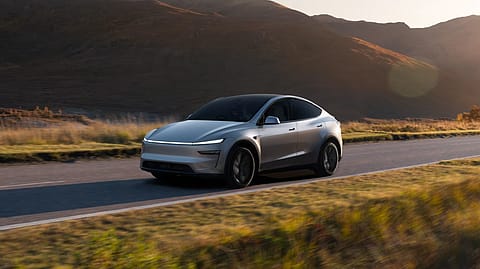
The 6-seater version features a longer wheelbase and an all-wheel-drive system, while offering the same range as the higher-end variant—681 kilometres on a full charge. | Credits: Tesla
Tesla officially launched the 6-seater Model Y on its Indian website, with the car priced at ₹62 lakh (ex-showroom). This comes ahead of the formal launch scheduled for this afternoon in Mumbai.
As per the website, the Model Y L, as it is called, sees pricing sit between the Model Y (priced at ₹59,89,000) and the Model Y Long Range (priced at ₹67,89,000). The 6-seater version features a longer wheelbase and an all-wheel-drive system, while offering the same range as the higher-end variant—681 kilometres on a full charge.
Interestingly, Tesla has not yet launched the six-seater Model Y L in its home market, the US.
The Cybertruck-maker had earlier introduced this version in China, starting at 339,000 yuan or $49,687.80.
Model YL cater to the Indian market
Tesla, after pulling the plug on its long-running models—the Model X SUV and the Model S sedan—for global markets, indicated that the SUV model would not be making it to Indian shores.
Fortune India had earlier reported that the company is unlikely to bring its flagship Model X to the country, as the electric vehicle manufacturer shifts its focus towards more affordable, higher-volume EVs, according to sources aware of the development. The move reflects a broader global strategy to prioritise scale and newer platforms over premium, low-volume models.
Therefore, with the launch of the 6-seater version, the company appears to be aiming to cater to a larger Indian audience, especially as SUVs continue to see rising demand.
As per the monthly data shared by the Society of Indian Automobile Manufacturers (SIAM), India’s passenger vehicle (PV) industry scaled a record 4.64 million units in FY2026, with utility vehicles (UVs)—comprising SUVs and MPVs—tightening their grip on the market. UVs accounted for 3.10 million units, or a 67% share of PV sales, up from 65% in FY2025 and 60% in FY2024, underscoring a structural shift towards Sport Utility Vehicles (SUVs).
According to industry players, the SUV shift is being driven by consumer preference for higher ground clearance, road presence, and perceived safety, along with wider availability and feature-rich offerings. Demand is spreading beyond metros, supported by rural and semi-urban markets.
EV market evolves
The company’s India debut also came at a time when the domestic EV ecosystem is more mature than before, with improved charging infrastructure, rising consumer awareness, and stronger policy support at both central and state levels. This has allowed Tesla to enter a market that is not only larger but also more receptive to premium electric vehicles than it was a few years ago.
{{#most-powerful-women-snapshot-individual.slug}} {{/most-powerful-women-snapshot-individual.slug}} {{^most-powerful-women-snapshot-individual.slug}} {{/most-powerful-women-snapshot-individual.slug}} {{#showRanking}} {{current-rank}} {{/showRanking}} {{#photo.0.url}}
{{name}}
At the same time, Tesla’s strategy appears measured, focusing on select models and urban centres initially, rather than an aggressive nationwide rollout. Industry observers note that the company is likely to closely track early demand trends, pricing response, and infrastructure readiness before scaling up its presence in the country.
Follow Fortune India
Frequently Asked Questions
NEXT STORY