2025 sees deliveries boom in India, says data from Blue Dart
/ 3 min read
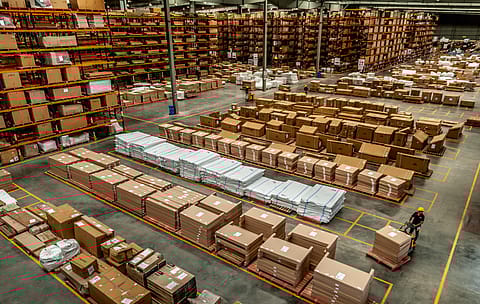
Operational data from Blue Dart for the January–December 2025 period offers a clear view of how express logistics is evolving from a support function for e-commerce into core national infrastructure.
2025 sees deliveries boom in India, says data from Blue Dart
In 2025, India's logistics sector, led by Blue Dart, experienced a significant transformation, evolving from a support function to a core national infrastructure. With shipment volumes doubling on peak days and a shift towards digital onboarding, the industry faces challenges in cost management and service expectations, especially as Tier II cities drive growth.
This summary is AI-generated, and Fortune India is not responsible for its content or any associated copyright issues.
Rising shipment intensity, longer routes, and more specialised cargo show how express logistics is becoming critical economic infrastructure.
Operational data from Blue Dart for the January–December 2025 period offers a clear view of how express logistics is evolving from a support function for e-commerce into core national infrastructure.
India’s logistics sector crossed an inflection point in 2025. Volumes rose, routes expanded, and shipments became more complex—placing sustained pressure on networks originally built for speed but now required to deliver resilience.
Operational data from Blue Dart for the January–December 2025 period offers a clear view of how express logistics is evolving from a support function for e-commerce into core national infrastructure.
Demand is becoming structurally higher
One of the clearest signals of change is frequency. Blue Dart recorded 20 separate days in 2025 when shipment volumes were twice the daily average, indicating that peak demand is no longer confined to festivals or sale-led spikes.
The busiest day came in July, when more than 14,000 tonnes moved through the network in a single day. Over the full year, 47 million secured parcels were delivered—reflecting not only consumer demand but rising B2B movement of financial documents, regulated cargo, and medical supplies.
For logistics operators, this matters: consistently high volumes reduce slack in the system, leaving less room to absorb disruption.
Distance is driving cost pressures
Blue Dart’s road operations covered more than 2 billion kilometres in 2025. While often framed as a scale milestone, the figure highlights a deeper cost challenge.
As shipment growth increasingly comes from Tier II cities, average delivery distances rise and drop densities fall. This structurally increases fuel costs, transit times, and last-mile complexity—putting pressure on margins in an industry where pricing power remains limited.
Infrastructure is no longer optional
The company now operates close to 399,000 square metres of logistics infrastructure, including hubs and sorting centres. These assets run round-the-clock to support time-bound deliveries across banking, healthcare, and industrial segments.
What distinguishes 2025 from earlier years is utilisation intensity. Infrastructure is increasingly deployed for shipments where failure carries regulatory, financial, or medical consequences—raising both operating costs and service expectations.
Cold-chain and specialised cargo are scaling up
Logistics in India is no longer just about parcels. In 2025, the network handled shipments ranging from insulin at 2–8° C and plasma at –80° C to cell and gene therapies transported using dry ice. At the extremes, liquid nitrogen consignments at –196° C and deliveries to Leh at roughly 3,500 metres above sea level highlight the operational breadth now expected from express logistics players.
These categories offer higher yields but also bring higher compliance costs, specialised infrastructure requirements, and elevated operational risk.
{{#most-powerful-women-snapshot-individual.slug}} {{/most-powerful-women-snapshot-individual.slug}} {{^most-powerful-women-snapshot-individual.slug}} {{/most-powerful-women-snapshot-individual.slug}} {{#showRanking}} {{current-rank}} {{/showRanking}} {{#photo.0.url}}
{{name}}
Digital onboarding is lowering entry barriers
Another notable development is the shift towards fully digital customer onboarding, with shipping accounts activated in roughly 90 seconds.
For SMEs and D2C brands, this accelerates access to national distribution. For logistics firms, it compresses the sales cycle but increases exposure to credit and compliance risk—shifting competitive focus from front-end acquisition to backend controls.
Tier II cities are driving incremental growth
Tier II markets accounted for about 60% of shipment growth in 2025. These cities are no longer peripheral demand centres and are increasingly shaping network expansion strategies.
The challenge lies in balancing service parity with cost discipline, as customers in these markets expect metro-level delivery standards without corresponding price increases.
More than 600 employees at Blue Dart have been with the company for over 25 years, contributing to operational continuity in a sector known for high attrition.
As networks scale and automation increases, the test will be whether such experience can be embedded into systems rather than remain dependent on individual tenure.
The 2025 numbers point to a logistics sector that is becoming mission-critical to India’s economy—supporting healthcare, finance, manufacturing, and small businesses alongside consumer commerce.
The next phase of competition is unlikely to be defined by speed alone. Instead, profitability, risk management, and the ability to handle complexity at scale will determine which logistics players endure as volumes continue to rise.
Follow Fortune India
NEXT STORY