ABD Maestro enters ultra-luxury spirits with ₹11-lakh Macallan 1991 single malt
/ 3 min read
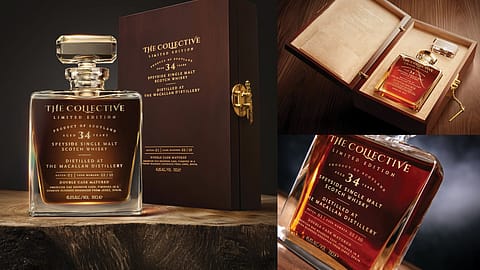
For ABD Maestro, the launch is a deliberate move to test the depth of India’s ultra-luxury spirits market rather than chase volumes.
ABD Maestro enters ultra-luxury spirits with ₹11-lakh Macallan 1991 single malt
ABD Maestro Pvt. Ltd., co-founded by actor Ranveer Singh, has launched a ₹11-lakh Macallan 1991 single malt in India, targeting the ultra-luxury spirits market. Limited to 60 decanters, this move tests the depth of India's high-end whisky market, appealing to discerning consumers who value craftsmanship and exclusivity.
This summary is AI-generated, and Fortune India is not responsible for its content or any associated copyright issues.
The Allied Blenders & Distillers subsidiary is testing the depth of India’s ultra-high-net-worth demand with a 60-bottle release, betting on scarcity, provenance, and a maturing luxury consumer base.
THIS STORY FEATURES
For ABD Maestro, the launch is a deliberate move to test the depth of India’s ultra-luxury spirits market rather than chase volumes.
India’s ultra-luxury consumption market is expanding beyond cars, watches and art—and fine spirits are now staking a claim. ABD Maestro Pvt. Ltd., the super-premium and luxury spirits subsidiary of Allied Blenders & Distillers (ABD) co-founded by actor Ranveer Singh, has entered the highest end of the whisky market with The Collective, a limited-edition 34-year-old Speyside single malt distilled at Macallan Distillery in 1991.
Priced at ₹11 lakh for a 700-ml bottle in Maharashtra, the release is restricted to 60 individually numbered decanters for India, putting it among the most expensive officially retailed whiskies in the country. The whisky is being offered via pre-orders, select high-end retail stores in key metros, and India travel retail.
For ABD Maestro, the launch is a deliberate move to test the depth of India’s ultra-luxury spirits market rather than chase volumes. “At this end of the spectrum, consumers are extremely informed and discerning,” says Bikram Basu, managing director, ABD Maestro. “They understand lineage, age statements, and craft, and are willing to pay if the product stands up to scrutiny.”
From premium to ultra-luxury
India’s premiumisation story in alcohol has been underway for years, but executives say the shift to true ultra-luxury is being driven by the top 1–2% of consumers—high-net-worth individuals with global exposure and evolving tastes. According to Basu, while incomes have risen, the bigger change is mindset.
“India always understood luxury through craftsmanship,” he says. “What has changed is the confidence to value global luxury brands alongside that tradition and assign them a price.”
The Macallan 1991 release reflects a period collectors often regard as a high point in traditional Scotch whisky-making, before large-scale capacity expansions altered production styles. Matured in sherry casks for more than three decades, the whisky is positioned as a private-cask, limited-edition offering rather than a repeatable label.
Collectability over consumption
While India’s collector culture has historically centred on art, jewellery and watches, fine spirits are beginning to be seen as both experiential luxury and alternative assets. In mature Western markets, rare whiskies and private casks have long attracted collectors due to value appreciation.
“Some buyers will collect, some will open the bottle for a once-in-a-lifetime experience, and many will do both,” Basu says. “Those nuances are now being understood in India.”
The whisky has been developed in collaboration with Speyside Capital, with decanters hand-filled, engraved and finished in Scotland. Distribution will be limited to Mumbai, Delhi-NCR and a few other major markets.
Limited marketing, targeted reach
Unlike mass premium launches, The Collective will see little traditional advertising. ABD Maestro plans to engage directly with high-net-worth individuals through private interactions and word-of-mouth networks—reflecting how ultra-luxury products typically change hands.
“These are not impulse purchases,” Basu notes. “They are considered decisions.”
{{#most-powerful-women-snapshot-individual.slug}} {{/most-powerful-women-snapshot-individual.slug}} {{^most-powerful-women-snapshot-individual.slug}} {{/most-powerful-women-snapshot-individual.slug}} {{#showRanking}} {{current-rank}} {{/showRanking}} {{#photo.0.url}}
{{name}}
Policy backdrop and competition
The launch comes at a time when India’s trade negotiations with the European Union and the UK are ongoing, while discussions with the US continue intermittently.
Although there has been no across-the-board reduction in import duties on alcoholic beverages, recent policy signals and bilateral negotiations have renewed industry expectations of a more rationalised duty structure over the medium term.
“Any movement towards more predictable and rational duties helps consumers understand value better and pushes companies to compete on quality,” Basu says. “Even at the ultra-luxury end, competition forces a sharper focus on craft and credibility.”
What next for The Collective
ABD Maestro plans to expand The Collective over time, potentially across different spirit categories and formats. Future releases may vary in focus—ranging from rarity and age statements to design-led or culturally resonant collaborations—but the company says pace will remain measured.
“Ultra-luxury takes time,” Basu says. “When someone is paying this kind of money, precision matters.”
With its ₹11-lakh debut, ABD Maestro is effectively gauging whether India’s luxury story is ready to sustain spirits at the very top of the price pyramid—where scarcity, heritage and credibility matter more than scale.

Follow Fortune India
NEXT STORY