Abundantia Entertainment, invideo commit ₹100 crore to launch AI-driven film studio
/ 3 min read
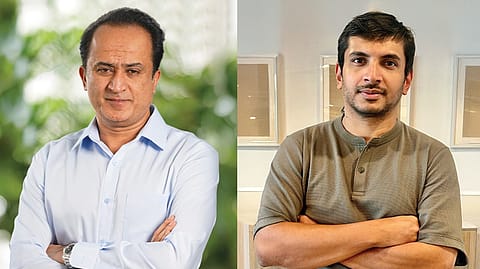
(L-R) Vikram Malhotra, founder and CEO, Abundantia Entertainment and Sanket Shah, founder and CEO of invideo
Abundantia Entertainment, invideo commit ₹100 crore to launch AI-driven film studio
Abundantia Entertainment and invideo have announced a ₹100 crore investment to establish an AI-driven film studio, marking a significant shift in India's film production landscape. The partnership aims to produce five AI-powered films over three years, blending human creativity with AI technology to enhance storytelling without replacing the filmmaker's voice.
This summary is AI-generated, and Fortune India is not responsible for its content or any associated copyright issues.
Five-film slate over three years signals one of India’s largest structured bets on AI-powered filmmaking, as studios move from experimentation to institutional capital deployment.
(L-R) Vikram Malhotra, founder and CEO, Abundantia Entertainment and Sanket Shah, founder and CEO of invideo
In what could mark a pivotal shift in India’s film production ecosystem, Abundantia Entertainment has partnered with AI video technology firm invideo to set up an artificial intelligence-driven film studio, committing ₹100 crore to build a slate of five AI-powered films over the next three years.
The announcement was made at the India AI Film Festival held at Delhi’s Qutb Minar on the sidelines of the India AI Impact Summit 2026.
₹100 crore bet on AI-led cinema
The investment marks one of the largest structured financial commitments towards AI-led filmmaking in India so far. The capital will be deployed towards development and production of five feature films under Abundantia’s AI storytelling division, aiON.
For Abundantia, known for films such as Baby, Airlift and Toilet – Ek Prem Katha, the move represents a strategic expansion rather than a pivot. The studio has been gradually integrating AI workflows under its aiON vertical, positioning the technology as a creative enabler rather than a cost-cutting substitute.
“AI in filmmaking is now real. Every leap in cinema—from sound to colour to digital—has expanded storytelling possibilities. AI is the next inflection point,” said Vikram Malhotra, founder and CEO, Abundantia Entertainment. “With aiON, we are building a future where AI strengthens the filmmaker’s voice, not substitutes it. Our partnership with invideo allows us to design a future-facing studio blending human imagination with technological capability.”
Industry observers say the scale of the corpus signals that AI experimentation in Indian cinema is moving from pilot projects to institutional capital allocation.
From tools to studio-grade workflows
For invideo, which counts over 50 million users globally, the partnership extends its AI video creation capabilities from short-form and marketing content into long-form cinematic production.
Backed by global investors including Tiger Global Management and Peak XV Partners, invideo has been building generative-video pipelines designed for enterprise users. The company recently announced a collaboration with Google Cloud to develop studio-grade AI production infrastructure.
Sanket Shah, founder and CEO of invideo, said the partnership marks a strategic expansion into high-quality filmmaking. “Our mission has been to democratise high-quality video creation through AI. Partnering with a studio like Abundantia allows us to build tools and workflows that help creators move from idea to cinematic expression faster and more freely. This is about enhancing creativity, not automating it.”
The company’s pitch to studios hinges on AI-powered workflows that compress pre-production timelines, enable rapid visualisation, and potentially reduce dependence on heavy physical sets or early-stage VFX iterations.
India’s first AI-led Hindi features in pipeline
The collaboration builds on Abundantia aiON’s existing projects, including what the studio describes as India’s first AI-generated Hindi feature film, Chiranjeevi Hanuman, slated for release in 2026, and Jai Santoshi Mata: Sukh Sampatti Daata.
{{#most-powerful-women-snapshot-individual.slug}} {{/most-powerful-women-snapshot-individual.slug}} {{^most-powerful-women-snapshot-individual.slug}} {{/most-powerful-women-snapshot-individual.slug}} {{#showRanking}} {{current-rank}} {{/showRanking}} {{#photo.0.url}}
{{name}}
If executed successfully, the slate could serve as a proof of concept for AI-integrated mainstream cinema rather than experimental digital releases.
However, questions remain around cost structures, intellectual property ownership, guild responses, and the balance between human authorship and machine-generated inputs—issues that global studios are still grappling with.
A structural shift or a high-risk experiment?
Globally, AI adoption in filmmaking has largely been confined to visual effects enhancement, de-ageing, script analysis, and virtual production. A fully AI-driven studio model in India, backed by a defined corpus and multi-film slate, is relatively untested at scale.
The ₹100-crore commitment, while significant for AI-led production, remains modest compared to the budgets of large commercial Hindi films. Analysts say the real test will be whether AI meaningfully reduces production timelines and improves capital efficiency without compromising creative quality.
For Abundantia, which straddles theatrical and streaming platforms, the move also positions the studio at the intersection of technology and storytelling at a time when content economics are under pressure.
Whether this partnership catalyses a broader AI arms race in Indian cinema—or remains a niche innovation bet—will likely depend on the performance of the first two films in the slate.
But one thing is clear: AI in Indian filmmaking has moved from panel discussions to balance sheets.
NEXT STORY