The FAQs are AI-generated, and Fortune India is not responsible for its content or any associated copyright issues.
As Bharat consumption crosses $1 trillion, can online grocery keep up?
/ 3 min read
While metro markets are driving gross merchandise value growth through quick commerce, user growth is increasingly coming from Tier-II and smaller markets through value-focused commerce models.
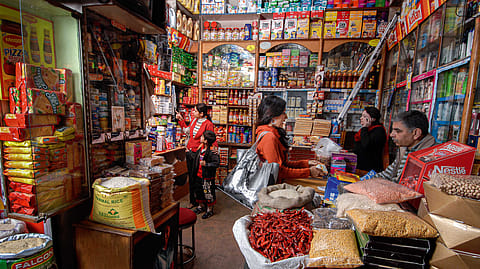
Representative image of customers shopping at a grocery store | Credits: Fortune India
India’s next wave of online grocery growth may not come from the race to deliver in 10 minutes, but from serving value-conscious households across smaller towns and cities, according to a new report by Redseer Strategy Consultants.
The report estimates that Bharat households will account for around 40% of all Indian households by 2030 and consume more than $1 trillion worth of goods and services, creating a large but largely untapped market for digital grocery platforms.
Despite India’s grocery market expanding from $658 billion in 2025 to nearly $992 billion by 2030, kirana stores are expected to continue dominating the category with an 86% share, down only marginally from 91% today. E-commerce, including quick commerce, is projected to increase its share from 3% to 7% over the same period, highlighting the significant headroom for organised online players.
“While the market fixates on the ten-minute delivery race in the metros, a quieter model is unlocking India’s next 100 million online shoppers,” the report notes. “Value grocery is winning not on speed, but on SKU selection and low-cost logistics.”
The report argues that online retail is increasingly becoming “a tale of two Indias”. While metro markets are driving gross merchandise value growth through quick commerce, user growth is increasingly coming from Tier-II and smaller markets through value-focused commerce models.
The consulting firm estimates that India’s online retail market grew 21% year-on-year in FY26 to reach $79 billion, with transaction growth of roughly 40% supported by about 25% growth in users. Active transacting users are estimated to have risen to 335-355 million in FY26.
Bharat’s grocery basket is changing
Interestingly, there are several structural shifts reshaping consumption patterns among Bharat households. The number of Bharat households is expected to exceed 150 million by FY30, supported by household fragmentation and the rise of nuclear families. Consumption by these households is projected to rise from about $625-675 billion in FY24 to $1.07-1.13 trillion by FY30.
At the same time, consumers are moving steadily toward packaged and branded food products. The report noted that packaged edible oil penetration has climbed to 70%, while packaged atta and rice are growing at high-teen rates.
Health and nutrition are also becoming key purchase drivers. The report found that protein consumption is increasingly becoming part of daily diets, with eight out of ten households now regularly consuming protein-fortified or high-protein convenience products. Bharat consumers are also willing to pay a 10-15% premium for fortified and clean-label products.
Food and grocery categories are expected to remain among the fastest-growing consumption segments through 2030, alongside health, beauty and personal care, and home-related categories.
For online grocery players, Redseer believes success in Bharat will depend less on delivery speed and more on assortment, affordability and fulfilment efficiency.
{{#most-powerful-women-snapshot-individual.slug}} {{/most-powerful-women-snapshot-individual.slug}} {{^most-powerful-women-snapshot-individual.slug}} {{/most-powerful-women-snapshot-individual.slug}} {{#showRanking}} {{current-rank}} {{/showRanking}} {{#photo.0.url}}
{{name}}
The report highlighted a scaled value-grocery player as an example of how the model can work. For instance, the platform carries roughly three times more regional and private-label assortment than large horizontal e-commerce platforms. Around 58% of its grocery SKUs come from regional or private-label brands compared with 18-20% for a legacy e-commerce player.
The platform also offers a wider range of smaller pack sizes, a critical factor for price-sensitive consumers, and operates a community partner-led logistics model with fulfilment costs of about ₹50-55 per order. Redseer estimates this is roughly half the delivery cost incurred by quick commerce platforms.
“Winning the white space means competing on price, selection and cost-to-serve,” the report said, adding that regional assortment, private labels, low-cost fulfilment and localised offerings will be key to capturing the next phase of grocery demand in Bharat.
As quick commerce continues to expand in urban India, the larger long-term opportunity may lie in digitising the grocery purchases of millions of households that still depend almost entirely on their neighbourhood kirana stores.
Follow Fortune India
Frequently Asked Questions
NEXT STORY