AWL Agri Business aims at ₹10,000 crore revenue from food business by 2027
AWL Agri Business aims at ₹10,000 crore revenue from food business by 2027
AWL Agri Business aims to boost its food segment revenue to ₹10,000 crore by 2027, reducing reliance on the volatile edible oil market. The company plans to increase food's contribution to 30%-35% of its volume, leveraging better margins and a growing demand for branded staples.
Food currently contributes 18%-19% of its overall volume and the intent is to ensure that it contributes around 30%-35%
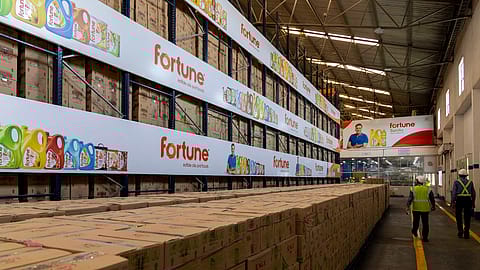
AWL Agri Business (formerly Adani Wilmar) is looking at considerably reducing its dependence on edible oil and positioning itself as a food company. Currently, food, for the ₹65,000-odd crore maker of the Fortune brand of oil contributes 18%-19% of its overall volume and the intent is to ensure that it contributes around 30%-35%. “We sell over million tonnes of food, close to ₹6,000 crore in revenue and we want to make it ₹10,000 crore by March 2027,” says Shrikant Kanhare, MD & CEO, AWL Agri Business.
Kanhare believes that food complements its edible oil business and is more importantly a great way of derisking itself from the highly volatile oil business. “Food has better gross margins than edible oil, even EBITDA margins are better. So, if there is more food in your basket your overall margin structure will obviously improve. Also, food is less volatile compared to edible oil. The more you add food the more you are able to de-risk your business.”
“In edible oil your gross margins can be 12%-13%, but food can go up to 25%. In edible oil you can get 4%-4.5% EBITDA margins at the most, in food, it can go up to 8%-9%,” Kanhare further explains.
In 2022, AWL acquired the Kohinoor brand of rice from McCormick Switzerland GMBH. The company’s food play would largely focus on branded staples. “In India, 90% of staples is sold loose. The conversion from loose to packaged is happening rapidly with ecommerce, also the COVID-19 pandemic has led consumers to buy packaged staples. The incremental market for packed food which is getting generated every year is so big, that for companies such as ours which has a brand and distribution and manufacturing in place, it is easy to grab the incremental market,” says Angshu Mallick, chairman, AWL Agri.
Over 80% of the edible oil market is packaged and branded, however, the staples market is predominantly unbranded. “Everybody has the habit of looking at the grain and buying, but slowly people are willing to buy branded.” Mallick explains the opportunity in the staples business with data. “When you look at sugar, hardly 5% or 7% is branded, atta is highest at 12%-15%, dal is 2%-3%. Branded basmati rice is 30-40% branded, but non-basmati is 8%-12%. So, this category is unbranded, fragmented and people are not sure what they are buying, but slowly, they are getting brand conscious”
“Also, edible oil consumption is only 17 kg per annum, but sugar is 24 kg, atta is 50 kg, rice is 60 kg and dal is 22 kg per annum. If you look at the entire staples basket, it is much bigger than edible oil. So, all this, after 5-15 years, if 40-50% of the food basket is branded, just imagine the size of the business,” Mallick further adds.
Mallick says that the food business is also a game of logistics. The better your logistics, the more you will grow, he says. “The price of sugar is ₹40 a kg, the transport cost is ₹3-4 a kg, 10%-15% is freight, packaging is another 5%-6%, so, you must be smart in packing and logistics cost. A sugar-only player will find it difficult to take sugar packed in Pune or Baramati to the North East or Kolkata, but if you have a range of products like oil, sugar, flour, you can take them together. An integrated approach will support logistics, it will support easy dispatches and the entire basket is kitchen basket. My brand fit is there, manufacturing fit is there, distribution fit and my consumers are there.”
