Balaji 2.0: How Balaji Telefilms is evolving beyond television with films, digital, and IP-led growth
/ 3 min read
In an interview with Fortune India, Group CEO and CFO Sanjay Dwivedi and CRO Nitin Burman outline Balaji’s transformation strategy centred on content ownership, platform diversification, capital efficiency and new revenue engines.
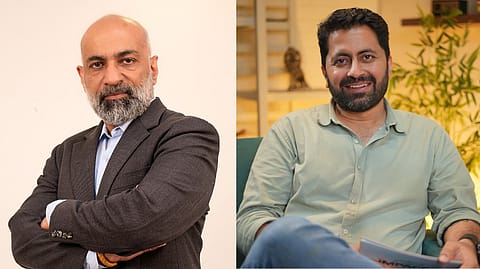
L-R: Sanjay Dwivedi, Group CEO and CFO; Nitin Burman, chief revenue officer, Balaji Telefilms | Credits: Balaji Telefilms
For decades, Balaji Telefilms was synonymous with Indian television. It built franchises, launched talent, and shaped appointment viewing for millions of households. But the company now believes the next phase of growth will not come from repeating that playbook.
Instead, Balaji is repositioning itself as an IP-first entertainment business—one that spans films, OTT, YouTube, creator-led formats, talent ecosystems and direct consumer engagement, while placing profitability and return on capital at the centre of decision-making.
In an interview with Fortune India, Sanjay Dwivedi, group CEO and CFO, and Nitin Burman, chief revenue officer, laid out what they describe as Balaji 2.0—a transformation strategy designed to reduce dependence on linear television and unlock new revenue streams across content ownership and digital extensions.
The pivot comes at a time when Balaji’s financial profile is also improving. The company reported revenue of ₹467.5 crore and net profit of ₹84.6 crore in FY25 even as it accelerated investments across films, digital formats and newer consumer-facing initiatives.
“Balaji, at the core, will always remain a storyteller,” Burman tells Fortune India. “The platform is simply a mode of distribution. Whether the consumer watches on television, OTT, YouTube or another format, our job is to create stories for where the audience exists.”
That philosophy reflects a broader structural shift underway in India’s media industry.
According to Dwivedi, the economics that once made television attractive are changing. Traditional TV production offered predictability and recurring cash flows, but left little room for ownership.
“Historically, television was stable, but the IP and upside largely remained with broadcasters,” says Dwivedi. “You generated cash, but you did not necessarily create enterprise value.”
The pressure has intensified as linear television growth slows and broadcasters become more cautious on content spending.
What does Balaji’s shift beyond television actually look like?
Balaji’s answer has been to rethink the business model entirely.
Over the next three to five years, the company expects films to emerge as its largest business vertical, followed by digital and television. Internally, the ambition is to create a more diversified revenue mix anchored in owned intellectual property and scalable digital businesses.
{{#most-powerful-women-snapshot-individual.slug}} {{/most-powerful-women-snapshot-individual.slug}} {{^most-powerful-women-snapshot-individual.slug}} {{/most-powerful-women-snapshot-individual.slug}} {{#showRanking}} {{current-rank}} {{/showRanking}} {{#photo.0.url}}
{{name}}
The transition is also changing how Balaji approaches risk.
Unlike earlier models where production houses developed projects before finding buyers, Balaji says its OTT strategy now starts with commissioning.
“We are not making shows and then trying to sell them,” Burman says. “We pitch concepts, get them approved by platforms and then produce them. That means the content is funded and our risk exposure is significantly lower.”
The same discipline is extending to films.
Dwivedi says Balaji is deliberately avoiding oversized budgets and prioritising pre-sales, licensing and upfront monetisation before projects move into production.
“We don’t go on floors until there is enough visibility on recovery,” he says. “There may be occasions where you sacrifice some upside, but in this business, protecting capital is equally important.”
That thinking has also influenced Balaji’s expansion beyond content.
The company has launched and scaled businesses such as Kutingg, Balaji Astro Guide, Hoonur and The Impacct Circle—initiatives designed to create engagement and monetisation opportunities beyond conventional production.
According to Dwivedi, these newer businesses are being built with a very different playbook from earlier direct-to-consumer bets.
Balaji’s previous streaming experience showed that scale alone is not enough if it comes at the cost of sustained cash burn.
“We want to participate in B2C, but we don’t want growth at any cost,” he says. “Every initiative must eventually demonstrate profitability.”
Can platform diversification and new formats become Balaji’s next growth engine?
Content formats are also becoming increasingly platform-specific.
The company is now producing theatrical films, OTT originals, YouTube-first formats and experimenting aggressively with micro dramas—short-format storytelling that has seen strong adoption globally.
Balaji believes YouTube is no longer just a discovery channel but can become a standalone monetisation engine.
Burman says the company has already launched its own YouTube-led content strategy and is evaluating multilingual distribution opportunities, including regional and global audiences.
Regional content itself is becoming an increasingly important growth lever.
The company sees languages such as Telugu, Tamil and Malayalam extending beyond domestic audiences into global diaspora markets—opening opportunities for wider distribution and monetisation.
For Balaji, however, the success metric remains straightforward.
“Profitability is the milestone,” says Burman. “A robust order book, disciplined execution and sustained returns—that’s how we’ll know this transformation is working.”
For a company that built its legacy on television, the next chapter is less about moving away from one screen and more about following audiences across every screen. If Balaji’s bets pay off, the transformation could redefine it not as a TV producer, but as a diversified storytelling and IP-led entertainment business built for the digital era.
NEXT STORY