The FAQs are AI-generated, and Fortune India is not responsible for its content or any associated copyright issues.
Bengaluru Yellow, Pink Metro Lines to drive realty growth; 5-7 million sq. ft office demand seen: Colliers India
/ 2 min read
Colliers said Bengaluru ranks first globally in tech talent availability, with nearly twice as many professionals as the next-largest city worldwide.
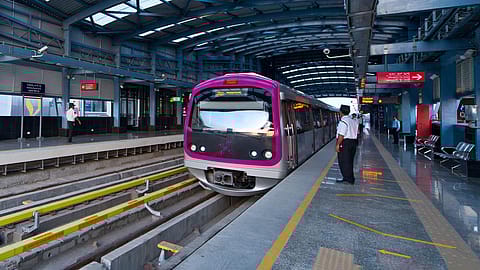
Bengaluru's metro network currently consists of five lines at different stages of development, all expected to become operational in the next few years.
The recent launch of Bengaluru’s Yellow Metro Line and the upcoming Pink Line are expected to accelerate real estate activity across key micro markets, with 5-7 million square feet of incremental office demand likely over the next two years, according to a report by Colliers India.
The consultancy said Bengaluru’s rise as one of India’s fastest-growing real estate markets has been underpinned by the city’s strong technology ecosystem, expanding startup base, presence of multinational corporations, robust industrial and manufacturing sectors, and favourable business environment.
Citing its Global Tech Markets: Top Talent Locations 2025 report, Colliers said Bengaluru ranks first globally in tech talent availability, with nearly twice as many professionals as the next-largest city worldwide.
Infrastructure development has also played a crucial role in the city’s growth, including arterial roads, expressways, airport expansions and metro rail connectivity. With Bengaluru’s rapid urban expansion over the past few decades, sustained infrastructure investment has become essential to ease congestion and unlock new growth corridors.
Metro expansion may reshape office and housing markets
The city’s metro network currently consists of five lines at different stages of development, all expected to become operational in the next few years.
The Green Line (Madavara-Silk Institute) and Purple Line (Challaghatta-Whitefield), which are already operational, have boosted office leasing and residential demand in key locations such as Whitefield, KR Puram, MG Road, and Indiranagar. They have also supported warehousing demand in peripheral industrial hubs like Hoskote and Nelamangala.
The recently operational Yellow Line (RV Road-Bommasandra) and the soon-to-be-launched Pink Line (Kalena Agrahara-Nagawara) are expected to further transform the city’s real estate landscape by significantly reducing travel time and improving connectivity across central and southern Bengaluru.
The Yellow Line, which became operational in 2025, has strengthened connectivity to major employment hubs such as Electronic City, Hosur Road and Bommasandra. Meanwhile, the Pink Line, expected to open in phases through 2026 and early 2027, is likely to ease congestion in areas including Bannerghatta Road, JP Nagar, Shivajinagar and Nagawara, while enhancing access to established commercial, residential and industrial zones.
Rentals may rise 5-10%
Colliers said the Yellow Line has already firmed up office demand, fresh supply and rentals in the Electronic City micro market. The Pink Line is expected to spur demand for Grade A office spaces in central business district locations such as MG Road, Richmond Road and Vittal Mallya Road, as well as secondary business district areas including Bannerghatta Road and JP Nagar.
The report estimates cumulative new office demand of 5-7 million sq. ft across the catchment areas of the two lines over the next two years. Fresh office supply is also expected at a similar level, taking total Grade A office stock in these markets to nearly 40 million sq. ft by 2027.
Average office rentals in these locations are projected to rise 5-10%, driven by better connectivity, strong occupier interest and new high-quality developments.
{{#most-powerful-women-snapshot-individual.slug}} {{/most-powerful-women-snapshot-individual.slug}} {{^most-powerful-women-snapshot-individual.slug}} {{/most-powerful-women-snapshot-individual.slug}} {{#showRanking}} {{current-rank}} {{/showRanking}} {{#photo.0.url}}
{{name}}
“The expansion of Bengaluru’s metro network is set to boost the city’s office market across key central and secondary business districts, as well as peripheral locations such as Electronic City. The Yellow Line has already improved connectivity and demand, while the Pink Line is expected to further enhance Grade A office uptake in its catchment areas,” said Arpit Mehrotra, Managing Director, Office Services, India, Colliers.
Follow Fortune India
Frequently Asked Questions
NEXT STORY