Birla's power play to reshape India's green grid
/ 3 min read
As climate mandates intensify and international buyers demand low-carbon supply chains, securing dependable green energy has become an absolute commercial necessity.
THIS STORY FEATURES
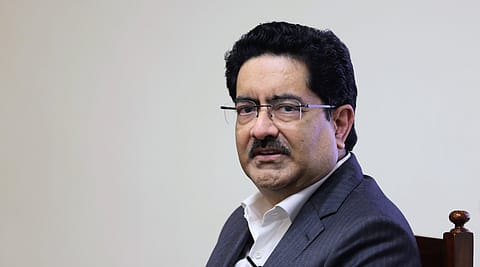
Kumar Mangalam Birla, chairperson of the Aditya Birla Group
Industrialist Kumar Mangalam Birla has spent nearly two decades pursuing a significant foothold in the power sector. The recent breakthrough—Aditya Birla Renewables' ₹17,200-crore buyout of Shell-backed Sprng Energy—marks the definitive turning point that had long evaded the $72 billion textiles-to-metals conglomerate. The $1.8-billion transaction instantly catapults the group’s clean energy capacity to roughly 9.3 gigawatts (GW) and accelerates its ambition to become a 20 GW player in the coming years, while helping meet the group's requirement of achieving carbon neutrality in its industrial operations.
For the Aditya Birla Group, this transaction represents much more than a routine expansion into the green energy sector. It marks a foundational pivot for a century-old manufacturing giant whose core operations—spanning aluminium, copper, cement, chemicals, textiles, and financial services—require massive volumes of electricity. As climate mandates intensify and international buyers demand low-carbon supply chains, securing dependable green energy has become an absolute commercial necessity.
The buyout provides the enterprise with immediate market scale. Sprng Energy contributes roughly 5 GW of secured renewable assets, featuring nearly 3.3 GW of operational capacity alongside 1.7 GW under development, complemented by a robust pipeline of future projects. Rather than spending years developing green infrastructure organically, Birla has efficiently acquired scale and operational expertise in one swift move.
The timing of this expansion is equally vital. Hindalco's aluminium and copper business, UltraTech Cement, and other production units under the Aditya Birla banner rank among the country's heaviest industrial electricity users. Powering metal and cement production with clean energy will systematically slash carbon footprints and bolster their standing in global export markets where investors insist on green manufacturing, said analysts.
The conglomerate's past bids to become a dominant utility player never quite materialised. The Rosa thermal project in Uttar Pradesh was initially designed to anchor a massive power empire, but shifting market trends, fuel supply bottlenecks, and regulatory hurdles halted the creation of a national utility network on par with Tata and Adani. "While the group evaluated several energy opportunities over the years, none offered the transformative scale and technology that Sprng Energy delivers," said an official.
Furthermore, this transaction hinges on long-term market positioning. The domestic power sector is locked in a fierce rivalry where energy access is proving critical for industrial growth.
Tata Power commands a generation capacity of over 16.7 GW (of which 7,856 mega watt is renewable capacity), while funding aggressive expansions in solar manufacturing, rooftop installations, battery storage networks, transmission lines, and EV charging hubs. The firm has committed billions towards scaling its renewable assets and distribution grids. The Adani Group positions itself as the market's most aggressive player. Between Adani Green Energy's 20.1 GW operational green portfolio and Adani Power's thermal footprint exceeding 18.1 GW, the conglomerate operates one of the nation's largest integrated energy networks. It is investing huge capital in the Khavda green energy hub, hydrogen ventures, grid infrastructure, and storage systems.
Reliance Industries approaches the industry through a different lens. Instead of setting up traditional utilities, Mukesh Ambani is injecting billions into the Dhirubhai Ambani Green Energy Giga Complex in Jamnagar to manufacture solar modules, battery systems, electrolysers, and hydrogen equipment, alongside developing captive green generation.
Faced with these formidable rivals, Birla’s calculated step significantly narrows the competitive gap. While the organisation still trails Tata and Adani in sheer capacity, it now commands the critical mass required to emerge as a top-tier green power producer virtually overnight.



Follow Fortune India
NEXT STORY