Board resolution to reappoint Chandrasekaran illegal: Tata Trusts
/ 2 min read
The statement comes after the Tata Sons board approved a resolution seeking Chandrasekaran’s reappointment as chairman.
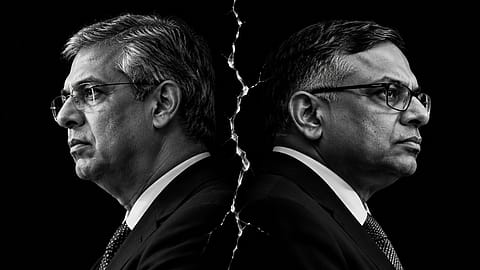
Tata Trusts said they formally accepted N. Chandrasekaran’s decision the following day and advised Tata Sons to initiate the process of constituting a Selection Committee to appoint his successor, in accordance with the company’s Articles of Association. | Credits: Photo Illustration by Saurabh Singh
Tata Trusts on Thursday reiterated that N. Chandrasekaran’s decision not to seek reappointment as chairman of Tata Sons after the end of his current tenure on February 20, 2027, had been accepted and was final.
In a statement following the Tata Sons board meeting, the Trusts said Chandrasekaran had communicated his decision to the board on August 12, 2026, and that it was “freely taken” and “clearly expressed”. The decision, the Trusts said, was not the outcome of any review process and had been made public without prior intimation to, or deliberations with, the company’s shareholders.
“Once such a decision has been publicly communicated, it has consequences which cannot be afterwards undone,” the Trusts said, arguing that employees, lenders, counterparties, the market and the majority shareholder had proceeded on the basis of that decision.
The Trusts said they formally accepted Chandrasekaran’s decision the following day and advised Tata Sons to initiate the process of constituting a Selection Committee to appoint his successor, in accordance with the company’s Articles of Association.
Trusts question validity of reappointment resolution
The Trusts reiterated that position at Thursday’s board meeting, describing it as the considered judgment of the majority shareholder. The statement came after the Tata Sons board approved a resolution seeking Chandrasekaran’s reappointment as chairman. Four directors voted in favour of the proposal, while Tata Trusts Chairman Noel Tata voted against it.
The Trusts, however, said the resolution was a “legal nullity” under Tata Sons’ Articles of Association. According to the Trusts, the Articles require a majority of the Trusts’ nominee directors to vote in favour of a chairman’s appointment or reappointment.
The Trusts further argued that the requirement applies both to a first appointment and to the reappointment of an existing chairman. As a result, they said, a board resolution on the appointment or reappointment of the chairman cannot be validly passed unless both Trust nominee directors are present and vote in favour.
“With Mr Noel Tata, being one of the Trust nominee directors, voting against the proposal, it was rendered legally void and without any basis,” the Trusts said.
Noel Tata also submitted a legal opinion from former Chief Justice of India Justice D.Y. Chandrachud on the validity of the Trusts’ position, according to the statement. The Trusts said the board did not take note of the opinion.
Tata Trusts push for leadership transition
The statement added that a detailed submission made by Noel Tata to the Tata Sons board regarding Chandrasekaran’s proposed reappointment had also been annexed to the communication.
The latest development follows Chandrasekaran’s decision in August not to seek another term after his current tenure ends in February 2027. The Trusts said the decision had been accepted and that they had subsequently advised Tata Sons to begin the process of setting up a Selection Committee to identify his successor.
{{#most-powerful-women-snapshot-individual.slug}} {{/most-powerful-women-snapshot-individual.slug}} {{^most-powerful-women-snapshot-individual.slug}} {{/most-powerful-women-snapshot-individual.slug}} {{#showRanking}} {{current-rank}} {{/showRanking}} {{#photo.0.url}}
{{name}}
The Trusts said they remained committed to ensuring an “orderly and timely leadership transition” at Tata Sons and across the Tata Group, in what could now become a contested process over the company’s leadership and the interpretation of its Articles of Association.
Follow Fortune India
NEXT STORY