Bombay HC quashes spectrum levy on Airtel, Vi; Supreme Court set to decide final outcome
/ 3 min read
The ruling ends, at least for now, a dispute that has hung over the telecom sector for more than a decade and dates back to the years before spectrum auctions became the norm.
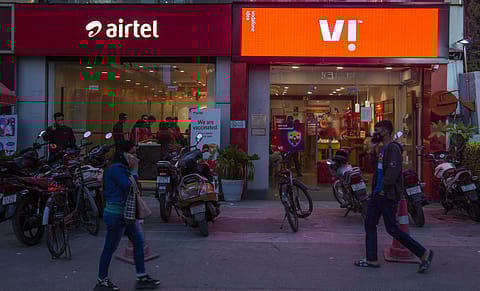
Bombay HC spectrum judgment | Credits: Sanjay Rawat
The Bombay High Court on Monday handed a big victory to Bharti Airtel and Vodafone Idea by striking down the Union government's one-time spectrum charge (OTSC) on airwaves allocated beyond 6.2 MHz, potentially removing a liability that industry estimates have pegged at around ₹20,000 crore for the two operators combined.
The ruling ends, at least for now, a dispute that has hung over the telecom sector for more than a decade and dates back to the years before spectrum auctions became the norm.
The court held that the government lacked the legal authority to retrospectively impose the levy from July 2008 and said the Department of Telecommunications (DoT) could not unilaterally alter the commercial terms under which spectrum had originally been allotted.
"The respondent cannot be permitted to change the contract midway to change the goal post," the court observed.
What was the dispute?
The case stems from a government decision taken in 2012 to impose a one-time charge on telecom operators that held spectrum beyond 6.2 MHz.
The DoT argued that operators had received additional spectrum through administrative allocation and should therefore pay an extra fee. It decided that the charge would be applied retrospectively from July 1, 2008, and subsequently issued demand notices to operators including Airtel and Vodafone Idea.
The telecom companies challenged the levy, arguing that neither their licence agreements nor telecom laws allowed the government to impose a fresh charge years after the spectrum had already been allotted.
Why the court ruled against the government
At the heart of the judgment is a simple question: where did the government get the power to impose the charge?
The High Court concluded that the Union government failed to identify any provision in the Telegraph Act or in the licence agreements that allowed it to retrospectively levy the one-time spectrum charge.
"The respondent has not been able to identify any source of power to issue the impugned decisions and the consequent demand notices," the Bench said.
The judges also rejected the government's argument that revenue generation alone could justify the levy in the name of public interest.
{{#most-powerful-women-snapshot-individual.slug}} {{/most-powerful-women-snapshot-individual.slug}} {{^most-powerful-women-snapshot-individual.slug}} {{/most-powerful-women-snapshot-individual.slug}} {{#showRanking}} {{current-rank}} {{/showRanking}} {{#photo.0.url}}
{{name}}
"Equating revenue maximization to public interest in all cases without exception is unacceptable," the court observed.
Why this is important for Airtel
For Airtel, the verdict removes another long-running regulatory dispute from the pre-auction telecom era.
The company has already moved beyond many legacy telecom litigations, and the ruling reduces uncertainty around a disputed liability that has remained unresolved for years.
The judgment also strengthens Airtel's argument that commercial terms agreed under telecom licences cannot be altered retrospectively.
Bigger relief for Vodafone Idea
The ruling could be more meaningful for Vodafone Idea.
The debt-laden telecom operator continues to battle funding challenges while simultaneously investing in network expansion and 5G deployment.
Any reduction in legacy liabilities improves the company's balance-sheet position and could aid its efforts to attract investors and lenders.
While the exact accounting impact will depend on disclosures and future legal developments, the High Court's order removes the immediate threat arising from the disputed spectrum demand.
Supreme Court battle still remains
Despite the High Court victory, the dispute is far from over.
Several connected matters involving the same one-time spectrum charge are already pending before the Supreme Court, including appeals arising from the Madras High Court's Aircel judgment and challenges to TDSAT orders dealing with the levy.
The Bombay High Court has now taken a view that differs from the Madras High Court's earlier ruling, increasing the likelihood that the Supreme Court will eventually deliver the final word on the issue.
What happens next?
The Union government is expected to carefully examine the judgment and could challenge it before the Supreme Court.
Given the potential revenue implications, the conflicting High Court rulings and the broader policy questions around spectrum pricing, the dispute is unlikely to end at the Bombay High Court.
NEXT STORY