Budget 2026 seeks to overhaul India’s tourism ecosystem
/ 4 min read
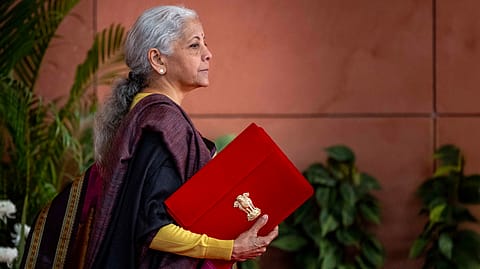
Nirmala Sitharaman, Budget 2026 | Credits: Narendra Bisht
Budget 2026 seeks to overhaul India’s tourism ecosystem
Union Budget 2026 aims to revitalize India's tourism sector by enhancing infrastructure, training guides, and developing new destinations. The plan includes establishing a National Institute of Hospitality, upskilling guides, and creating digital documentation of cultural sites. Additionally, it seeks to promote ecological trails, medical tourism, and regional connectivity, positioning India as a world-class destination.
This summary is AI-generated, and Fortune India is not responsible for its content or any associated copyright issues.
From setting up a National Institute of Hospitality and upskilling the humble tourist guides to promoting India as world class trekking and hiking destination, Budget 2026 seeks to boost Indian tourism.
Nirmala Sitharaman, Budget 2026 | Credits: Narendra Bisht
If the past couple of years was all about religious and spiritual tourism getting immense traction, Union Budget 2026 aims to give the overall Indian tourism sector a boost. After all, India is not just about monuments, palaces, temples, churches and mosques, the country’s diverse geographical landscapes provide for ample tourism opportunities – from ecological trails and bird-watching to cultural immersion and medical tourism – the scope is enormous. The tourism sector could also play a large role in employment generation, forex earnings and expanding the local economy.
To boost tourism, one would also need infrastructure to train and skill talent. Finance Minister, Nirmala Sitharaman in Union Budget 2026 has announced setting up a National Institute of Hospitality by upgrading the existing National Council for Hotel Management and Catering Technology. It will function as a bridge between academia, industry and the Government.
India may have a lot of historical heritage to boast about but if one goes to any of these sites, be it a Red Fort in Delhi or Konarak Temple in Odisha, there would be a handful of trained guides who actually have in-depth knowledge of the history and the culture of the place. The FM has announced a pilot scheme for upskilling 10,000 guides in 20 iconic tourist sites through a standardized, high-quality 12-week training course in hybrid mode, in collaboration with an Indian Institute of Management. Furthermore, a National Destination Digital Knowledge Grid will be established to digitally document all places of significance—cultural, spiritual and heritage. This initiative, according to the FM would create a new ecosystem of jobs for local researchers, historians, content creators and technology partners.
Budget 2026 also seeks to position India as a world-class trekking and hiking destination. “We will develop ecologically sustainable mountain trails in Himachal Pradesh, Uttarakhand and Jammu and Kashmir; Araku Valley in the Eastern Ghats and Podhigai Malai in the Western Ghats. Turtle Trails along key nesting sites in the coastal areas of Odisha, Karnataka and Kerala; and bird watching trails along the Pulikat lake in Andhra Pradesh and Tamil Nadu,” said the Finance Minister in the Budget speech.
India’s cultural and historical heritage is immense but a lot of it is actually not there on the tourist map. The PM in her Budget speech talked about developing some of the not so well-known archaeological sites. “I propose to develop 15 archaeological sites including Lothal, Dholavira, Rakhigarhi, Adichanallur, Sarnath, Hastinapur and Leh Palace into vibrant, experiential cultural destinations. Excavated landscapes will be opened to the public through curated walkways. Immersive storytelling skills and technologies will be introduced to help conservation labs, interpretation centres and guides,” she said.
Industry Reacts
Sitharaman also talked about the development of an integrated East Coast Industrial Corridor with a well-connected node at Durgapur, creation of five tourism destinations in the five Purvodaya States and the provision of 4,000 e-buses.
“The north-eastern region is a civilisational confluence of Theravada and Mahayana/Vajrayana traditions. I propose to launch a scheme for development of Buddhist circuits in Arunachal Pradesh, Sikkim, Assam, Manipur, Mizoram and Tripura. The scheme will cover preservation of temples and monasteries, pilgrimage interpretation centres, connectivity and pilgrim amenities,” she added.
“The government’s infrastructure-led investments have played an important role in supporting the growth of domestic tourism, and it is encouraging to see this momentum being sustained. Continued focus on regional connectivity and destination development, along with an emphasis on skilling and the creation of a national digital repository for destinations, will help improve destination discovery and enhance the overall traveller experience,” says Rajesh Magow, Chair, FICCI Tourism Committee and Co-founder & Group CEO, MakeMyTrip.
The plan is also to promote India as a hub for medical tourism services. The FM has announced a scheme to support States in establishing five regional medical hubs in partnership with the private sector. These hubs will serve as integrated healthcare complexes that combine medical, educational and research facilities. “They will have AYUSH centres, medical value tourism facilitation centres and infrastructure for diagnostics, post-care and rehabilitation. These hubs will provide diverse job opportunities for health professionals including doctors and AHPs (allied health providers).”
Apart from for promoting domestic tourism, Budget 2026 has also cut down TCS on outbound travel packages to 2%. “What stood out for me in this Budget is that it doesn’t treat travel as a one-sided story. Outbound travel needed a course correction, and cutting TCS on foreign tour packages to 2% does exactly that, it takes away a friction that travellers were feeling every time they planned a trip,” says Karan Agarwal, Director, Cox & Kings.
“The rationalisation of TCS on overseas tour packages is a welcome step that addresses upfront liquidity impact on Indian outbound travellers,” adds Magow.
Follow Fortune India
NEXT STORY