Budget 2026 seen as test of policy continuity, execution over big-bang announcements: Grant Thornton Survey
/ 3 min read
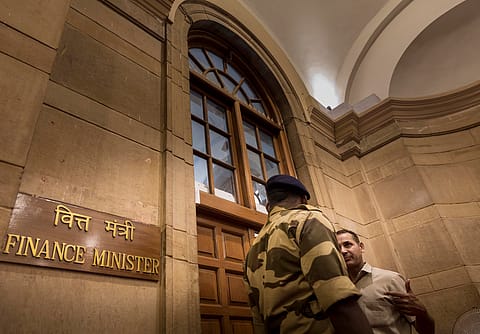
Against a backdrop of global uncertainty and a calibrated fiscal consolidation path targeting a deficit of about 4.4% of GDP, Budget 2026 is being watched as a signal of India’s medium-term economic intent. | Credits: Narendra Bisht
Budget 2026 seen as test of policy continuity, execution over big-bang announcements: Grant Thornton Survey
The Grant Thornton Bharat survey reveals that as India approaches the Union Budget 2026, businesses are prioritising policy clarity and execution over headline-grabbing announcements. With the economy projected to grow at 6.5–7% in FY26, the focus is on sustaining momentum through stable frameworks, fiscal discipline, and long-term investment certainty, especially in infrastructure and clean energy.
This summary is AI-generated, and Fortune India is not responsible for its content or any associated copyright issues.
Industry seeks predictability, stable tax frameworks, and smoother implementation as economy targets 6.5–7% growth.
Against a backdrop of global uncertainty and a calibrated fiscal consolidation path targeting a deficit of about 4.4% of GDP, Budget 2026 is being watched as a signal of India’s medium-term economic intent. | Credits: Narendra Bisht
As India heads into Union Budget 2026, industry sentiment is shifting decisively away from headline-grabbing announcements towards policy clarity, continuity and execution, according to Grant Thornton Bharat’s pre-Budget expectations survey. With the economy projected to grow at around 6.5–7% in FY26 and central government capital expenditure now more than three times its FY20 level, businesses are assessing how the Budget will sustain momentum while crowding in private investment.
Against a backdrop of global uncertainty and a calibrated fiscal consolidation path targeting a deficit of about 4.4% of GDP, Budget 2026 is being watched as a signal of India’s medium-term economic intent.
Predictability over short-term measures
The survey underscores a strong preference among companies for stable policy frameworks, simplified compliance and effective implementation rather than incremental or short-term incentives. Companies making long-term decisions on capacity expansion, supply chains, and decarbonisation are seeking certainty that allows them to plan with confidence.
“Across tax, trade and customs, the survey points to a consistent theme: businesses are seeking greater clarity and predictability,” said Richa Sawhney, Partner – Tax, Grant Thornton Bharat. “Whether it is the transition to a new Income-tax Act, GST administration or digital integration in customs, the emphasis is on stable frameworks, smoother implementation and reduced compliances.”
She added on the personal taxation front, despite last year’s overhaul of slab rates under the new tax regime, demand for further tweaks continues to top taxpayers’ wishlists.
Fiscal discipline with growth focus
On fiscal strategy, respondents favour a balanced approach. While 35% believe growth and employment should take priority even if fiscal consolidation slows, 28% call for a balance between deficit control and growth-oriented spending. Another 26% stress strong fiscal prudence to sustain investor confidence, indicating broad support for discipline without undermining economic momentum.
Innovation support is expected to be practical and incentive led. Sector-specific innovation funds and weighted tax deductions for R&D, each backed by 30% of respondents, emerged as the most effective tools, followed by public–private partnerships in research.
Policy certainty key to infra push
Long-term infrastructure investment, the survey finds, depends more on certainty than additional incentives. A stable tax regime for InvITs, REITs and infrastructure bonds was identified by 41% of respondents as the most critical factor in attracting long-term capital. This was followed by tax certainty for PPP and hybrid structures (23%) and streamlined cross-border funding approvals (19%).
Renewable energy and storage infrastructure topped priority areas at 43%, reflecting India’s clean-energy transition, followed by urban infrastructure (26%) and transport and logistics (21%).
Execution and ease of doing business in focus
Improving execution emerged as a clear priority. Digitised project-tracking dashboards and real-time transparency led expectations at 37%, followed by performance-linked incentives for contractors and states (24%) and better inter-ministerial coordination (21%).
On ease of doing business, 40% of respondents prioritised streamlining compliance and licensing, while 33% sought time-bound service delivery obligations on public authorities. Faster dispute resolution and reduced tax uncertainty were seen as important but secondary to upfront regulatory clarity.
{{#most-powerful-women-snapshot-individual.slug}} {{/most-powerful-women-snapshot-individual.slug}} {{^most-powerful-women-snapshot-individual.slug}} {{/most-powerful-women-snapshot-individual.slug}} {{#showRanking}} {{current-rank}} {{/showRanking}} {{#photo.0.url}}
{{name}}
Exports, customs reforms to aid manufacturing
For trade, a simplified and predictable export-incentive framework was the top priority for 40% of respondents, followed by faster conclusion of free trade agreements with key partners (31%).
On customs, alignment of classification and origin norms with global standards (39%) and reduced duties on strategic manufacturing inputs (30%) were viewed as the most effective measures to boost competitiveness, alongside the need for a predictable duty roadmap.
Managing the shift to the new Income Tax Act
Minimising disruption during the transition to the New Income Tax Act is a key concern. Extending transition timelines with relaxed penalties (28%), dedicated support channels (26%) and sector-wise government–industry consultations (25%) were the most sought-after measures.
For salaried taxpayers, 44% believe lower tax rates or wider slab intervals would make the new regime more attractive, followed by limited deductions (26%).
Digital customs, MSME, and start-up support
Momentum is building for API-driven customs systems, with nearly three in ten respondents fully prepared to adopt such platforms. Another 28% are ready but seek greater clarity and infrastructure support.
For MSMEs, access to affordable working capital remains the top priority (40%), followed by support for export readiness and standards certification (25%). Among start-ups, R&D and innovation-linked tax credits were seen as the most impactful measure (47%), followed by tax incentives for venture capital and angel investments (34%).
Green investment incentives gain traction
To accelerate the clean-energy transition, 42% of respondents prioritised tax credits for green capital expenditure and low-carbon R&D. Tax relief for renewable-energy components and storage systems (26%) and concessional regimes for green finance also featured prominently.
Follow Fortune India
NEXT STORY