Can Oriflame’s business model still deliver growth in India’s omnichannel beauty market?
/ 4 min read
Despite declining revenue and three straight years of losses, the Swedish beauty brand is doubling down on a digital-first direct selling model, betting that personalised beauty advice can outperform India's fast-growing omnichannel retail boom.
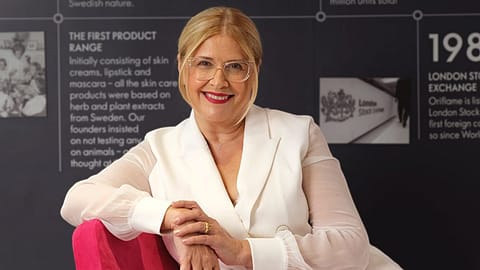
Edyta Kurek, senior vice president and GM, Oriflame India | Credits: Oriflame India
Three decades after introducing Indians to European skincare through direct selling, Oriflame is trying to reinvent itself without abandoning the model that built its business. Even as India's beauty market shifts decisively towards marketplaces, quick commerce and omnichannel retail, the Swedish beauty company continues to sell exclusively through its network of beauty entrepreneurs and its own website, arguing that protecting its direct selling ecosystem is more important than chasing wider distribution.
Oriflame's financial performance in India, however, paints a mixed picture. According to Tracxn, the company's revenue remained almost flat at ₹434.69 crore in FY25 from ₹436.78 crore a year earlier. Total sales slipped 0.7% to ₹431.95 crore, while net loss widened nearly 34% to ₹30.61 crore despite a sharp improvement in operating performance. EBITDA loss narrowed to ₹2.76 crore from ₹20.11 crore a year ago after significant cost rationalisation, although the wider net loss was largely driven by a tax expense of ₹22.66 crore.
The longer-term trend is even more telling.
Revenue has fallen nearly 40% from ₹720.87 crore in FY21, while the company has moved from reporting a profit of almost ₹73 crore four years ago to losses for three consecutive years. Operating cash flow has also swung from a positive ₹161 crore in FY21 to a negative ₹19.2 crore in FY25.
Yet Edyta Kurek, senior vice president and GM, Oriflame India, believes the company's future lies not in expanding to e-commerce platforms like Amazon, Nykaa or physical stores but in strengthening its direct selling network through digital tools.
"We are perceived as a direct selling company, from face to face, from hand to hand. But we developed a very impressive digital platform which is allowing the partners not to leave their homes but do the business this way," she tells Fortune India, adding that the company has digitised everything from training platforms to business apps for its sellers.
Choosing loyalty over marketplaces
Despite the rapid rise of online beauty retail, Oriflame has remained firm on one principle. It does not sell on any marketplace! Products are available only through nearly 200,000 active beauty entrepreneurs and the company's own website, where customers can also register as VIP buyers. Around 87% of its beauty entrepreneurs are women.
The decision, Kurek argues, is deliberate rather than technological.
"If we start selling on e-platforms, I will create competition to my leaders, to my brand partners, because their customers will try to buy from there. This is a loyalty-based cooperation. This is the business model," she says.
But is Oriflame missing out on the opportunity?
To put it into perspective, India's online beauty and personal care market has reached approximately ₹56,000 crore ($ 6.7 billion) today, expanding at a year-on-year growth rate of about 35%. The broader beauty and personal care industry stands at roughly $28 billion, according to a Redseer report.
{{#most-powerful-women-snapshot-individual.slug}} {{/most-powerful-women-snapshot-individual.slug}} {{^most-powerful-women-snapshot-individual.slug}} {{/most-powerful-women-snapshot-individual.slug}} {{#showRanking}} {{current-rank}} {{/showRanking}} {{#photo.0.url}}
{{name}}
"The brands and platforms that will capture disproportionate share are those that have correctly identified which engine they are competing in and built their channel strategy, content investment, and retention mechanics accordingly," the report emphasises.
But Oriflame sees more value in its premium direct-selling and social-commerce business model.
They currently have an active network of approximately 200,000 brand partners in India, which has grown by 10% compared to previous year.
And instead of marketplaces, Oriflame wants its beauty entrepreneurs to become neighbourhood beauty advisors who offer product demonstrations, samples and personalised recommendations, something Kurek believes digital marketplaces cannot fully replicate.
Around 50% of the business now comes from the North East and Tier 2, Tier 3 and Tier 4 markets. "We continue to witness strong demand from these markets, driven by rising awareness of beauty and wellbeing products, along with the growing appeal of entrepreneurship through social selling," shares Kurek.
What's new on the horizon
The company says its transformation is instead focused on becoming leaner, reducing its product portfolio, localising products for Indian consumers and attracting younger buyers. "Our biggest struggle is that we made happy moms, but we didn't create the portfolio which can attract the young generation," Kurek admits.
She believes college students and young adults can use Oriflame to earn supplementary income, and the flexibility of working on one's own schedule resonates with younger people. Moreover, the company is repositioning skincare around prevention and skin longevity rather than correcting signs of ageing.
Another significant shift is happening behind the scenes. Oriflame recently sold its manufacturing business in India to Akums (one of India's largest CDMOs), as part of a global strategy that also saw it divest a cosmetics factory in Poland in 2025. Kurek said the move towards an asset light model would allow the company to access better technologies, work with specialised manufacturers and shorten product development cycles instead of investing in manufacturing capabilities across multiple categories.
"It gives us bigger flexibility. We decided to go for external manufacturers who are experts in certain areas," she says, adding that the strategy would help bring products to the Indian market faster while leveraging greater local expertise.
Globally, Oriflame's revenue fell 7.1% year on year to €561 million in FY25 from €604 million in FY24, pointing to the company's ongoing business transformation across its presence in more than 60 international markets.
But India is Oriflame's second-largest market globally, up from fifth place when Kurek took over about two-and-a-half years ago, and she says her ambition is to make it the company's biggest market.
Whether that ambition can be realised without embracing the channels that increasingly define India's beauty market remains the larger question. Oriflame is betting that a digital-first direct selling network, backed by localised products and an asset light operating model, can deliver growth even as the rest of the industry races towards omnichannel distribution.
NEXT STORY