Can Tata Sons board override Trust rights? Singhvi for Noel Tata, Harish Salve for Chandra invoke rival legal views
/ 2 min read
Singhvi invokes Tata-Mistry verdict as Tata Trusts challenges Chandra reappointment; Salve backs Tata Sons' board decision and listing push
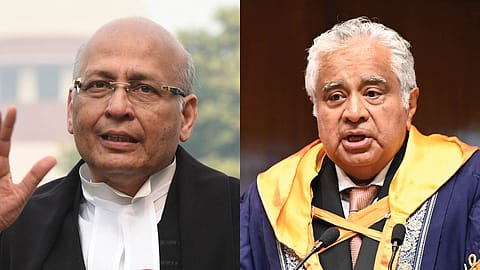
(L to R) Senior advocates Abhishek Manu Singhvi and Harish Salve
The Tata Sons-Tata Trusts battle has now turned into a legal face-off between two of India's most prominent senior advocates, with Abhishek Manu Singhvi representing Tata Trusts chairman Noel Tata and Harish Salve advising Tata Sons chairman N Chandrasekaran as the dispute widens over board powers, Trust rights and the holding company's proposed listing.
Singhvi, in his first public comments after taking up the matter, invoked the Supreme Court's 2021 Tata-Mistry judgment, arguing that shareholder rights and the special governance relationship between Tata Trusts and Tata Sons cannot be overridden.
“Fundamental rights of shareholder-owners cannot be nullified,” Singhvi said in a post on X. “To stultify shareholder ownership rights would spell doomsday for corporate governance across hundreds of Indian companies.” He also said ignoring the “unvarying precondition of Trust unanimity in voting” and the “clear veto” provided under the Articles appeared unjustified.
The Chandra reappointment fight
The immediate flashpoint is the September 17 Tata Sons board meeting, where Chandrasekaran was reappointed for another five-year term despite Noel Tata voting against the move. Tata Trusts has called the resolution a “legal nullity”.
The dispute centres on the special provisions in Tata Sons' Articles governing Trust-nominated directors. Noel and Venu Srinivasan, the two relevant Trust nominees, voted on opposite sides. The resulting deadlock was broken by a casting vote, allowing the reappointment to pass. Former Chief Justice of India D.Y. Chandrachud's legal opinion, submitted by Noel, questioned whether the chairman's casting vote could resolve a deadlock between the Trust nominees.
The Supreme Court in Tata-Mistry had upheld the validity of the affirmative-voting mechanism applicable to Trust nominees. However, the judgment did not decide the precise question now before the company: what happens when the two Trust nominees themselves split 1-1? That remains a key point of contention.
Salve's counter: Tata Sons cannot remain in deadlock
Salve has defended Tata Sons' position as “legally perfect” and argued that “no company can function in deadlock”. He has also backed the company's move towards becoming a public company, saying Tata Sons needs to evolve as a global institution and that the regulatory requirement is straightforward.
That puts the two sides on fundamentally different readings of the governance structure: Singhvi is arguing that established shareholder and Trust rights cannot simply be bypassed, while Salve's position emphasises the company's ability to function and the board's responsibility to take decisions.
The central bank's role
The RBI issue is a separate legal track. RBI rejected Tata Sons' attempt to surrender its CIC registration on September 11, leaving the company subject to the applicable NBFC-Upper Layer framework and its listing-related requirements.
The Tata-Mistry judgment does not itself override RBI's regulatory powers. The more precise legal question is whether, even while complying with RBI requirements, Tata Sons' board must follow the special governance provisions in its Articles when deciding how to do so.
Follow Fortune India
NEXT STORY