Critical minerals key to India’s energy transition, but import dependence and technology gaps remain
/ 3 min read
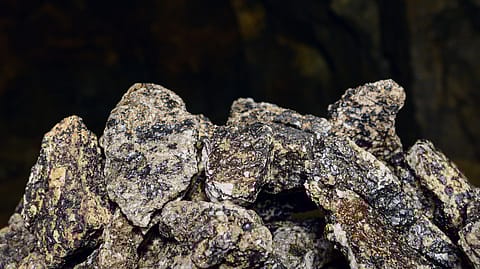
India’s strategic push towards clean energy and industrial self-reliance has placed critical minerals at the centre of its resource agenda. | Credits: Getty Images
Critical minerals key to India’s energy transition, but import dependence and technology gaps remain
India's energy transition hinges on critical minerals, yet the country faces challenges like import dependence and technological gaps. Despite having deposits of essential minerals, domestic production is insufficient. The government is pushing for self-reliance through initiatives like the National Critical Mineral Mission, aiming to boost exploration, processing, and skill development to meet rising demand.
This summary is AI-generated, and Fortune India is not responsible for its content or any associated copyright issues.
The report, titled “Critical Minerals and Rare Earth Elements: Driving India’s Transition to a Resilient and Self-reliant Economy,” highlights that India’s demand for these minerals is set to rise sharply as the country accelerates its clean-energy transition and technological expansion.
India’s strategic push towards clean energy and industrial self-reliance has placed critical minerals at the centre of its resource agenda. | Credits: Getty Images
Critical minerals are becoming indispensable inputs for a wide range of high-demand manufacturing sectors, including metallurgy, chemicals, energy storage systems, electric mobility, power generation, high-end electronics, aerospace, defence, and data transmission hardware, according to a report by Deloitte and Federation of Indian Chambers of Commerce and Industry (FICCI).
The report, titled “Critical Minerals and Rare Earth Elements: Driving India’s Transition to a Resilient and Self-reliant Economy,” highlights that India’s demand for these minerals is set to rise sharply as the country accelerates its clean-energy transition, and technological expansion.
India has set ambitious climate targets, including installing 500 gigawatts (GW) of renewable energy capacity by 2030, transitioning 30% of vehicles to electric mobility by 2030, and achieving net-zero greenhouse gas emissions by 2070. These goals are expected to significantly increase the demand for minerals critical to energy storage, EV batteries and advanced manufacturing.
Heavy reliance on imports
Although India has deposits of several critical minerals across different regions—such as tin, rare earth elements (REEs), copper, silicon and titanium—domestic production remains insufficient to meet growing demand.
The report notes that India is fully dependent on imports for several critical minerals, including cobalt, beryllium, bismuth, indium, lithium, niobium, rhenium, strontium, tantalum, and tungsten.
As a result, securing supply chains for these resources has become a strategic priority as India pursues its energy transition and industrial growth.
Key challenges
Despite the strong demand outlook, several challenges continue to hinder the growth of India’s critical minerals sector.
One of the key issues is the lack of proven reserves and quality exploration data. India does not have declared reserves for several minerals such as cobalt, niobium, germanium, and rhenium. Limited geological data has also dampened investor interest, with 22 out of 55 critical mineral blocks remaining unauctioned.
Another challenge is difficulty in economic extraction. Many deposits are located deep underground, requiring advanced technologies that are currently limited in the country. For instance, despite possessing 5.9 million tonnes of lithium resources in Jammu and Kashmir, India still lacks the technological capability to extract lithium economically from these formations.
Mine development also remains complex due to land acquisition issues, deposits extending beyond lease boundaries, rehabilitation challenges and long development timelines.
Further, India faces a shortage of advanced processing and downstream value-addition technologies. Even though the country has the world’s third-largest deposits of titanium-bearing minerals and rare earth elements, it still relies heavily on imports due to the absence of commercial-scale processing technologies.
{{#most-powerful-women-snapshot-individual.slug}} {{/most-powerful-women-snapshot-individual.slug}} {{^most-powerful-women-snapshot-individual.slug}} {{/most-powerful-women-snapshot-individual.slug}} {{#showRanking}} {{current-rank}} {{/showRanking}} {{#photo.0.url}}
{{name}}
Downstream activities, such as converting ilmenite into titanium sponge or processing monazite into separated rare earth elements and finished magnets, remain limited.
The report also highlights the need for skill development to support the domestic supply chain. A trained workforce is essential for exploration, mining, processing and recycling of critical minerals.
Emerging opportunities
India’s strategic push towards clean energy and industrial self-reliance has placed critical minerals at the centre of its resource agenda.
The government launched the National Critical Mineral Mission in January 2025 to strengthen domestic capabilities across exploration, mining and processing.
The mission allocates ₹34,300 crore through FY30-31, including ₹16,300 crore in government funding and ₹18,000 crore expected from public sector enterprises. The initiative aims to support exploration campaigns, overseas acquisitions of mineral assets, recycling ecosystems, and skill development centres.
The government has also accelerated auctioning of critical mineral blocks. Since November 2023, the Ministry of Mines has launched six auction tranches covering more than 80 blocks, with 46 blocks already awarded to preferred bidders.
Additionally, the Ministry of Environment, Forest and Climate Change has exempted mining projects involving atomic, critical and strategic minerals from public consultation requirements, which could help accelerate project execution.
Technology and collaboration
The report notes that India has significant potential to scale up advanced exploration technologies, including AI-based mineral targeting, drone-based geophysics and seismic surveys. Collaborative efforts between the Geological Survey of India, Mineral Exploration and Consultancy Ltd., and private players could help accelerate discovery and commercialisation.
There is also growing opportunity to build midstream processing and recycling capacity. The National Critical Mineral Mission proposes specialised hubs for lithium, cobalt, nickel, graphite, and rare earth elements, supported by production-linked incentives, public-private partnerships and improved infrastructure.
India's untapped potential
India also has untapped potential in recovering critical minerals from secondary sources, such as extracting cobalt from zinc waste and vanadium from steel slag.
International collaborations are also expanding. India has secured lithium blocks in Argentina through Khanij Bidesh India Ltd. and is strengthening partnerships with countries such as Australia and Japan for technology and resource access.
Meanwhile, domestic institutions including Council of Scientific and Industrial Research, Bhabha Atomic Research Centre and Indian Institutes of Technology are advancing technologies for processing minerals such as lithium, cobalt and nickel.
Follow Fortune India
NEXT STORY