Cyrus S. Poonawalla’s ₹167.2-cr buy of Raja Ravi Varma artwork reflects surging demand for ‘national treasures’
/ 3 min read
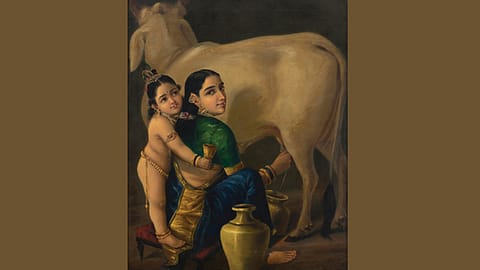
The demand for paintings by South Asian artists has been pushed to new heights with the sale of this artwork for ₹167.2 crore by Saffronart to Poonawala, chairman of Serum Institute of India. | Credits: saffronart
Cyrus S. Poonawalla’s ₹167.2-cr buy of Raja Ravi Varma artwork reflects surging demand for ‘national treasures’
Raja Ravi Varma’s intimate depiction of Yashoda and infant Krishna has sold for ₹167.2 crore to billionaire Cyrus Poonawalla, setting a new auction record and underscoring Varma’s stature as the father of modern Indian art. The sale highlights a booming Indian art market, where demand for culturally significant, nationally protected masterpieces is surging alongside the country’s economic growth.
This summary is AI-generated, and Fortune India is not responsible for its content or any associated copyright issues.
The recent multi-crore sale of one of his paintings, ‘Yashoda and Krishna’, to billionaire businessman Cyrus S. Poonawala not only underscores Varma’s status as the pioneer of modern Indian art but also highlights a broader shift in the country’s economic and cultural landscape.
THIS STORY FEATURES
The demand for paintings by South Asian artists has been pushed to new heights with the sale of this artwork for ₹167.2 crore by Saffronart to Poonawala, chairman of Serum Institute of India. | Credits: saffronart
The Indian art market is currently witnessing a historic surge, marked by record-breaking sales and a renewed global interest in South Asian masterpieces. At the forefront of this boom is Raja Ravi Varma, whose ability to blend European techniques with Indian sensibilities continues to captivate collectors more than a century after his passing.
The recent multi-crore sale of one of his paintings, ‘Yashoda and Krishna’, to billionaire businessman Cyrus S. Poonawala not only underscores Varma’s status as the pioneer of modern Indian art but also highlights a broader shift in the country’s economic and cultural landscape. As India’s economy continues its robust upward trajectory, the surging demand for such “national treasures” reflects a deepening appreciation for cultural heritage among the country’s elite collectors.
The demand for paintings by South Asian artists has been pushed to new heights with the sale of this artwork for ₹167.2 crore ($17.9 million) by Saffronart to Poonawala, chairman of Serum Institute of India.
Belonging to an aristocratic family, Raja Ravi Varma was considered the father of modern Indian art and well known for his ability to use European oil painting techniques and creating magical depictions of epics such as Mahabharata and Ramayana especially that of the Hindu deities drawn from them.
During his lifetime, he produced several works and with Yashoda and Krishna featuring in many of them. In this painting that fetched the record price in the history of Indian auctions, Yashoda is seen milking the cow with infant Krishna leaning close to her with a glass, demanding his share of the milk.

“What makes this work especially endearing is Krishna’s quiet anticipation—holding his little cup, waiting eagerly for his turn. There is a spark of excitement in his eyes, a child’s simple impatience softened by affection. It is, in this fleeting, almost anecdotal detail that Varma transforms the divine into something deeply relatable and human,” wrote Raja Ravi Varma Heritage Foundation in a social media post.
What makes the works by Ravi Varma even more special is the fact that they can be bought only by Indian collectors as they are categorised as art treasures, making them rare and restricted geographically. “A tender and deeply evocative portrayal by Raja Ravi Varma, this composition captures the quiet, intimate world of maternal devotion. Yashoda, in a moment of everyday grace, is seen milking the cow while young Krishna leans into her—playful, adorned and utterly secure in her presence,” says the Foundation’s post.
This $17.9-million tag breaks the previous record of $13.8 million last year of a M.F. Hussain painting titled ‘Gram Yatra’.
“The Indian art market is reported to be booming. More art is being sold today in the country than ever before, and for higher prices—a sea change in the market evidenced by the repeated shattering of auction records. Last September, a single sale at the New Delhi auction house Saffronart made $40.2 million, while, in March, a 1954 painting by the Modernist master Maqbool Fida Husain sold for $13.8 million at Christie’s in New York,” says the Art Basel website. “With the Indian economy experiencing strong growth (the IMF recently upgraded India’s 2025-26 GDP growth from 6.6% to 7.3%), there is every chance the current upswing in the market will be sustainable, but buyers’ tastes remain cautious, focussed on bankable names and conventional genres.”
This milestone suggests that while the market remains discerning, the appetite for iconic, historically significant masterpieces is stronger than ever, setting a new benchmark for the future of South Asian art on the global stage.
Follow Fortune India
NEXT STORY