Davos 2026: From ports to data centres, what nine Indian states are pitching at WEF
/ 3 min read
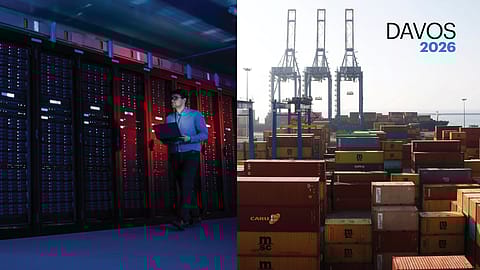
The nine participating states are Gujarat, Maharashtra, Uttar Pradesh, Andhra Pradesh, Kerala, Madhya Pradesh, Telangana, Assam, and Jharkhand, with Assam and Jharkhand making their debut at the summit.
Davos 2026: From ports to data centres, what nine Indian states are pitching at WEF
At the World Economic Forum 2026 in Davos, nine Indian states are presenting a unified investment market under the India Pavilion. They aim to attract global investors by showcasing strengths in energy, technology, and manufacturing. Key focuses include ease of doing business and digital infrastructure, with states like Gujarat and Maharashtra highlighting their industrial and digital capabilities.
This summary is AI-generated, and Fortune India is not responsible for its content or any associated copyright issues.
All participating states are integrated with the National Single Window System, a centralised digital platform designed to streamline approvals and clearances for investors.
The nine participating states are Gujarat, Maharashtra, Uttar Pradesh, Andhra Pradesh, Kerala, Madhya Pradesh, Telangana, Assam, and Jharkhand, with Assam and Jharkhand making their debut at the summit.
Nine Indian states are presenting themselves as a single, integrated investment market under the India Pavilion at the ongoing World Economic Forum (WEF) 2026 in Davos, Switzerland, as India sharpens its pitch to global investors across energy, technology and manufacturing value chains.
The nine participating states are Gujarat, Maharashtra, Uttar Pradesh, Andhra Pradesh, Kerala, Madhya Pradesh, Telangana, Assam, and Jharkhand, with Assam and Jharkhand making their debut at the summit. Several states are leveraging the WEF’s Digital FDI initiative, which helps countries attract investments into digital infrastructure and advanced technology ecosystems.
A key focus of the joint presentation is ease of doing business, aimed at boosting investor confidence. The states highlighted reforms aligned with the World Bank’s Ease of Doing Business framework, which ranks economies based on regulatory and legislative environments. All participating states are integrated with the National Single Window System (NSWS), a centralised digital platform designed to streamline approvals and clearances for investors.
Each state is also highlighting its distinct strengths within a broader national framework.
Gujarat
India’s most industrialised coastal state, Gujarat, is reinforcing its position as a low-risk, scale-ready manufacturing base, supported by strong port infrastructure and established clusters in petrochemicals, chemicals, automobiles and export-oriented manufacturing. The state is exploring opportunities in Global Capability Centres (GCCs), advanced textiles and technology-driven manufacturing parks.
Maharashtra
Maharashtra, which dominates India’s data centre market, is positioning itself as a global digital and maritime convergence hub. With a well-developed ecosystem spanning ports, shipbuilding, logistics and manufacturing, the state is pitching integrated opportunities linking data centres, green steel, renewable energy and maritime infrastructure.
Uttar Pradesh
One of India’s largest consumer markets, Uttar Pradesh, is presenting itself as a scale-driven manufacturing and consumption hub anchored in domestic demand. With expanding electronics, defence and infrastructure corridors, the state is targeting investments in clean energy, digital infrastructure and defence manufacturing.
Andhra Pradesh
Andhra Pradesh is leveraging its long coastline, multiple ports and industrial corridors to position itself as a port-led manufacturing and food-security hub. The state is also expanding its footprint in defence, tourism and clean energy, backed by under-utilised manufacturing zones.
Telangana
Telangana, home to India’s leading pharmaceutical and life sciences ecosystem, is showcasing Hyderabad’s role in vaccine production, bulk drugs and R&D. The state is now expanding beyond pharma into deep tech, high-value research, medical innovation and artificial intelligence, positioning itself as a next-generation life sciences and AI hub.
Madhya Pradesh
Madhya Pradesh, centrally located with logistical advantages, is highlighting its growing agri-processing capacity, automotive manufacturing base and renewable energy-driven EV ecosystem. The state is pitching itself as a cost-competitive alternative for solar panel, battery and clean-tech manufacturing.
Kerala
Kerala, with strong human capital and capabilities in IT, healthcare, education and services, is positioning itself as a knowledge-driven green economy focused on technology-led and skill-intensive sectors rather than heavy manufacturing.
{{#most-powerful-women-snapshot-individual.slug}} {{/most-powerful-women-snapshot-individual.slug}} {{^most-powerful-women-snapshot-individual.slug}} {{/most-powerful-women-snapshot-individual.slug}} {{#showRanking}} {{current-rank}} {{/showRanking}} {{#photo.0.url}}
{{name}}
Jharkhand
Jharkhand, a mineral-rich state traditionally focused on extraction, is outlining its transition towards value-added manufacturing, green metallurgy, recycling and circular economy systems, as it seeks to play a larger role in India’s energy security.
Assam
Assam, the gateway to the Northeast, is aligning itself with India’s eastward growth and connectivity strategy. With strengths in energy, tea and regional logistics, the state is preparing for an increasingly automated and AI-driven future through workforce skilling and industry-aligned training.
Held against the backdrop of the WEF’s 2026 theme, ‘A Spirit of Dialogue’, the annual summit brings together global leaders from government, business, civil society and academia, and will conclude on January 23.
Union Ministers Ashwini Vaishnaw, Shivraj Singh Chouhan, Pralhad Joshi, and K Rammohan Naidu are attending the summit, along with the Chief Ministers of Maharashtra, Andhra Pradesh, Assam, Madhya Pradesh, Telangana, and Jharkhand. At the national level, the Department for Promotion of Industry and Internal Trade (DPIIT) is leading India’s investment outreach while the Confederation of Indian Industry (CII) is acting as the nodal agency coordinating activities at the India Pavilion.
Follow Fortune India
NEXT STORY