Did ABB bet its future with the robotics arm sale — or make a brilliant $5.4bn cash call?
/ 9 min read
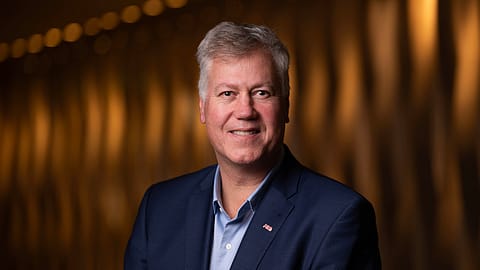
ABB CEO Morten Wierod | Credits: Padmini B
Did ABB bet its future with the robotics arm sale — or make a brilliant $5.4bn cash call?
ABB’s $5.4 billion sale of its storied robotics arm to SoftBank has split opinion on whether the Swiss group has sacrificed its future in physical AI or executed a shrewd cash call. CEO Morten Wierod and experts argue ABB was no longer the “best owner,” citing volatility, lagging AI/AMR capabilities and stronger returns in electrification and automation, even as SoftBank pursues a bold physical AI vision.
This summary is AI-generated, and Fortune India is not responsible for its content or any associated copyright issues.
Having built its robotics business for over 50 years, ABB sold the division to SoftBank, marking a clear break towards electrification and automation.
ABB CEO Morten Wierod | Credits: Padmini B
When I reached out to Dr. Jean-François Manzoni, professor of leadership, at the Lausanne-based IMD, I half expected him to tell me the answer was obvious. He had, after all, sat down with Morten Wierod, ABB's CEO, as part of IMD's CEO Dialogue series in September 2025. The two men had spoken at length on energy transitions, and ABB's evolving identity.
Having been closeted with one of Europe's most consequential industrial leaders — who joined ABB as a graduate engineer in 1988 and rose through the ranks to become the CEO in 2024— it was natural for the professor to have little trouble explaining why the 54-year-old CEO, a month later, had presided over ABB’s decision to sell its robotics division to Japan’s venture capital giant, SoftBank, for $5.4 billion.
“First, I will sympathise with your initial reaction. I, too, was surprised,” Manzoni tells Fortune India.
So, here was someone who spent decades studying how leaders make decisions, doing a double take on ABB’s decision to completely exit the business, it had spent more than half a century building to emerge as the No 1 player alongside Japan-based Fanuc, instead of a planned spin-off, to be followed by an IPO.
“At first and, maybe, also second glance, robotics looked very relevant in the group that ABB is building, including because of its link with the “major societal trends” identified by ABB,” expresses Manzoni.
To understand what ABB is giving up, let’s begin with 1974. That was the year ABB, then ASEA [prior to its 1988 merger with Brown Boveri], introduced IRB 6, the first all-electric, microprocessor-controlled, commercially available industrial robot.
Over the next five decades, ABB became synonymous with industrial robotics. Its orange-armed machines became a fixture on automotive assembly lines across Europe, Asia, and the Americas. In 2025, the division generated revenues of $2.3 billion, about 7% of the group's total business of $33.2 billion, and pre-tax profits of $257 million.
In 2024, ABB's board and executive committee had decided that the robotics business was no longer quite fit with a plan to list it separately.
Then came SoftBank with an offer – an 18 times Ebitda multiple – that was too good to refuse.
Why ABB did, what it did
Wierod, who was in India recently, explained the rationale for the deal in an exclusive interaction with Fortune India.
He was careful in the way that CEOs of large public companies tend to be but was candid enough to reveal what went behind the decision. “We always have to look at portfolio management and ask ourselves: are we the best owner? When we looked at robotics, we believed that the valuation of that business would be higher on the outside of ABB than inside," said Wierod.
{{#most-powerful-women-snapshot-individual.slug}} {{/most-powerful-women-snapshot-individual.slug}} {{^most-powerful-women-snapshot-individual.slug}} {{/most-powerful-women-snapshot-individual.slug}} {{#showRanking}} {{current-rank}} {{/showRanking}} {{#photo.0.url}}
{{name}}
The original plan, he said, was the listing. Then SoftBank arrived with a number that made the board think. “It wasn’t an easy decision to make but the board deliberated on it a lot. Together, when we looked at the business plan, how it's been performing, and when we looked at the offer we had on the table, we felt that the best interests of ABB’s owners and shareholders lay in doing a sale,” explains Wierod.
He was direct about something else too.
The robotics business, whatever its long-term promise, comes with a specific temperament. "Robotics has much higher volatility — both historically and probably also in the future — than the rest of ABB's automation and electrification markets," he said, adding: "And this volatility doesn't always fit when you are a stock-listed company and are viewed by our owners and the market as to how do we perform.”
It’s a to-the-point answer, and an honest one.
ABB Chairman Peter Voser had put it plainly when the deal was announced: "SoftBank's offer has been carefully evaluated by the board and executive committee and compared with our original intention for a spin-off. It reflects the long-term strengths of the division, and the divestment will create immediate value to ABB shareholders."
SoftBank: a VC by DNA, a robotics collector by design
The buyer in this story is worth examining closely.
SoftBank is not a traditional industrial company. It is, at its core, a vision fund — a bet-making machine that Masayoshi Son has spent three decades pointing at whatever technology he believes will define a new frontier.
Son's current conviction is physical AI: the idea that artificial intelligence will move from screens and servers into physical robots/cobots. "SoftBank's next frontier is Physical AI. Together with ABB Robotics, we will unite world-class technology and talent under our shared vision to fuse Artificial Super Intelligence and robotics," Son said when the deal was announced.
What it already has is a collection: SoftBank Robotics Group, Berkshire Grey, AutoStore, Agile Robots, Skild AI and the likes are pieces the fund has been assembling. ABB's division, with its decades of engineering credibility, its global customer relationships, a 7,000-strong workforce and its hard-won manufacturing expertise, is now being added to that portfolio.
The logic, from SoftBank's side, is portfolio synergy. “Hopefully, they will manage to create some positive synergies between their various robotics investments,” says Manzoni.
From ABB's side, the question is whether it is the right steward for something they spent fifty years building. That is where the debate gets interesting.
The view from the campus
Professor Manzoni offers the most structured defence of ABB's position: "There can be a number of good reasons for a group to jettison a business that is in-principle-within-your-remit. One reason is: we feel we're not the best owner for this business.”
His central point was that selling a business you have built does not automatically signal short-term thinking or strategic failure. There can, he argued, be perfectly good long-term reasons for letting go. “The fact that they decided to sell it does not necessarily mean that they were driven by short-term profitability concerns,” says Manzoni.
The question is not simply whether a business is good. But whether capital, culture, management bandwidth, and strategic priorities align to make a good business into a great one.
Manzoni also raised something that the deal's critics tend to gloss over: the robotics division's actual performance. "The robotics business is sexy and all, but it was not particularly successful, from a growth or a profitability perspective," says Manzoni. A 12.1% operational EBITA margin is decent but not stellar, especially when stacked against the margins ABB generate in its electrification and process automation businesses at 22.6% and 13.9%, respectively. "Sometimes this 'satisfactory underperformance' can happen owing to dearth of critical skills, or if its short of critical mass, or because the business is too different from other businesses in some way,” says Manzoni.
To shed more light on that, here’s what Asian Robotics Reviews mentions about how ABB, in recent years, stayed behind the curve, a case in point is the belated recognition of autonomous mobile robots (AMRs). “The global AMR market exploded from $1.97 billion to a projected $8.70 billion by 2028, growing at 23.7%CAGR, yet ABB had no organic capabilities in this rapidly expanding sector,” states the article titled, Why the World’s Second-Largest Robotics Giant Sold to SoftBank.
“To catch up, ABB acquired Spanish AMR manufacturer ASTI in 2021, followed by Swiss startup Sevensensein January 2024 for their AI-based Visual SLAM navigation technology. These acquisitions represented a bigpill to swallow. The company’s first meaningful AMR product, the Flexley Tug T702, didn’t arrive until 2024, while competitors such as Mobile Industrial Robots (now part of Teradyne) and others had already entered the market years before,” mentions the article.
Further, it seems, ABB was also late in recognising the AI revolution as weeks before announcing the SoftBank sale, it had invested in LandingAI and launched OmniCore EyeMotion, an AI-enabled machine vision software. “These moves came too late—the company was already years behind competitors who had integrated AI capabilities into their core offerings,” states the article.
Against this backdrop, Theodoros Evgeniou, professor of technology and business at INSEAD, is less willing to extend the benefit of the doubt but equally careful not to condemn. "One of the biggest challenges of executives, boards and investors is to have the necessary clarity about how key scientific and technological capabilities evolve," Evgeniou tells Fortune India.
His frame of reference: Daimler-Benz. European automotive companies were arguably the most advanced in the world on autonomous driving. They had the engineers, the data, the manufacturing base, and the industrial culture. And then, over the following two decades, they ceded that leadership — incrementally, almost imperceptibly — to companies that hadn't yet been founded.
"Given short-term market expectations as well as executive compensation incentives, this is a significant challenge that, perhaps, needs to be largely resolved by the board and of course the owners/shareholders," elaborates Evgeniou.
AI literacy for executives and boards, Evgeniou argues, is not simply about mastering tools or understanding AI's impact on productivity — it demands a far deeper grasp of long-term scientific and technological forces, and how nations are positioning themselves in what he calls the unfolding 'AI global game.
The question is not whether robotics makes sense in 2025. The question is whether, in 2035 or 2045, when physical AI has matured from promise into infrastructure, ABB will wish it had stayed in the game. “It is not clear whether the ABB story falls into the category of short-term thinking, owing to poorer longer-term focused governance or lack of understanding of key mega-trends. Given that one of the “hottest things” discussed these days is robotics and physical AI, it would be surprising if the ABB board “missed” this. One would expect that the ABB board has studied such questions closely and has a very clear strategy not only for the next one to five years, but even for the next twenty,” says Evgeniou.
The KUKA parallel — and why it matters
KUKA was, for decades, Germany's robotics champion. In 2016, Midea, a Chinese origin company, acquired it for $5 billion. KUKA went to China. Comau, Fiat's robotics arm, was sold to a private equity group. ABB's robotics division is in transit to Japan.
So, does that mean there is something structural about European landscape that systematically leads to these strategic retreats from transformative technologies?
The answer, according to Evgeniou, is the relative weakness of the European startup ecosystem: the depth of risk capital, and the proximity to cutting-edge research. "While Europe is really strong in scientific and technical talent, it is relatively behind in the space of startups. Startups in this space will not only become some of the future industry leaders, but they also enrich the ecosystem, helping today's industry leaders more easily tap into the latest innovations."
What ABB is becoming
But to the credit of Wierod and his board, the ABB that emerges from this transaction is not a diminished company but a more focused one.
The proceeds will be redeployed in line with what ABB’s Voser calls as "well-established capital allocation principles." In practice, that means electrification and automation: the businesses where ABB believes its right to win are strongest and their competitive moats are the deepest. “The money received today and invested in business where ABB has a stronger right-to-win may lead to even higher long-term returns than if it had held on to this business that it wasn’t super equipped to excel in,” explains Manzoni.
The timing does look impeccable.
Data centres are consuming power at a rate that is giving a fillip to engineering companies such as ABB that sell power management equipment. The company last year generated 7% of its revenues from data centres, selling electrification systems. So, indeed at one level, ABB has plugged into the AI race through its core business.
Future perfect, past tense
In September 2025, just weeks before the sale agreement was signed, ABB was at the China International Industry Fair in Shanghai, showcasing its autonomous versatile robotics platform. It had just invested in LandingAI, a California-based vision AI company, to accelerate robot perception. Marc Segura, president of the robotics division, was speaking about autonomous robot programming, about robots that could one day receive natural language instructions and navigate complex environments on their own.
"We stand at a pivotal moment in the evolution of AI and industrial robotics. Today, we are bringing these capabilities together in new ways to redefine industrial robotics,” Segura said at the fair.
A month later, the division was sold.
"The challenge in business and management research is that we can never go back and rewind to the past in order to try out another decision and see how it turns out," says Manzoni.
There is only the decision that was made.
“It is not clear whether the ABB story falls into the category of short-term thinking. One would expect — and hope — that there is a well thought through, longer term strategy that is minimising risks that this will turn out to be one of those moments remembered as a negative butterfly effect,” says Evgeniou.
ABB, for now, does not have to lose sleep: free cash flow hit $4.6 billion in 2025, with the proceeds from the robotics sale--expected in the second half of the year--to further fortify its balance sheet. The first capital allocation call, post the sale, is a $2-billion share buyback.
I asked Wierod about whether the $5.4 billion that looks like a clever exit today might, in a decade, might appear as a missed-the-bus moment.
Wierod doesn’t deflect: “You have to make decisions. You never know how the future will truly look. We make our assumptions, and that's the basis on which we make decisions. Hopefully, you make good ones. But only the future will tell if I made the right decisions. That's where I will be judged."
He pauses and says: "Let's give it a few years."
For now, the question is whether the robotics sale is the price of ABB's focus, or the cost of its foresight? But then in businesses, capital allocation decisions are either a crown or a millstone – and only time will tell which one ABB chose.
NEXT STORY