Economic Survey 2026: Civil aviation on strong growth path; airports seen emerging as global hubs
/ 2 min read
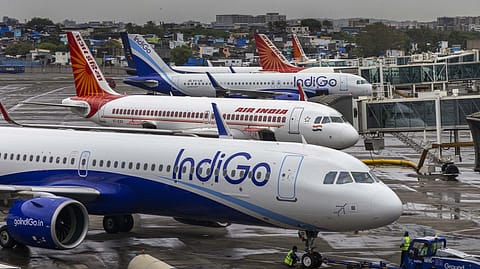
Passenger traffic at Indian airports stood at 412 million in FY25 and is projected to increase to 665 million by FY31. | Credits: FILE
Economic Survey 2026: Civil aviation on strong growth path; airports seen emerging as global hubs
India's civil aviation sector is on a robust growth path, driven by favourable policies, rising passenger demand, and infrastructure expansion, according to the Economic Survey 2026. With aspirations to become a global aviation hub, India is focusing on transforming domestic airports into international transit hubs, despite the sector's sensitivity to global economic cycles.
This summary is AI-generated, and Fortune India is not responsible for its content or any associated copyright issues.
As India seeks to position itself as a global aviation hub, the Survey said that domestic airports can aspire to become international transit hubs by promoting layovers and improving the overall transit experience for global passengers.
Passenger traffic at Indian airports stood at 412 million in FY25 and is projected to increase to 665 million by FY31. | Credits: FILE
India’s civil aviation sector is on a sustained growth trajectory, supported by a conducive policy environment, rising passenger demand and steady expansion of infrastructure, the Economic Survey said on Thursday.
As India seeks to position itself as a global aviation hub, the survey said domestic airports can aspire to become international transit hubs by promoting layovers and improving the overall transit experience for global passengers. While the sector remains sensitive to global economic cycles and requires continuous capacity upgrades, current passenger volumes reflect only a fraction of the country’s long-term potential, it added.
Third-largest domestic aviation market
India is currently the world’s third-largest domestic aviation market, with the number of operational airports rising to 164 last year from 74 in 2014. Passenger traffic at Indian airports stood at 412 million in FY25 and is projected to increase to 665 million by FY31.
However, the Survey highlighted that India operates just about 0.11 airports per million people, significantly lower than the US (47.35) and China (0.39), indicating substantial headroom for further expansion.
Investments in airport and air navigation infra
The Survey noted that investments in airport and air navigation infrastructure, along with the growth of ancillary segments such as maintenance, repair and overhaul (MRO) and aircraft leasing, are strengthening the aviation ecosystem. Coupled with increased technology integration, these developments position civil aviation as a key driver of economic connectivity and national integration.
Earlier this week, Prime Minister Narendra Modi highlighted the sector’s growth potential and policy stability while addressing an aviation summit, pitching India as an attractive destination for investment. He said there are significant opportunities in aircraft manufacturing, pilot training, advanced air mobility and aircraft leasing, and added that the government is undertaking regulatory reforms to make air cargo movement faster and more efficient.
The Economic Survey also underscored the role of aviation services in sustaining passenger mobility and cargo flows. Overall air passenger traffic rose 9.4% year-on-year to 411.8 million in FY25. However, growth moderated during April–November 2025, with passenger traffic rising 3.5%, reflecting flight disruptions and short-term demand adjustments in the domestic segment.
Air cargo volumes increased from 2.53 million metric tonnes in FY15 to 3.72 million metric tonnes in FY25, with 2.95 million metric tonnes handled in FY26 so far (up to December), driven by a series of policy initiatives and reforms, the Survey said.
NEXT STORY