Explained: Gig workers, social security and the strike that triggered a wider debate
/ 5 min read
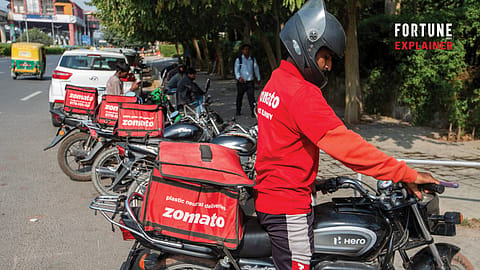
Credits: Sanjay Rawat
Explained: Gig workers, social security and the strike that triggered a wider debate
India's new labour framework aims to provide social security benefits to gig workers, amid tensions between workers, platforms, and policymakers. The draft rules propose a 90-day work threshold for eligibility, sparking a nationwide strike by app-based workers demanding better pay, safety, and job security. The debate highlights the struggle between dignity and flexibility in the gig economy.
This summary is AI-generated, and Fortune India is not responsible for its content or any associated copyright issues.
Stakeholders have been invited to send feedback before the rules are finalised, with April 2026 being discussed as a potential nationwide rollout window.
Credits: Sanjay Rawat
The Centre’s long-pending push to roll out India’s new labour framework has moved a step forward, even as tensions between gig workers, platforms and policymakers spill into public view.
On December 31, the Ministry of Labour and Employment released draft rules under the Code on Social Security, 2020, laying out how gig and platform workers could finally access social security benefits.
The move comes against the backdrop of a nationwide strike by app-based workers and an unusually sharp political and industry-level debate on pay, safety and the future of the gig economy.
Firstly, let's understand:
What the draft Social Security Code rules propose
The draft Code on Social Security (Central) Rules, 2025 are part of the government’s broader attempt to operationalise the four labour codes - Code on Wages, Industrial Relations Code, Social Security Code and the Occupational Safety, Health and Working Conditions Code - notified on November 21, 2025. Stakeholders have been invited to send feedback before the rules are finalised, with April 2026 being discussed as a potential nationwide rollout window.
The framework introduces a minimum eligibility threshold of 90 days of work in a year for gig and platform workers to access social security benefits.
A gig or platform worker will be counted as “engaged” for one full day if they earn any income, irrespective of the amount, from an aggregator on a calendar day.
If a worker is active on multiple platforms, days of engagement will be calculated cumulatively across aggregators.
If a worker earns income from three aggregators on the same day, it will be counted as three days of engagement under the rules.
The ministry says the 90-day threshold is meant to define work continuity in a sector marked by flexible, task-based engagements rather than traditional employer–employee relationships.
Officials argue the threshold strikes a balance between wider inclusion and preventing misuse of welfare benefits, while keeping the gig model intact.
Welcoming the move, Aam Aadmi Party Rajya Sabha MP Raghav Chadha called the draft rules “a first step towards recognition, protection and dignity” for gig workers. “This is a small win, but an important win,” Chadha said in a post on X, even as he continued to press for stronger protections.
Why then did the gig workers go on strike in the first place?
Reason behind the strike
Even as the draft rules were released, gig worker unions had already called for strikes during the high-demand Christmas to New Year period. Associations such as the Indian Federation of App-Based Transport Workers (IFAT) and the Telangana Gig and Platform Workers Union (TGPWU) said the action was meant to draw attention to long-standing grievances that go beyond social security.
Their demands include the immediate discontinuation of “10-minute delivery” models, which they argue encourage unsafe riding. Unions have also called for transparent pay structures, with clear base pay and incentives that factor in distance, time, fuel costs and other expenses. Algorithmic opacity - how orders are allocated and incentives calculated - remains a major flashpoint.
{{#most-powerful-women-snapshot-individual.slug}} {{/most-powerful-women-snapshot-individual.slug}} {{^most-powerful-women-snapshot-individual.slug}} {{/most-powerful-women-snapshot-individual.slug}} {{#showRanking}} {{current-rank}} {{/showRanking}} {{#photo.0.url}}
{{name}}
Workers are also seeking job security measures such as health insurance, accident and disability cover, provident fund, pension and ESI, along with grievance redressal systems that protect them from arbitrary account suspensions. Some unions have pushed for a government-mandated minimum rate of ₹15 per km, guaranteed minimum wages, regulated working hours and formal statutory recognition of gig workers.
According to Karan Taurani, executive vice president of Elara Capital, around 2.1 lakh gig workers participated in the December 31 strike, against an estimated base of over 12 million gig workers, as per NITI Aayog estimates. Taurani said the union has indicated the possibility of further strikes if demands are not addressed at either the policy or platform level, though he noted that the impact of the December 31 strike on overall platform performance was non-material.
The debate: dignity versus flexibility
The strike quickly escalated into a broader public debate after Chadha criticised food delivery and quick-commerce platforms over pay, safety and working conditions. He accused platforms of branding protesting workers as “miscreants” and turning labour demands into a law-and-order issue. “Workers asking for fair pay are not criminals,” he said, arguing that systems that rely on police presence to function during peak demand reveal deeper structural problems.
Chadha also questioned ultra-fast delivery promises, saying incentive structures that reward speed compromise road safety for delivery partners and the public. “Progress is not how fast we deliver. Progress is whether the people who make the system run can live with dignity,” he said, adding that he was “pro-business, not pro-exploitation.”
But Zomato CEO Deepinder Goyal quickly stepped in to respond with detailed data to defend the gig model. In 2025, average earnings per hour for a Zomato delivery partner stood at ₹102, up from ₹92 in 2024, a year-on-year increase of about 10.9%. Goyal said in 5-part post on X that if a partner worked 10 hours a day for 26 days a month, gross earnings would be around ₹26,500, translating to net earnings of roughly ₹21,000 after accounting for fuel and maintenance costs.
On safety concerns, Goyal said delivery partners are not shown customer-facing time promises and that faster deliveries are driven by store proximity, not higher speeds. On Blinkit, the average distance per order was 2.03 km, with an average driving speed of about 16 km per hour in 2025.
Zomato and Blinkit together spent over ₹100 crore on insurance coverage for delivery partners in 2025, covering accidents, medical expenses, loss of pay and maternity benefits, he added.
The debate drew support from industry leaders such as Naukri.com's founder, Sanjeev Bikhchandani and former NITI Aayog CEO Amitabh Kant.
“I can testify to the fact that discussions on delivery partner welfare and fair compensation occupy a significant percentage of the time in Board meetings. The management and the board are bothered about these. Now the people who ran this campaign and unsuccessfully tried to organise a strike could have written or come over and asked for this information and got it and had a discussion. However they preferred to instead launch a campaign on social media - it suited them and their political agenda better,” said Bikchandani taking a dig at the Chadha.
Meanwhile, Kant warned that politicising the gig economy could undermine one of India’s biggest job-creation engines, projecting gig jobs to grow from 7.7 million to 23.5 million by 2030. “Politicising the gig economy will kill quick commerce, destroy jobs & push workers back into the informal sector (zero rights, zero safety)," he said while calling Chadha and AAP "job killers".
“Let markets work, strengthen safety nets — don’t sabotage innovation for political ends,” he added.
Platforms such as Swiggy, Zepto and others stayed away from the debate even as select platforms offered double or enhanced incentives during peak hours (up to ₹120 per order), which is a standard industry practice during festivals and year-end.
Elara Capital sees non-material impact of December 31st strike on overall platform performance. “We have a BUY on ETERNAL with TP of INR 415 per share and ACCUMULATE on SWIGGY 490 per share,” said Taurani.
At the end of the day, platform leaders acknowledge the need for safety nets but insist the model’s flexibility is its defining feature, and that many workers choose gig work precisely for that reason.
With the draft Social Security rules now open for consultation and unions signalling the possibility of future strikes, the conversation is now about how India will balance workers’ calls for dignity and security with flexibility and growth, and whether the new labour codes can bridge a divide that touches millions of livelihoods.
Follow Fortune India
NEXT STORY