Explained: What is GOBARdhan? How India’s ₹23,731-crore bioenergy scheme will work
/ 3 min read
The scheme will run from FY26-27 to FY35-36, with the objective of making CBG an important part of India's future energy mix.
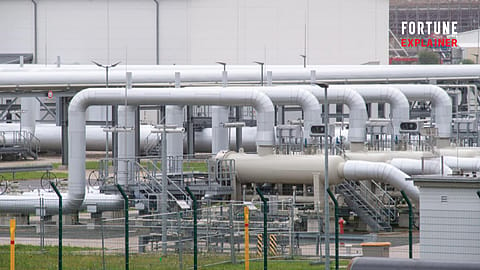
The government expects reduced energy-import dependence to save more than ₹40,000 crore in foreign exchange over the decade.
India currently imports nearly half of the natural gas it consumes. That dependence has become an important energy-security concern, particularly as geopolitical tensions and disruptions around the Strait of Hormuz have highlighted the vulnerability of global energy supply chains. The route carries 55–60% of India's LNG imports.
Against this backdrop, the Union Cabinet approved GOBARdhan, the National Circular Bioenergy Scheme, on 6 August 2026, with a total outlay of ₹23,731 crore.
What is GOBARdhan?
GOBARdhan stands for Galvanizing Organic Bio-Agro Resources Dhan. The initiative was first launched in 2018 under the Swachh Bharat Mission (Grameen) as part of efforts to improve solid and liquid waste management in rural areas.
The basic idea was simple; instead of allowing animal waste, kitchen waste, crop residue and market waste to become an environmental problem, these resources could be processed into biogas and bio-slurry.
The new GOBARdhan scheme takes that idea much further. The Compressed Biogas (CBG) ecosystem, which was earlier spread across four ministries, has now been brought under the Ministry of Petroleum and Natural Gas. The scheme will run from FY26-27 to FY35-36, with the objective of making CBG an important part of India's future energy mix.
Why does CBG matter for India?
Compressed Biogas is chemically equivalent to natural gas. This means it can be used within the existing gas ecosystem while being produced from renewable organic resources.
For India, that creates an important opportunity. CBG can help meet part of the country's growing demand for gas in transport, households, industry and commercial activities, while reducing dependence on imported fossil fuels.
The government expects reduced energy-import dependence to save more than ₹40,000 crore in foreign exchange over the decade.
There is also a rural-economy angle. A CBG plant can create demand for cattle dung, crop residue and other organic waste, generating opportunities for farmers, biomass aggregators, transporters, plant operators, and producers of organic manure.
How to build on an existing foundation?
The government has already been developing the CBG ecosystem through several initiatives, including the SATAT initiative, the Market Development Assistance Scheme for organic manure, the Biomass Aggregation Machinery Scheme, the Development of Pipeline Infrastructure Scheme, and Central Financial Assistance under the National Bioenergy Programme.
The BAM Scheme, for example, supports CBG producers in purchasing machinery needed to collect and aggregate biomass. It has an outlay of ₹564.75 crore. As of 16 March 2026, 37 proposals had been approved, involving nearly ₹248 crore in financial assistance. Similarly, the DPI Scheme has an outlay of ₹994.5 crore for FY24-25 to FY28-29 and is intended to improve the evacuation of CBG from plants to trunk pipelines and City Gas Distribution networks.
{{#most-powerful-women-snapshot-individual.slug}} {{/most-powerful-women-snapshot-individual.slug}} {{^most-powerful-women-snapshot-individual.slug}} {{/most-powerful-women-snapshot-individual.slug}} {{#showRanking}} {{current-rank}} {{/showRanking}} {{#photo.0.url}}
{{name}}
The government has also supported organic manure generated by CBG and GOBARdhan plants. Under the MDA Scheme, ₹1,500 per metric tonne is provided for products such as Fermented Organic Manure, Liquid Fermented Organic Manure and Phosphate Rich Organic Manure.
What are the six growth engines of GOBARdhan?
The scheme is built around six key components.
Assured CBG offtake: One of the biggest challenges for CBG producers is knowing whether there will be a reliable market for their output. GOBARdhan addresses this through an assured-offtake framework.
City Gas Distribution companies will procure CBG to meet the notified CBG obligation: 3% in FY26-27, 4% in FY27-28 and 5% from FY28-29 onwards for the CNG transport and PNG domestic segments.
Stable pricing: The scheme introduces a government-backed administered price of ₹2,110 per MMBTU, equivalent to ₹105 per kg of CBG.
The objective is to give producers greater revenue certainty while protecting consumers through government affordability support and a broader cost-sharing mechanism. The pricing framework has a minimum 10-year horizon, giving investors greater visibility.
Capital assistance: Eligible greenfield CBG projects can receive capital assistance of up to ₹2 crore per tonne per day of installed capacity. The support can cover not only core plant equipment but also assets linked to feedstock aggregation, organic manure processing, and value addition. Brownfield projects that expand capacity can also qualify.
Pipeline infrastructure: Producing CBG is only part of the challenge. It also needs to reach consumers. GOBARdhan therefore supports both cluster-based and standalone pipelines connecting CBG plants with trunk pipelines and City Gas Distribution networks.
Credit guarantee support: Financing remains a major hurdle for smaller CBG developers. The scheme introduces a dedicated credit guarantee mechanism for eligible MSME-based projects, with coverage of up to 85% of eligible loans.
By reducing lending risk and potentially lowering collateral requirements, the mechanism can make institutional finance more accessible to MSMEs, women entrepreneurs and first-time developers.
CBG Ecosystem Challenge Fund: The final component focuses on building the ecosystem at the district level. The fund will support feedstock mapping, aggregation infrastructure, district-level CBG plans, technology adoption, organic-manure value addition, capacity building and stakeholder awareness.
What could GOBARdhan achieve over the next decade?
The government's ambition is substantial. GOBARdhan aims to increase domestic CBG production nearly ten-fold and attract large-scale private investment.
Over 10 years, the scheme is expected to reduce fossil-fuel use by 10 million metric tonnes, save more than ₹40,000 crore in foreign exchange, contribute over ₹75,000 crore to national GDP and create more than 1.5 lakh jobs. According to the government, the industry to produce around 250 million metric tonnes of organic fertilizer and reduce CO₂ emissions by more than 40 million tonnes by diverting organic waste away from landfills and putting it to productive use.
NEXT STORY