Explained: Why govt plans to add 100 ships to its merchant fleet and cut $75 billion freight bill
/ 3 min read
A major portion of the freight earned from carrying Indian cargo, however, goes to foreign shipping companies because of the country’s limited domestic fleet.
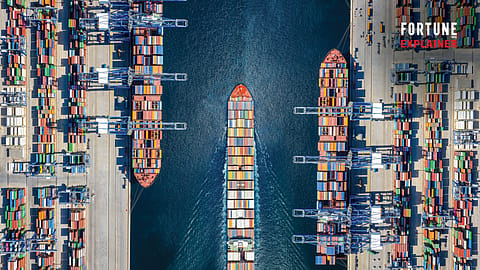
The government is also seeking to develop an ecosystem around shipbuilding and container manufacturing.
India plans to add 100 new vessels to its merchant fleet over the next five years as the government looks to reduce the country’s dependence on foreign-flagged ships and bring down its freight bill by as much as $75 billion.
Shipping Minister Sarbananda Sonowal has recently announced the plan, saying the expansion of India’s merchant fleet would strengthen the country’s maritime capabilities and create more employment opportunities. India currently has around 1,600 seagoing merchant vessels.
Why does India want more ships?
India’s large trade volumes are heavily dependent on maritime transport. A major portion of the freight earned from carrying Indian cargo, however, goes to foreign shipping companies because of the country’s limited domestic fleet. Expanding the Indian-flagged fleet is therefore aimed at retaining a larger share of freight earnings within the country while strengthening India’s maritime security and reducing its exposure to disruptions in global shipping.
The government’s target of adding 100 vessels over five years is part of a broader push to build domestic shipping and shipbuilding capabilities.
What is the cost disadvantage for Indian ships?
Despite the push to expand the domestic fleet, operating an Indian-flagged vessel remains more expensive than operating under a foreign flag. Participants at the Sagar Samvad event said flying the Indian flag can be 16-20% more expensive than operating under a foreign flag.
The cost gap has been attributed to several factors, including taxes on ship imports and maintenance services, tax deducted from seafarers’ wages, taxes on freight and higher domestic cost of capital.
Foreign shipping operators do not face some of these costs to the same extent, giving them a competitive advantage.
What is the Right of First Refusal?
India has a Right of First Refusal (RoFR) mechanism under which Indian-flagged vessels get preference in certain cargo tenders. However, industry participants at the event pointed out that Indian shipowners are still expected to match the freight rates offered by foreign competitors to secure cargo.
This means that while Indian vessels may get preference, the higher cost of operating under the Indian flag can make it difficult for domestic shipowners to compete on price.
What is the government doing to strengthen the maritime sector?
The government is also seeking to develop an ecosystem around shipbuilding and container manufacturing.
Sonowal highlighted the success of the ₹10,000-crore Container Manufacturing Assistance Scheme, under which global shipping major Maersk has placed orders for containers manufactured in India.
{{#most-powerful-women-snapshot-individual.slug}} {{/most-powerful-women-snapshot-individual.slug}} {{^most-powerful-women-snapshot-individual.slug}} {{/most-powerful-women-snapshot-individual.slug}} {{#showRanking}} {{current-rank}} {{/showRanking}} {{#photo.0.url}}
{{name}}
The initiative is aimed at building domestic manufacturing capacity and reducing dependence on imported containers. The government’s maritime strategy also focuses on expanding shipbuilding capacity and developing a stronger domestic supply chain for the sector.
Why is the workforce important?
The government sees the maritime sector as a key source of employment, particularly for India’s young workforce.
Sonowal said India is expanding training capacity and strengthening industry-led skilling to create more employment opportunities in the sector.
The focus includes addressing gender disparities in maritime employment and preparing workers for emerging areas such as cruise shipping and advanced shipbuilding. India also aims to strengthen its position as a leading global supplier of skilled seafarers.
How does this fit into India’s long-term maritime plans?
The expansion of the merchant fleet and development of maritime skills form part of India’s broader maritime ambitions under Maritime India Vision 2030 and Maritime Amrit Kaal Vision 2047.
The government wants to build a stronger domestic shipping and shipbuilding ecosystem, increase India’s participation in global maritime trade and develop the skills required to support the industry.
The proposed addition of 100 vessels is therefore not just about increasing the number of Indian-flagged ships. It is part of a wider effort to make India’s maritime sector more competitive, reduce the outflow of freight earnings and build domestic capabilities across shipping, shipbuilding, container manufacturing, and maritime services.
NEXT STORY