Fortune India Exclusive: Netflix CEO Ted Sarandos on the Warner Bros. deal and how to stay ahead of competition
/ 6 min read
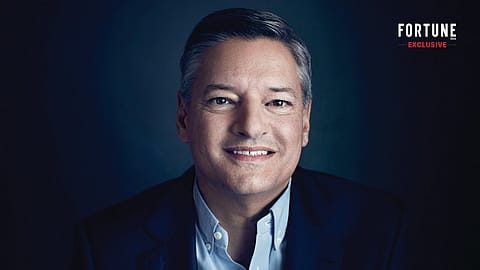
Netflix CEO Ted Sarandos
Fortune India Exclusive: Netflix CEO Ted Sarandos on the Warner Bros. deal and how to stay ahead of competition
In an exclusive interview, Netflix CEO Ted Sarandos outlines the benefits of acquiring Warner Bros., a move that strengthens Netflix's position in the entertainment industry. The acquisition allows Netflix to expand into theatrical releases and television production, while continuing to innovate and invest in diverse content. Sarandos reassures that job creation remains a priority.
This summary is AI-generated, and Fortune India is not responsible for its content or any associated copyright issues.
Sarandos says Netflix is committed to releasing movies exactly how Warner releases them today. He also talks about the streaming giant’s game plan for the Indian market and its growth strategy, among other things.
Netflix CEO Ted Sarandos
The fifth season of the popular Netflix show, Emily in Paris, dropped on the streaming platform in December 2025. While most would have clicked on the ‘skip’ button to quickly get to the show, those following the real-life hostile bid staged by Paramount Skydance against Netflix to acquire Warner Bros. Discovery, would have probably paused: the Netflix show is a Paramount Television Studios production!
In January 2026, the Warner Bros. board turned down Paramount’s bid of $108.4 billion (Netflix won the deal, securing a $72-billion equity agreement). Ted Sarandos, CEO of Netflix, in an exclusive interview with Fortune India, talks about the bid to acquire Warner, the streaming platform’s game plan for the Indian market, and much more. Edited excerpts:
How will the Warner Bros. deal benefit Netflix?
This is a rare opportunity that’s going to help us achieve our mission to entertain the world and to bring people together through great stories. We’ve built a great business and to do that, we’ve had to be bold and continue to evolve. Remember, we started off as a DVD-by-mail company, then we moved to streaming, to producing original content, live programming, from a U.S.-centric business to a global business. In a world where people have more choices than ever on how to spend their time, we can’t stand still. We need to keep innovating and investing in stories that matter most to audiences. And that’s what this deal is all about. The combination of Netflix and Warner Bros. creates a better Netflix for the long term. It sets us up for success for decades to come.
We expect these businesses, by joining forces, to create a stronger organisation than either of us could have achieved alone. We have the innovation, global reach, and the best-in-class streaming service to bring these franchises, brands, shows, and movies to a larger audience than ever before. And that’s why we think this deal makes so much sense.
There has been a concern that Netflix’s acquisition of Warner could impact theatrical releases…
In this transaction, we pick up three businesses, basically, that we are not currently in. One of them is a motion picture studio with a theatrical distribution machine… we are deeply committed to releasing those movies exactly the way they have released those movies today.
All three new businesses, we want to keep operating largely as they are. The theatrical business… we have not talked a lot about in the past about wanting to do it because we have never been in that business. And when this deal closes, we are in that business, and we are going to do it… If we had done this deal 24 months ago, all of those movies we saw this year do so well at the box office for Warner Bros. would have been released in the same way in theatres.
I am talking about Minecraft. I am talking about Superman. I am talking about Weapons, all those movies—and Sinners. These movies will be released on Netflix through theatres the way that Warner Bros. did it before. But with the Warner Bros. operating entity, we think it’s really important in the way that they create and the way that they drive value. We didn’t buy this company to destroy that value.
The second one is the television studio that produces and licenses content to third parties. Also, we were never in that business, we are in it now. And I think it is an important thing that when we get under the hood, that is a really healthy business. It’s not as big as ours, and that’s why we haven’t really focussed that much on doing it. The growth opportunity in our core business has been greater. But now in this transaction, we own that business.
And then HBO is another example of that, which is a prestige television brand that people really love. And I would say that they have been doing gymnastics to make themselves into a general entertainment brand. And I think under this transaction, they don’t have to do that anymore. We are already a very well-established general entertainment brand, and we want HBO to double down on the things that people have loved for 50 years about HBO. Their assets work better in our business model, and our business model works better with these assets.
{{#most-powerful-women-snapshot-individual.slug}} {{/most-powerful-women-snapshot-individual.slug}} {{^most-powerful-women-snapshot-individual.slug}} {{/most-powerful-women-snapshot-individual.slug}} {{#showRanking}} {{current-rank}} {{/showRanking}} {{#photo.0.url}}
{{name}}
What about the fear around job cuts?
Our original productions have employed 140,000 people from 2020 to 2024. Our economic contribution to the U.S. economy in that production is about $125 billion. We are producing in all 50 states. We have used 500 independent production companies to make content for us, about roughly 1,000 original projects. And beyond just the jobs, we are also producing, we are also investing in the entertainment ecosystem. We are spending $1 billion building a studio in New Jersey right now, built on the old Fort Monmouth military base… it’s been empty for about 13 years, and it’s revitalising the economy all over that area. We’ve got 11 films in production right now in New Jersey. We have a fully running studio we built in New Mexico. It’s been a great job centre and great jobs training centre. We’ve got many of our shows that we’re shooting there. So, we continue to invest in this. And again, I think the [U.S.] President’s interest in this is the same as ours, which is to create and protect jobs. We are not cutting jobs. We are making jobs.
Netflix is a decade old in India and the country is among the fastest-growing markets for the company. We would like to know more about that journey and if there are any lessons learnt, which helped in carving strategies for other markets?
India has a rich history of storytelling. Indians love their own stories, but they’re also some of the most adventurous viewers anywhere. We’ve learnt that India isn’t one market, it’s many, and that variety really matters. India has also helped shape Netflix, from Delhi Crime winning the first International Emmy Award for India to seeing Indian stories, like Heeramandi, travel globally and connect with audiences everywhere.
Your financial reports clearly show that Netflix is on a high-growth trajectory. Which are the major engines of growth globally?
Our goal is to offer a wide variety of quality series, films and games that our members love. This in turn drives engagement on Netflix and when people watch more and love what they watch, they stick around longer (retention), recommend Netflix to others (acquisition) and place a higher value on our service. We monetise this engagement through both subscription and advertising revenue. So, it’s all about providing great entertainment to our members—that’s how we grow the business.
After being a premium service for years, Netflix has been adopting a mass strategy in several parts of the world—you have created more affordable subscription slabs and also launched an ad-led revenue model in many parts of the world. What’s the rationale behind going mass? Is there a tendency for premium consumers to downtrade? Aren’t you risking diluting your core audience in the pursuit of going mass?
As we deliver more value to members, we continue to refine our plans and value proposition, which in turn allows us to reinvest to make Netflix even better for our members. We’ve expanded our pricing and product options to make Netflix accessible to more people, without moving away from being premium.
What’s next for Netflix? How do you intend to maintain your supremacy?
At Netflix, our goal is both simple and ambitious: to entertain the world. We achieve this by offering a diverse selection of series, films, and games that our members love.
Through it all, we have learnt that focus and continuous improvement are the best ways for us to compete and grow our business. To achieve a leadership position in entertainment, we’ve had to build many capabilities, including analytics, to help optimise our content spend across licensing and internal development, as well as across genres and geographies. We’ve had to build out the people, partnerships, and infrastructure to produce series and films in over 50 countries in many different languages. We’ve learnt how to create and nurture big franchises like Stranger Things, Squid Game, and Bridgerton. And we’ve had to continually innovate and evolve our user experience, recommendations, plans and pricing, payments infrastructure, and distribution partnerships across the globe. So, while our strategy of focus and continuous improvement is simple, the execution is not easy. We embrace change, relish, and thrive on competition as it pushes us to improve our service even faster for our members.
(This interview took place before the board of Warner Bros., in January 2026, turned down Paramount Skydance’s bid.)
NEXT STORY