The FAQs are AI-generated, and Fortune India is not responsible for its content or any associated copyright issues.
From catering to Café Delhi Heights: How Vikrant Batra walked away at his peak to build a ₹200-crore restaurant chain
/ 9 min read
In 2011, Vikrant Batra left a thriving catering business that couldn’t scale beyond him. What followed was a slow-cooked build that turned Café Delhi Heights into a ₹200-crore, 50-outlet restaurant chain across 17 cities—bootstrapped and profitable.
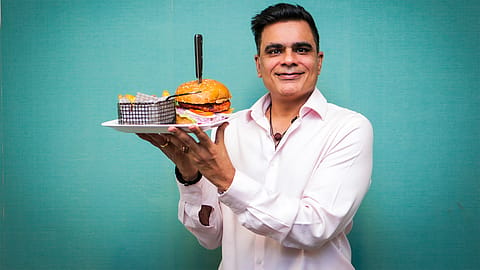
Vikrant Batra.
By the time he realised it, his body already knew.
Nights that ended at five in the morning. Days that began before noon. Sleep came in moving cars, in short bursts between events and in the margins of a business that refused to slow down.
Catering had taught Vikrant Batra everything—operations, logistics, people, pressure. It had also shown him its ceiling. This business would only grow as far as he could stretch himself.
So, Batra stopped stretching. And then he did something far more difficult. He walked away from a profitable business.
The decision was rooted in clarity alone.
He had grown up inside the family business. His parents had started Batra Banquets when he was still in school. Home was upstairs and the banquet hall was below. So, the young Batra drifted into the kitchen after classes, watched food being made, orders being managed, and chaos being handled. Over time, the curiosity turned into instinct.
Then came formal education—a degree in commerce, an MBA—and eventually, a return to the same business, this time as an operator. He ran it and then pushed it further. From outdoor catering to large-format events to pan-India execution, the scale looked impressive on paper and felt exhausting in real life. “You can learn every business in the world through catering,” he says.
And he did.
But the same business that taught him everything also boxed him in. There was no delegation at that level. No version of the business that could run without him at the centre of it. Growth had a limit. And that limit was him.
He didn’t wait for the business to break. He exited it when it was still at its peak, handing over the reins to his mum. Friends called it irrational. Family didn’t quite understand it.
Between speed and occasion
From the outside, it didn’t make sense. Walking away from a profitable business isn’t a move you can easily explain. But for Batra, comfort wasn’t the goal. Scale was.
{{#most-powerful-women-snapshot-individual.slug}} {{/most-powerful-women-snapshot-individual.slug}} {{^most-powerful-women-snapshot-individual.slug}} {{/most-powerful-women-snapshot-individual.slug}} {{#showRanking}} {{current-rank}} {{/showRanking}} {{#photo.0.url}}
{{name}}
That decision solved one problem. But it opened up another.
Batra stepped back. For nearly a year, there was no new business to run. He would show up for a few hours, sit with the numbers, think, and leave. Days passed without urgency, without a clear direction—just one question that kept returning: if the last business couldn’t grow beyond him, what would the next one need to look like? He didn’t rush into the next thing. For a while, he watched.
Around that time, his brother had taken up a restaurant franchise in Gurugram. Batra began spending more time there—on the floor, in the back office, watching how the place moved through the day.
It ran differently from anything he had known. Orders moved without chaos. The place didn’t lean on one person to hold it together. It kept going—steady, repeatable, almost indifferent to who was in charge at any given moment. He kept coming back to that.
Meanwhile outside, the city was shifting. It was the mid-to-late 2000s and office towers were filling up. Young professionals were moving in. Homes were getting smaller. Two people working, long commutes and very little time left at the end of the day became the new normal.
Result? Cooking began to slip and eating out filled the gap regularly. But the choices didn’t stretch far. There were quick-service restaurants for speed. And then there were sit-down restaurants for occasions. Everything in between was missing.
Batra had seen the problem up close.
Eating out as a family rarely stayed simple. Three generations at one table, each carrying their own habits. One meal would turn into negotiation. Someone adjusted. Someone settled. It happened often enough to stick.
The thought didn’t arrive fully formed. It came together slowly. What if one place could hold all of it together, a menu that didn’t force agreement and a space that didn’t demand occasion? What if it was a place people could walk into without planning, and stay as long as they liked?
The word café kept coming back. Back then, most cafés stopped at coffee and a few sides. They were places to meet, not places to eat a full meal.
Batra saw something wider. He pictured a space that carried the ease of a café, but the depth of a restaurant—food across cuisines, portions that didn’t feel restrained, and a room where you didn’t feel watched or hurried. Somewhere you could return to during the week, not just save for weekends.
In 2011, it was still just an idea. But that year, it found its first address in Gurugram. Batra started with one location and built it around a simple belief: remove the friction from eating out, and people will keep coming back.
One could see it in the details. The seating didn’t follow a single pattern. Tables changed height, shape, and mood. Some corners drew you into long conversations. Others worked if you wanted a quick meal and nothing more. The menu stretched deliberately—Indian, continental, comfort, indulgent—placed side by side without hierarchy. Nothing about the space asked you to behave a certain way. You could walk in easily. You could stay longer than you planned.
Held by hope, found by footfall
And then it opened.
The first few months didn’t look like the beginning of anything. They felt quiet. Batra was there every morning before the doors opened. He walked the floor, checked the kitchen, settled into the day as if it were already in motion.
It rarely was. A few tables through the day. Some evenings slightly better. Nothing that carried forward into the next day. Then the gaps began to stretch. Days when the numbers barely moved—₹5,000, ₹10,000. Some days didn’t cross that. Some didn’t register at all.
Time behaved differently on days like these. You notice the empty tables first. Then the clock. Then the distance between the two.
At home, the questions came in gently. His mother had seen enough businesses to recognise when something wasn’t working. One evening, she asked him, “What have you opened, my son? Wouldn’t an Indian cuisine restaurant have been the better choice?”
Batra said nothing. He went to his room, sat with it, and let it pass.
Then doubt gate-crashed—quietly, but persistently. It crept in during slow afternoons. It lingered in the kitchen, ready before the customers arrived. It returned in the same sales numbers, day after day.
Batra had seen this pattern before. He knew how it usually ended.
And yet, something refused to drop. A small group began to return. Not many. Twenty, maybe 30 people. But they came back. Again and again. Some showed up for breakfast. Stayed through lunch. Came back in the evening. The place had entered their routine before it had entered the market.
He started talking to them.
Why here? “There is no place to work. So, we come here, and you don’t eject us,” one smiled, half-confessing. “We sit here for five hours,” another laughed.
Batra let them stay.
That group didn’t move the numbers. Not yet. But it shifted something else. It gave the idea weight.
The losses, meanwhile, didn’t blink. Eight, nine months. Straight. “It was tough to hang on for so long,” recalls Batra. When there is almost no business, there is nothing to hold on to. What made it harder was the act of staying—month after month, despite the losses. “We were bleeding every month and what kept us alive was hope,” he says. “And this hope was irrational because numbers didn’t give us any hope.”
In stretches like that, data dries up. You either lean on instinct, or you lean on hope. Somewhere along the way, doubt and belief stopped pulling apart. They began to sit in the same room.
That’s usually when something starts to hold. And just as it did, something else arrived. The call didn’t come at the right time. The first outlet was still finding its footing. The numbers hadn’t settled. The losses hadn’t fully stopped in early 2012. And yet, an offer came in. A space at Ambience Mall, Gurugram.
It wasn’t an easy yes. Opening a second outlet meant stretching attention, money, and belief—again. But the logic held. Malls brought people. Footfall solved a problem the first outlet had struggled with: visibility.
So, Batra went ahead. The second outlet opened in early 2012. And almost immediately, the pace changed. This time, people didn’t need convincing. They were already there. Walk-ins turned into waiting lines and tables filled faster than the kitchen could keep up.
Paused to build, ready to scale
The change didn’t stay contained. Word travelled. At the same time, early Facebook food groups began to take shape. Small communities, active conversations, people sharing where they were eating, and what they had discovered… all added up.
Café Delhi Heights slipped into those threads. One post led to another. One table to the next.
By the time the rush settled into rhythm, the next question was already waiting. How far could this go?
Batra didn’t chase the answer immediately. Even with two outlets working, even with demand building, he held back. Why? Because he knew what could go wrong. Every plate had to land the same way. Every outlet had to feel familiar without feeling identical. The menu was wide, the operations were layered and consistency wasn’t automatic. It had to be built. So, he paused.
For nearly two years, expansion took a backseat. The work slipped behind the scenes. And the focus shifted quietly.
Batra built a central spine: procurement tightened, stronger people came in, a corporate structure began to take shape. Training, processes, controls—everything moved to the centre of the plate. “These are the things customers don’t see, but they feel when it’s missing,” he says. Money came in. And it went straight back out into the business. From the outside, it looked like a pause. But inside, it was assembly.
When growth returned, it didn’t sprint. It settled in. New outlets opened across cities. The format stayed intact. What began as a single café in Gurugram was no longer just a place. It was turning into a pattern.
Fast forward to April 2026. The pattern has scale.
Café Delhi Heights now runs across 50+ outlets in 17 cities, spanning 8 states. It closed FY25 at an operating revenue of ₹164 crore. And he is likely to close FY26 with an operating revenue of around ₹200 crore, Batra claims. Still bootstrapped. Still profitable.
And it works across moments because it was built to. A weekday lunch. A family dinner. A birthday that stretches into the night. A table you can hold without being hurried out. That flexibility was designed in early. “We always had the idea of feeding three generations together,” says Batra.
Food and beverage experts reckon that for casual dining brands that scale well over time, it’s rarely one bold swing. Ditto for Café Delhi Heights. “It’s a chain of steady, well-judged calls,” says Angad Chachra, Founder of The Bar Consultants, an F&B firm. Staying relevant to a wide audience while keeping the experience familiar has worked in their favour. “Layer in measured expansion and tight operational discipline, and you get a foundation built to endure,” he says, adding that longevity here is earned through consistency.
And that consistency spills into the experience as well.
“In today’s dining landscape, the experience stretches well beyond the plate,” says Chachra. Spatial design, pace of service, the overall environment—each shapes how a guest connects with a brand. Concepts that create a comfortable, unhurried, welcoming atmosphere tend to stay with people longer, and bring them back more often. “This is something that Café Delhi Heights has aced,” he adds.
The discipline behind the sprawl
Scale, however, complicates the same playbook. And this could be the one of the big challenges for Café Delhi Heights. As the brand grows and multiplies across formats, the real test sharpens. What does each format stand for? Where does it sit in the larger system? New concepts need distinct identities, yet still feel connected. “Managing that tension—between expansion and coherence—often defines what comes next,” says Chachra.
Inside the business, that tension plays out in the day-to-day. A wide menu brings complexity—different cuisines, different cooking styles, different expectations at the same table. And the portfolio only adds to it. There’s Juicy Lucy that operates as a cloud-kitchen brand. Then there’s Bakehouse Comfort, launched in 2021, which is a delivery-first bakery; this was followed by IKIGAI in 2023, and Neighbourly and Sarava in 2024—each concept was an experiment in format and cuisine, designed to resonate with a new generation of diners. The larger play was clear: expand the catchment, pull in newer consumers, and stay ahead of shifting tastes.
Holding that together, consistently, across locations, demands discipline.
Meanwhile, expansion is still ahead: More cities, more formats, and a wider footprint. The plan is to grow from the current footprint to over 100 outlets in the next few years—moving into newer cities, experimenting with formats such as Quick Service Restaurants and building physical and digital reach.
But the approach hasn’t changed much. It’s still growth without losing control. Batra has seen both sides of the business. When it doesn’t work, it keeps you up at night. And when it does, it still does. “If you remember from where you started, you would always know the next chapter of your story,” says Batra.
And his story didn’t begin with a café. It started in a kitchen above a banquet hall; in long nights that taught him how the business works; and in a decision to walk away before it could define how far he could go. And somewhere along the way, the meaning of ‘height’ in Café Delhi Heights changed.
It wasn’t in how fast the business grew, or how far it spread. It was in how much it could hold without losing control.
Follow Fortune India
Frequently Asked Questions
NEXT STORY