Green shoots in Q4, but inflation and geopolitical uncertainty cloud India’s consumption outlook for FY27
/ 3 min read
Credits: Sanjay Rawat
Green shoots in Q4, but inflation and geopolitical uncertainty cloud India’s consumption outlook for FY27
India’s consumer sector shows a broad-based recovery in Q4FY26, with staples, paints, QSR, innerwear and especially jewellery posting strong revenue and EBITDA growth. Rural resilience, urban revival and festive demand underpin the upturn. However, resurgent raw material inflation, volatile crude and gold prices, and geopolitical risks threaten margins and consumption momentum in FY27.
This summary is AI-generated, and Fortune India is not responsible for its content or any associated copyright issues.
According to a Motilal Oswal Financial Services preview, most consumer segments are set to report year-on-year growth in both revenue and profitability in Q4FY26.
Credits: Sanjay Rawat
India’s consumer sector appears to have turned a corner in the March quarter, with demand improving across most categories after a prolonged slowdown. But the relief may be short-lived. A fresh wave of raw material inflation and geopolitical uncertainty is expected to weigh on growth and margins in FY27.
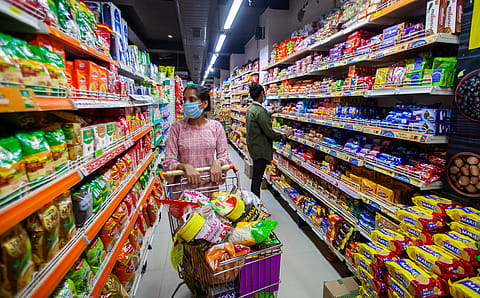
According to a Motilal Oswal Financial Services preview, most consumer segments are set to report year-on-year growth in both revenue and profitability in Q4FY26. Staples are expected to grow 8% in both sales and EBITDA, while categories like paints and adhesives could see 7% revenue growth and 14% EBITDA expansion. Liquor, QSR and innerwear segments are also likely to post steady gains, while jewellery stands out with sharp growth of 38% in sales and 47% in EBITDA.
“Demand recovery was visible across categories, and in most of the months in 4Q, we found a trend after a long time,” said Naveen Trivedi, research analyst at Motilal Oswal, noting that the quarter marked a break from the patchy consumption seen earlier in the year.
Broad-based recovery, with pockets of strength
The improvement has been driven by a mix of factors including better rural resilience, a gradual urban recovery, and seasonal tailwinds. In staples, domestic growth has picked up, even as international business, especially in the Middle East, remains under pressure for companies like Dabur and Emami due to geopolitical disruptions.
Food categories continue to outperform personal care, while companies have begun taking modest price hikes of around 2% in March, with more expected in April to offset rising input costs. Overall, the staples universe is likely to deliver 8% sales growth and 6% profit growth in Q4.
Paints and adhesives have seen a steady recovery after a weak October, with demand improving over the past five months. Price hikes of 5–8% announced by companies are expected to kick in from April, while benign raw material costs through most of the quarter should support margin expansion.
In discretionary segments, jewellery has emerged as a clear outlier. Despite gold prices surging nearly 80% year-on-year and 20% sequentially, demand has held up, aided by weddings, festive buying, and exchange-led purchases. The sector is expected to clock 65% profit growth for the quarter.
QSR and innerwear segments are also showing early signs of recovery. QSR chains saw improved traction in January, although demand was partly affected by Ramadan and early Navratri. Innerwear demand, meanwhile, benefited from seasonal strength and festive timing, with the quarter typically contributing 35–40% of annual sales.
Inflation risks return
While Q4 performance is set to be healthy, the outlook beyond that is less certain. Commodity prices, which remained largely stable during the quarter, have begun to turn volatile again.
{{#most-powerful-women-snapshot-individual.slug}} {{/most-powerful-women-snapshot-individual.slug}} {{^most-powerful-women-snapshot-individual.slug}} {{/most-powerful-women-snapshot-individual.slug}} {{#showRanking}} {{current-rank}} {{/showRanking}} {{#photo.0.url}}
{{name}}
Crude oil prices rose 7% year-on-year and 27% sequentially to $126 per barrel, while gold prices surged sharply. At the same time, some agricultural commodities such as wheat (-13% YoY) and maize (-23% YoY) have softened, offering partial relief.
“The RM pricing scenario has completely changed since Mar’26 onwards amidst the ongoing geopolitical pressures,” Trivedi said, adding that the impact of higher crude and currency depreciation will be more visible in the June quarter.
Companies are expected to respond with calibrated price hikes, but the risk is that higher prices could dampen consumption. Motilal Oswal has already cut earnings estimates, factoring in sustained inflationary pressures through the first half of FY27.
The report cautions that while near-term demand held up due to improving macros and festive support, “overall, near-term demand growth and margins are likely to remain muted” as cost pressures build.
Follow Fortune India
NEXT STORY