How Burma Burma is building a national restaurant brand on a cuisine India barely knew
/ 3 min read
No meat, no alcohol, no franchising. Founders Chirag Chhajer and Ankit Gupta are rewriting the casual dining playbook, one packed table at a time.
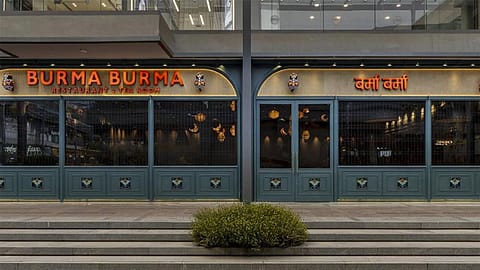
Burma Burma | Credits: Burma Burma Restaurant & Tea Room
"On the road to Mandalay," Rudyard Kipling wrote more than a century ago, conjuring a Burma most Indians would only ever meet in verse. A decade ago, Burmese cuisine was hardly a familiar category on India's dining map. For childhood friends Chirag Chhajer and Ankit Gupta, however, it was a cuisine they had grown up around, and one they believed Indian diners would embrace.
That conviction led to the launch of Burma Burma in Mumbai's Kala Ghoda in 2014. Twelve years later, the vegetarian, alcohol-free chain operates 22 restaurants and delivery kitchens across nine cities. It employs more than 1,500 people and reported sales of ₹155.5 crore in FY26, about 47% more than a year earlier, according to filings compiled by Tracxn. Its parent, Hunger Pangs Pvt. Ltd., has raised $11.2 million across five rounds, the latest of about ₹38 crore in January 2026. It was valued at $52.7 million in March 2026.
"We are a 13-year-old startup," says Chhajer. "Nothing was done in haste."
From passion project to pan-India chain
Gupta's connection with Burma was personal, as his mother's family is from the country. After travelling there in 2011, the friends ran pop-ups to test the idea. "I was just blown away by what that country had to offer," Gupta recalls. "There was validation, and half of it was gut feeling." The founders have since made 16 or 17 trips to Burma, working with chefs to broaden the menu.
The first eight years were bootstrapped and focussed on perfecting the product. Burma Burma had only six restaurants by 2022. The inflection point came with its first institutional round, led by Negen, in late 2022. "Once you raise money, access to money becomes irrelevant. That's when you start thinking about scale," says Chhajer.
The company opened nine restaurants last financial year, compared with 12 in its first 11 years, and revenue has grown more than five-fold since FY22. It reported ₹51.25 crore for April–June 2026 alone. It plans five to six openings this year, all company-owned and operated. "Both of us will always own all the restaurants we open," says Chhajer.
The economics of no meat, no alcohol
"We are not a vegetarian brand. We are a Burmese brand that happens to be vegetarian," says Chhajer. The founders felt strong non-vegetarian broths could overpower the dining room. They use fermented vegetables, mock meats and vegan fish sauce instead, and about 80% of dishes are vegan.
Skipping alcohol was the bolder call, since the bar is usually a major margin driver. The founders argue it pays off through table turns. "The moment we have alcohol, the turnover time of the table increases from one hour to 2.5 hours," says Gupta. Burma Burma turns its tables three to four times in a three-hour service. A beverage programme of zero-proof cocktails, kombuchas and bubble teas, priced at ₹300–450, fills the gap. "A consumer can eat only a limited amount of food, but they always have an appetite for desserts and beverages," Gupta says. Average spend has risen from ₹800–900 to about ₹1,200–1,300.
Real estate is the other lever. Some outlets pay among the highest rentals in the country, besides restaurants charging ₹3,000–4,000 a head. "We are premium at fairly reasonable prices," says Chhajer. The founders say they receive requests from at least 50 cities as malls fill their food and entertainment space.
Consistency comes from SOPs, audit apps, a new-store opening team and the Burma Burma Academy, which has about 100 training modules. Each restaurant, though, is uniquely themed. Chhajer sums up the philosophy as "hospitality first, guest first and everything [else] second".
Growth, at a cost
The expansion has not come cheap. Hunger Pangs' net loss widened to ₹14.55 crore in FY26 from ₹2.5 crore as it opened nine restaurants. The operating picture is healthier. EBITDA rose to ₹30.5 crore, a margin of about 19%, and operating cash flow quadrupled to ₹45.9 crore, nearly all of it reinvested. The company carries virtually no debt.
{{#most-powerful-women-snapshot-individual.slug}} {{/most-powerful-women-snapshot-individual.slug}} {{^most-powerful-women-snapshot-individual.slug}} {{/most-powerful-women-snapshot-individual.slug}} {{#showRanking}} {{current-rank}} {{/showRanking}} {{#photo.0.url}}
{{name}}
The founders call Hunger Pangs "profit-conscious." They say investors bought into its defensibility, ratings and national proof of concept. "About 95% of the dishes you like at Burma Burma, the only place you get them again is Burma Burma. It is like having a monopoly in a cuisine," says Chhajer. "One nation, one menu, one price."
Beyond dining, the company has built retail, ice cream, packaged snacks and catering businesses, and it sees a future abroad. "This is a restaurant brand made to go global," says Gupta.
For now, the next phase may be less about making Burmese food familiar and more about proving that a tightly focussed cuisine can become a scalable, profitable, national restaurant business.
NEXT STORY