India's energy storage capacity crosses 7.5 GWh; 140 GWh projects in pipeline: Shripad Naik
/ 3 min read
Over 53% of India's installed electricity generation capacity now comes from non-fossil fuel sources, the minister says.
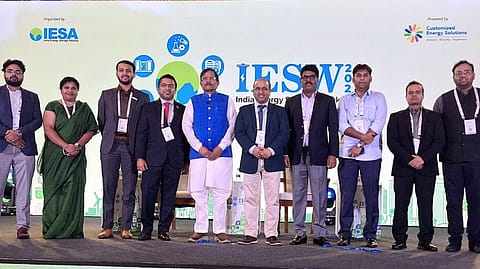
Shripad Naik, Minister of State for Power and New and Renewable Energy, at the 12th India Energy Storage Week event.
India has commissioned around 7.5 gigawatt-hours (GWh) of energy storage capacity, while projects with a combined capacity of more than 140 GWh are under construction, awarded or under tendering, Minister of State for Power and New and Renewable Energy Shripad Yesso Naik said on Thursday.
Speaking at the 12th India Energy Storage Week (IESW) 2026 in New Delhi, Naik said India must accelerate energy storage deployment to build a more flexible electricity grid as renewable energy capacity continues to expand.
"India has commissioned around 7.5 gigawatt-hours of storage capacity, while more than 140 gigawatt-hours is under construction, awarded, or under tendering. But if we are to build a truly flexible grid, deployment must accelerate further because the requirement is no longer measured only in gigawatts. It is measured in our ability to respond instantly to changing system conditions," he said.
The minister noted that more than 53% of India's installed electricity generation capacity now comes from non-fossil fuel sources. He reiterated the government's commitment to achieving 500 GW of non-fossil fuel capacity by 2030 and net-zero emissions by 2070.
He said flagship initiatives such as PM Surya Ghar, PM-KUSUM and the National Green Hydrogen Mission are transforming the country's energy landscape, but the focus has now shifted from generating sufficient electricity to ensuring power is delivered at the right time and place.
Referring to a recent paper by the Economics Advisory Council to the Prime Minister titled The Duck and the Camel, Naik said India's electricity grid is increasingly constrained by timing and flexibility rather than generation capacity alone.
Highlighting the growing role of battery storage, the minister said battery energy storage systems (BESS) have evolved beyond backup applications and are becoming critical flexibility assets capable of absorbing surplus renewable power, reducing curtailment, supporting frequency regulation, lowering peak-hour costs, deferring transmission investments and improving grid resilience.
He said the government has introduced several measures to promote battery storage, including viability gap funding for standalone BESS projects, support through the Power System Development Fund, waiver of interstate transmission system (ISTS) charges, integration of storage with renewable energy projects, infrastructure status for BESS and the 50 GWh Advanced Chemistry Cell (ACC) Production Linked Incentive (PLI) scheme, including dedicated capacity for stationary storage.
Naik also said India has the opportunity to emerge as a global manufacturing hub not only for battery cells but for the broader energy storage ecosystem, including battery management systems, power conversion equipment, thermal management, fire safety systems, recycling technologies, power electronics and grid software.
He added that while batteries would play a key role in short-duration energy storage and grid balancing, green hydrogen would become increasingly important for long-duration storage and industrial decarbonisation.
The three-day IESW 2026, organised by the India Energy Storage Alliance, is expected to attract more than 10,000 visitors, 1,000 delegates, 200 exhibitors and over 100 government officials. The event features more than 50 conference sessions and five country pavilions, with discussions covering gigafactories, battery supply chains, recycling, urban mining and energy storage technologies.
{{#most-powerful-women-snapshot-individual.slug}} {{/most-powerful-women-snapshot-individual.slug}} {{^most-powerful-women-snapshot-individual.slug}} {{/most-powerful-women-snapshot-individual.slug}} {{#showRanking}} {{current-rank}} {{/showRanking}} {{#photo.0.url}}
{{name}}
Debmalya Sen said this year's event focuses on manufacturing, supply chains and recycling, which are crucial for India's ambition to become a global hub for advanced energy storage technologies.
Vinayak Walimbe, Managing Director of Customized Energy Solutions, said the discussions and collaborations at IESW 2026 are helping accelerate the development of a resilient and sustainable energy storage value chain, supported by strong government policy and private sector participation.
Follow Fortune India
NEXT STORY