The FAQs are AI-generated, and Fortune India is not responsible for its content or any associated copyright issues.
India risks becoming an AI 'rule taker' without clear national direction, says Sarvam AI's Pratyush Kumar
/ 3 min read
Kumar argued that India must stop debating whether it should build its own AI models and instead focus on creating long-term strategic capability.
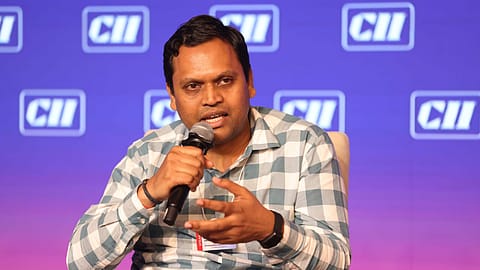
Pratyush Kumar, co-founder of Sarvam AI. | Credits: Sanjay Rawat
India’s ambitions of becoming a global AI power will depend less on slogans and more on whether it can build trusted infrastructure, sovereign capabilities and globally competitive products, industry leaders said at the CII Business Summit during a session 'AI & India’s Future: Rule Maker or Rule Taker'.
India cannot afford to remain merely a consumer in the artificial intelligence era and must urgently build its own foundational AI capabilities if it wants to shape global technology rules rather than follow them, according to Pratyush Kumar, co-founder of Sarvam AI.
Kumar said AI would become the defining technological layer across industries, governance, science and manufacturing, making ownership of core intelligence systems critical for economic value creation.
“What we saw with the steam engine, steel making and the internet, in all these eras, we became users and frankly lost out on the key value creation,” Kumar said. “This is now the start of a new era which is going to play out quarter by quarter.”
Kumar argued that India must stop debating whether it should build its own AI models and instead focus on creating long-term strategic capability. While much of the country should continue deploying and commercialising existing AI tools, he said a smaller pool of talent and capital must concentrate on developing frontier AI systems.
“You can rent it for now until we don’t have it, but you have to build it. You have to own the destiny around that,” he said.
The Sarvam AI co-founder also cautioned that the pace of disruption could outstrip policymaking and labour market preparedness. “I seriously don’t know what jobs would exist. I seriously don’t know where the value needs to be created, but I do know that the intelligence layer will be pervasive,” Kumar said.
He revealed that Sarvam AI is now preparing to train a trillion-parameter AI model within the next nine months after successfully building what he described as a proof of concept for India’s indigenous model-building capabilities.
“India can train a model where the data work, the algorithm work, the research work and the infrastructure work could lead to training a model end to end,” he said.
However, Kumar stressed that private industry would have to significantly increase investment into AI infrastructure and research if India hopes to stay competitive against global technology firms.
“The intelligence layer will accrue the value,” he said. “It requires infrastructure, but it requires R&D talent to build these models.”
{{#most-powerful-women-snapshot-individual.slug}} {{/most-powerful-women-snapshot-individual.slug}} {{^most-powerful-women-snapshot-individual.slug}} {{/most-powerful-women-snapshot-individual.slug}} {{#showRanking}} {{current-rank}} {{/showRanking}} {{#photo.0.url}}
{{name}}
He also pointed to the imbalance in global digital economics, arguing that India generates enormous amounts of data but captures limited value from it.
“We are great creators of data on YouTube, but we don’t get any value out of it except for getting ad revenue,” he said.
Warning against policy drift, Kumar said India still lacks a clearly defined national AI direction. “I think we don’t have a North Star that as a country we are going towards,” he said. “If we fumble our way, I don’t think we will be rule makers, we will be rule takers.”
Other panelists echoed the need for deeper domestic capability creation. Abhishek Singh, director general, National Testing Agency, Ministry of Education said India must focus on building globally competitive technology firms rather than worrying about access restrictions from international AI companies.
“Instead of worrying why Anthropic did not give access to us, we need to think why none of our companies have the capability to build a CrowdStrike,” Singh said.
Sunil Gupta of Yotta Data Services opined that India must continue building local data centre and compute capacity even if chip supply chains remain global.
Other panelists including Debjani Ghosh, chief architect, NITI Frontier Tech and Vijay Chandru, co-founder & director, Strand; Crisprbits; Yantri Labs; Biovergence, also stressed the importance of long-term investments, regulation and trusted partnerships as AI reshapes economies and industries globally.
Meanwhile, Sangeet Kumar, co-founder and CEO, Addverb said China currently dominates several layers of the robotics and physical AI ecosystem, highlighting the urgency for India to strengthen its position in emerging technologies.
Follow Fortune India
Frequently Asked Questions
NEXT STORY