India's next financial inclusion milestone should be financial health, not just account ownership: PwC-Dvara survey
/ 3 min read
The study surveyed 4,000 households across 18 districts in seven states to assess the financial well-being of underserved households in the country's "Bharat" segment.
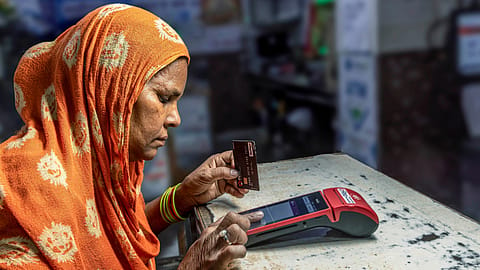
Southern India emerged as the most network-driven region, with 44% of financial advice coming from third-party providers and 40% through social networks. | Credits: Narendra Bisht
India's financial inclusion journey has been driven by the rapid expansion of bank accounts and digital payment infrastructure over the past decade, but the next phase should focus on improving households' financial health rather than merely expanding access, according to a joint report by PwC India and Dvara Research Foundation.
Titled "Rethinking Financial Health for Meaningful Impact", the study surveyed 4,000 households across 18 districts in seven states to assess the financial well-being of underserved households in the country's "Bharat" segment.
The report defines financial health as a household's ability to meet current financial needs, prepare for the future, and withstand economic shocks with confidence. It argues that measuring financial inclusion solely through metrics such as account ownership or card issuance is no longer sufficient, and that the focus must shift to outcomes such as resilience, confidence and the ability to manage income volatility.
The Financial Health Survey (FHS) follows an input-output-outcome framework. While inputs measure access to financial products and services, outputs track how households use them, and outcomes assess whether these products improve financial security, help absorb shocks and enable long-term financial planning. According to the report, this approach aligns with the Reserve Bank of India's National Strategy for Financial Inclusion (2025-30), which emphasises meaningful financial outcomes over simple access metrics.
"India's financial services ecosystem has made remarkable progress in expanding access. The next frontier is financial health. That means designing products around real household cash flows, combining digital scale with human support, and measuring success through resilience, meaningful usage and long-term customer outcomes," said Vivek Belgavi, Partner and Leader, Financial Services Advisory, PwC India.
The survey identified income volatility as the biggest factor undermining financial health. It noted that many financial products continue to be designed around fixed monthly salaries, making rigid EMIs, recurring deposits, and annual insurance premiums unsuitable for a large section of households with irregular incomes.
The report also highlighted a significant divide between renters and homeowners. In eastern India, 65% of renters said they would be unable to mobilise ₹30,000 in an emergency, underscoring the financial vulnerability of this growing urban population.
Misha Sharma, Lead at Dvara Research, said that while India has made significant progress in expanding financial access and credit, high levels of dormant accounts and persistent stress in the microfinance sector indicate that ownership of financial products has not consistently translated into better financial outcomes.
"The FHS is our contribution to shifting the operative goal from financial inclusion to financial health, equipping providers and policymakers with the ability to respond to customers' actual experiences with financial products," she said.
The study found that households with access to both physical and digital financial channels recorded the highest levels of product usage and better financial outcomes, suggesting that digital platforms are effective in onboarding customers while human interaction remains critical for building trust and sustained engagement.
It also observed that informal finance continues to complement formal financial services rather than compete with them, with households often relying on both sources simultaneously.
{{#most-powerful-women-snapshot-individual.slug}} {{/most-powerful-women-snapshot-individual.slug}} {{^most-powerful-women-snapshot-individual.slug}} {{/most-powerful-women-snapshot-individual.slug}} {{#showRanking}} {{current-rank}} {{/showRanking}} {{#photo.0.url}}
{{name}}
Regional disparities were also evident. In eastern India, 37% of households had never sought financial advice, while 23% had sought but failed to receive it. Informal borrowing remained highly concentrated, with 78% of informal loans sourced from a single lender.
In western India, digital financial services acceptance exceeded 95%, but nearly two-thirds of formal credit users reported having faced loan rejection at some point, indicating a gap between access and actual credit availability.
Southern India emerged as the most network-driven region, with 44% of financial advice coming from third-party providers and 40% through social networks. Adoption of multiple digital financial services exceeded 70%.
Northern India, meanwhile, faced infrastructure and trust-related challenges. About 40% of respondents lacked physical access to financial services within walking distance, while acceptance of digital financial services, at 75.67%, was the lowest among all regions surveyed.
The report concluded that financial service providers need to redesign savings, credit and insurance products to reflect irregular household cash flows, combine digital platforms with trusted human support, and evaluate success through improvements in financial resilience and customer outcomes rather than transaction volumes alone.
NEXT STORY