The FAQs are AI-generated, and Fortune India is not responsible for its content or any associated copyright issues.
India’s schools must nurture creativity and entrepreneurship in AI era: Shivika Goenka
/ 3 min read
Goenka said the skills required for children to “prosper and flourish” have changed significantly, with greater focus now being placed on collaboration, mental health and creative pursuits.
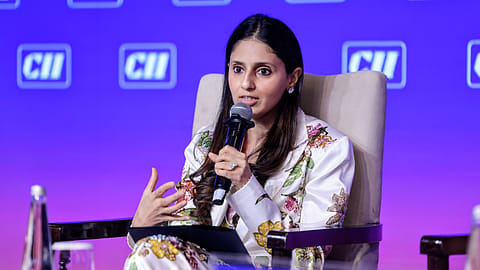
Shivika Goenka, director-luxury and education, RPSG Group; co-chair, CII Schools’ Forum.
As India looks to position creativity as a growth engine for the economy, education systems will need to move beyond rote learning and make entrepreneurship, critical thinking and design-led learning mainstream, Shivika Goenka said at the CII Business Summit.
Speaking at a session on 'Unleashing the Economic Potential of India's Soft Power', Goenka, director-luxury and education at RPSG Group and co-chair of the CII Schools’ Forum, said schools are already witnessing a major shift in how children are being taught and prepared for future careers.
“It’s no longer the traditional mode of education. There’s no more rote learning,” she said, adding that creativity, enquiry-based learning and critical thinking are increasingly becoming central to modern education systems.
“We need to measure what we treasure,” said Saurabh Garg, secretary, Ministry of Statistics & Programme Implementation (MoSPI), adding that culture and commerce are no longer separate. They are very much intertwined. “The focus on innovation, on creativity can only be increased as we move ahead.”
Goenka said the skills required for children to “prosper and flourish” have changed significantly, with greater focus now being placed on collaboration, mental health and creative pursuits. She pointed to international IB schools as examples of institutions that have begun integrating these ideas deeply into their curriculum and school culture.
According to her, this shift is also changing how parents and students think about careers. While traditional professions continue to remain relevant, more families are now open to alternative and creative career paths.
“There is a great mind shift happening,” she said.
According to Garg, India has jumped in the Global Innovation Index from being 81st globally in 2015 to 38 in 2025.
He also highlighted the scale of India’s growing intellectual property ecosystem, which includes around 40,000 patents, 1.7 lakh copyrights, 22 lakh trademarks, 1.4 lakh registered designs and nearly 700 GI tags. Nearly 85% of copyrights belong to the literary and artistic sector, reflecting the growing importance of creative industries in the economy.
What is AI's influence
On the growing role of artificial intelligence in classrooms, Goenka argued that AI should not be viewed as a threat to education but as an enabler of personalised learning. She said technology can help tailor education to the interests and capabilities of individual students instead of forcing uniform learning pathways.
“So it’s no longer that everyone has to follow the same thing. If you want to study zoology, you can. It’s literally made for each child and each capability,” she said. Goenka added that entrepreneurship and innovation labs are already being adopted not just by international schools but also by more traditional Indian institutions. As these models scale up, she said, children across backgrounds could gain equal access to opportunities in creative fields.
RANK
COMPANY NAME
REVENUE
(INR CR)
(INR CR)
{{#current-rank}} {{current-rank}} {{/current-rank}} {{^current-rank}} {{rank}} {{/current-rank}} {{name}} {{#revenue}} {{revenue}} {{/revenue}} {{^revenue}} {{noi}} {{/revenue}}
The discussion also turned to the role of cinema and storytelling in shaping India’s creative economy. Actor Prosenjit Chatterjee said films and audio-visual storytelling have the ability to spotlight local culture, history and tourism in ways that go beyond entertainment.
Referring to the impact of cinema on tourism, Chatterjee cited the example of Rajasthan and Satyajit Ray’s Sonar Kella. “After the film got released, people started coming to Rajasthan to see the Sonar kella (the golden fortress). Cinema has got power,” he said.
He argued that filmmakers and content creators can help market India’s culture, fashion, heritage and destinations to wider audiences by weaving them into stories with strong entertainment value.
“India has so much to say. We have so many stories and each of them has their own history,” Chatterjee said, adding that every Indian state carries its own cultural depth that can be showcased through cinema.
Lastly Garg also highlighted that the sector remains deeply undervalued, especially in the informal economy. India has nearly 8 crore informal enterprises, with creative arts and entertainment emerging as the fifth-largest sector by workforce size. Yet average annual gross value added per creative worker in the informal sector stands at only about ₹1 lakh, while sculptors, painters and jewellery makers typically earn between ₹1 lakh and ₹2 lakh annually.
Frequently Asked Questions
NEXT STORY