Indriya wants every store to win before it wins the market
/ 4 min read
Rather than setting store count as the primary objective, the company is focused on ensuring every outlet ranks among the top three jewellery stores in its local market.
THIS STORY FEATURES
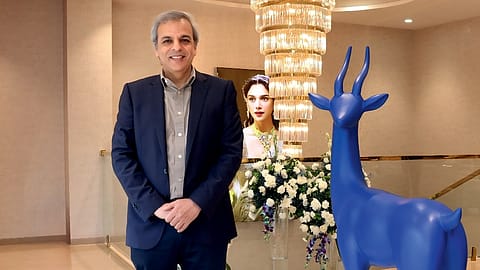
Sandeep Kohli, CEO of Indriya.
Even the largest national chains have only single-digit market shares in India's organised jewellery market, what chances does then a challenger brand like Indriya have? For Sandeep Kohli, CEO of Aditya Birla Jewellery's Indriya, the answer does not lie in chasing a national market share number. It lies in winning one neighbourhood at a time.
"Everybody is estimating whatever market share they are talking about," Kohli told Fortune India. Instead of focusing on a national figure, Indriya measures its success at the catchment level, benchmarking every outlet against competing stores in the same locality.
Titan's jewellery business, led by Tanishq, Mia, Zoya and CaratLane, crossed ₹53,500 crore in revenue in FY25 and exceeded ₹75,000 crore in FY26, making it India's largest organised jewellery retailer by sales. Rival Kalyan Jewellers reported ₹25,045 crore in FY25 revenue and has been one of the fastest-growing listed jewellery chains. Despite their scale, organised retail remains highly fragmented, with Titan estimated to command about 8% of the overall jewellery market, while industry estimates place Kalyan's share of the organised market at around 3.7% and Titan's at about 3.2% when measured on different organised retail definitions.
According to the Indriya's annual report, the company reported a total income of ₹710 crore in FY25.
"We are clear that we want to be among the top three players in terms of revenue," Kohli said. While he refrained from putting a timeline to that goal, he acknowledged that established rivals have spent four to five decades building their businesses. "You have to respect the time they have taken to get what they have. We want to find the right balance between speed and building the right business model."
That strategy is already shaping how Indriya expands. Rather than setting store count as the primary objective, the company is focused on ensuring every outlet ranks among the top three jewellery stores in its local market.
Launched in 2024, Indriya has become the first legacy-backed jewellery brand to enter India in more than three decades. It has also emerged as one of the country's fastest-growing retail brands, crossing 80 stores in less than two years. Today, it operates 81 stores across more than 40 cities and expects to touch 100 stores before the end of the year, with milestones of 85 and 90 stores coming in the next few weeks.
That still leaves a considerable gap with established rivals. Titan's jewellery portfolio spans more than 1,000 stores across Tanishq, Mia, Zoya and CaratLane, while Kalyan Jewellers has also expanded rapidly across India and overseas. Kohli, however, says comparing national footprints at this stage is less meaningful than comparing performance store by store within individual catchments.
Kohli attributes the rapid rollout to strong customer response across metros and smaller cities alike. "Every store that we open, whichever city we go to, we are surprised by the response," he said, adding that the next phase of expansion will prioritise quality over speed. New stores will only open once the company is satisfied with the location, merchandising and locally curated product assortment. Designs are customised city by city rather than following a standard national catalogue with in-house designers responsible for about 60%.
The company says the aggressive expansion is not coming at the expense of profitability. Kohli said Indriya remains "within the profitability targets" it had set for itself and is currently ahead of its business plan across key parameters, although he declined to disclose financial targets publicly.
Indriya's new sparkle strategy
Beyond expansion, Indriya is also trying to differentiate itself in the crowded jewellery market through diamonds. The company has introduced what it calls an industry-first benchmark for natural diamond selection, with only one in five diamonds making the cut after being screened for superior sparkle. It has also launched SparkleScope, an in-store technology that allows customers to evaluate a diamond's brilliance, fire and scintillation before making a purchase.
{{#most-powerful-women-snapshot-individual.slug}} {{/most-powerful-women-snapshot-individual.slug}} {{^most-powerful-women-snapshot-individual.slug}} {{/most-powerful-women-snapshot-individual.slug}} {{#showRanking}} {{current-rank}} {{/showRanking}} {{#photo.0.url}}
{{name}}
This is instead of relying only on the traditional four Cs of cut, colour, clarity and carat, the company screens diamonds for what it calls a fifth C: chamak (sparkle).
Indriya's expansion comes at a time when the global diamond industry is navigating one of its toughest phases. Wholesale prices of natural diamonds have corrected sharply over the past two to three years amid weaker demand, particularly from China, and increasing competition from lab-grown diamonds, although prices have begun to stabilise.
Yet Kohli believes the opportunity for natural diamonds lies not in positioning them purely as an investment, but as an expression of personal style.
"The investment angle is not just a diamond angle. People have always viewed jewellery as a form of investment because it is predominantly gold," he said. "But what is coming to the fore, especially for the younger generation, is that jewellery is also a form of expressing who they are and expressing their beauty. People are not simply saying they want to buy one kilogram of gold. They come saying this is my outfit and this is my budget."
That shift has also encouraged the company to design lighter jewellery, reducing the amount of gold required without altering the appearance, making products more affordable despite soaring gold prices.
Separately, the Aditya Birla Group is also building a technology backbone for the business through a nano global capability centre, which is expected to support digital capabilities as Indriya scales its retail network.
Follow Fortune India
NEXT STORY