Inflation bites, but price hikes and premium demand to power FMCG growth in Q1FY27
/ 3 min read
Recent price increases, premiumisation, innovation, GST rate cuts in select categories, favourable seasonal demand and expansion into alternate channels will continue to support growth, while the recent correction in crude and crude derivative prices could provide margin relief in the coming quarters.
THIS STORY FEATURES
Credits: Sanjay Rawat
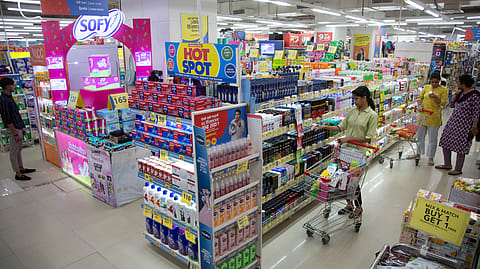
India's fast moving consumer goods (FMCG) sector appears set to deliver another healthy quarter despite persistent inflationary pressures, as companies successfully pass on higher costs through price hikes while premium products, modern trade and quick commerce continue to offset weakness in parts of rural India and general trade, according to a channel check by Anand Rathi.
The brokerage, which interacted with dealers, distributors and industry experts across FMCG, paints and alcoholic beverages, expects double digit revenue growth seen over the past two quarters to either sustain or improve in Q1FY27. It believes recent price increases, premiumisation, innovation, GST rate cuts in select categories, favourable seasonal demand and expansion into alternate channels will continue to support growth, while the recent correction in crude and crude derivative prices could provide margin relief in the coming quarters.
"Despite potential impact of El Nino on rural demand, we remain optimistic of steady volume growth along with moderate pricing power driving overall top line," the report said. It added that declining crude prices are likely to boost sector margins in the second half of FY27.
Quick commerce reshapes distribution as premium products lead demand
The channel checks suggest that while demand in the general trade channel weakened during the quarter because of slower rural consumption, urban markets remained relatively resilient. Inflation, driven partly by higher crude linked commodity costs and geopolitical tensions in West Asia, pushed companies to raise prices through higher MRPs and lower grammage, resulting in effective price increases of 10% to 20% across certain categories. Consumers have increasingly responded by shifting to smaller packs and local brands, making recent sector growth more pricing led than volume driven.
Quick commerce continues to emerge as one of the biggest structural shifts in the industry. According to an industry expert cited in the report, it now accounts for as much as 25% to 30% of urban FMCG sales in several cities, gradually taking share not only from modern trade but also from general trade in metros such as Mumbai, Bengaluru, Delhi and Chennai. Even so, the report notes that general trade still commands nearly 80% of FMCG distribution because of its deep rural reach.
The brokerage found premiumisation also to be a recurring theme across categories.
For Nestlé, Maggi remained the biggest growth driver despite price increases, while coffee demand recovered following GST led price corrections of nearly 20% in select SKUs. Nutrition products also remained healthy, supported by innovation and premium offerings. The company is also expanding the use of free visi coolers in smaller towns to strengthen visibility for chocolates and beverages.
Godrej Consumer Products saw strong traction in air fresheners, liquid detergents and fabric care, although household insecticides moderated because of an intense summer. Innovation led categories continued to outperform legacy businesses, while quick commerce emerged as the fastest growing channel.
For Hindustan Unilever, detergents and foods drove around 8% distributor growth. The report highlighted a growing consumer divide, with premium products and sachets performing well while mid sized packs remained under pressure. It also noted that HUL is expected to launch Horlicks biscuits within the next month as part of its foods portfolio expansion.
The report also found that biscuits continue to be driven by affordable ₹5 and ₹10 packs, which contribute nearly two thirds of category sales. Premium innovations, however, are seeing stronger acceptance in modern trade than in traditional retail.
Paints, cigarettes and premium liquor add to consumer momentum
Outside staples, paints demand remained robust despite cumulative industry price hikes of around 15% to 16%, with Asian Paints implementing another 4% increase in June. Anand Rathi believes disciplined pricing, easing crude prices and backward integration could support margins for paint companies later this fiscal.
{{#most-powerful-women-snapshot-individual.slug}} {{/most-powerful-women-snapshot-individual.slug}} {{^most-powerful-women-snapshot-individual.slug}} {{/most-powerful-women-snapshot-individual.slug}} {{#showRanking}} {{current-rank}} {{/showRanking}} {{#photo.0.url}}
{{name}}
The report also points to resilient cigarette demand despite successive price hikes by ITC, aided by staggered pricing and portfolio expansion. In alcoholic beverages, premiumisation continues to offset sluggish volume growth, with consumers increasingly trading up to premium whisky, beer and white spirits. It estimates India to be a 440 million case IMFL market, while premium beer sales have nearly tripled over the past three years. The India UK free trade agreement is also expected to reduce retail prices of imported premium Scotch by around 8% to 10%.
After a correction in FMCG stocks over the past three to four months due to rising input costs and supply chain disruptions, Anand Rathi believes valuations have turned attractive.
It expects companies under its coverage to deliver around 10% revenue CAGR and 14% earnings CAGR between FY26 and FY28, compared with 4% to 7% revenue growth and negative 3% to 5% earnings growth seen in FY25 and FY26.
The brokerage's preferred large cap picks remain Marico, Godrej Consumer Products and Hindustan Unilever, while Mrs Bector Foods and Zydus Wellness are its preferred small and mid cap bets. It has also upgraded the paints sector to Hold from Sell, citing improving demand, aggressive price increases and expectations of stronger margins.








Follow Fortune India
NEXT STORY