Inside Madame’s quiet reset: Why Akhil Jain is pulling back to move forward
/ 9 min read
Inside Madame’s quiet reset: Why Akhil Jain is pulling back to move forward
Akhil Jain, third-generation head of women’s wear brand Madame, is deliberately slowing growth to fix efficiency. Despite a revenue and profit dip since FY23, he frames it as a correction: tightening inventory built for a ₹500 crore scale, improving sell-through, and cutting finance costs. Rooted in early shop-floor lessons, his philosophy favours control and resilience over rapid expansion and outside capital.
This summary is AI-generated, and Fortune India is not responsible for its content or any associated copyright issues.
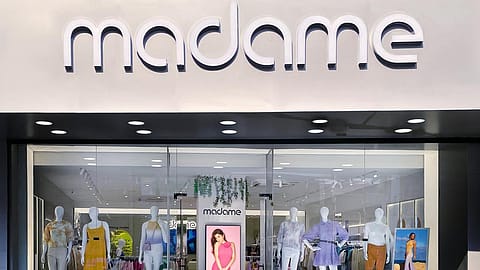
As the fashion market chases growth, Madame is tightening its business, fixing its math, and choosing control over scale. Can the third-generation entrepreneur tighten a bootstrapped, profitable brand without losing its edge?
Akhil Jain doesn’t like putting all his eggs in one basket. Not in business. Not in life. Not even in travel—he and his brother rarely fly together.
It sounds like a cliché. He laughs about it himself. But spend a little time with him, and it begins to feel less like a saying and more like a system. A way of thinking that runs quietly through everything he does—how he builds, how he scales, and, just as importantly, how he pulls back.
And why does it feel so? Because if there is one pattern in the way the third-generation entrepreneur runs his business, it is this: he resists the temptation to do more. He prefers to cut carefully and not stretch the fabric too thin.
That instinct, interestingly, feels almost out of place in fast fashion. This is an industry wired for urgency—new collections, faster turns, bigger stores, constant expansion. Growth is often a race against time. And lately, against capital.
And this is what makes the financial numbers at Jain Amar Clothing, the company behind women’s wear brand Madame, slightly confusing—or even unsettling—at first glance.
Revenue has fallen—from ₹354.20 crore in FY23 to ₹281.68 crore in FY25. Profit has shrunk even more sharply—from ₹9.80 crore to under ₹1 crore. The estimated numbers for FY26, though, break the pattern: a top line of ₹300 crore and a bottom line of a little over ₹1 crore.
Forget FY26. It’s still a work in progress.
Why Madame’s revenue and profit decline isn’t what it seems
From the FY23 peak to FY25, the numbers would invite tough questions in most boardrooms—around demand, relevance, and strategy. More so for a bootstrapped brand. The margin for error is thin. One loose thread can unravel the entire fabric.
Jain—MD of Jain Amar Clothing and CEO of Madame—however, doesn’t see it that way. To him, the numbers point to something less obvious: a correction underway.
“The challenge has never been demand,” he says. “It is efficiency. And that’s exactly what we are fixing.”
It’s a response that sounds measured, almost unusually calm for a sector where momentum is everything. But it becomes easier to understand once you trace where that thinking comes from—how the business has been cut, stitched, and reworked over time.
{{#most-powerful-women-snapshot-individual.slug}} {{/most-powerful-women-snapshot-individual.slug}} {{^most-powerful-women-snapshot-individual.slug}} {{/most-powerful-women-snapshot-individual.slug}} {{#showRanking}} {{current-rank}} {{/showRanking}} {{#photo.0.url}}
{{name}}
Jain joined the family business in 2003, but like most members of legacy businesses, his education had begun much earlier—on shop floors, inside warehouses, and around conversations that rarely made it into formal training. By the time he entered the business formally, he understood its mechanics well enough to feel confident about what he knew.
That confidence didn’t last long.
On his first day, his father sent him not to design or strategy, but to the wholesale counter. His job was simple: serve water to customers, pack goods, and deliver them.
He did it for six months.
“It jolted me,” Jain recalls. What he thought would be a short assignment turned into something else—a dismantling of assumptions. The exercise, he realised later, was deliberate. It was meant to strip away any early sense of entitlement and force an understanding of how the business actually functioned, at its most basic level.
It worked.
“My ego was shattered,” he says. “It grounded me.”
Fixing efficiency over chasing growth
The lesson stayed. So did the habits that came with it—questioning costs, paying attention to detail, and understanding how small inefficiencies compound. In a business like apparel, where margins are thin and inventory can quietly become the biggest liability, those instincts tend to matter more than ambition.
Perhaps that’s why Jain is careful about how he talks about growth.
“It’s always easy to grow on rocket fuel,” he says. Raising capital, expanding quickly, scaling visibility—there is nothing inherently wrong with it. But it is not the path he has chosen.
At Jain Amar, growth has been measured—often corrected mid-way, rather than pushed through.
There was a time, around 2014-15, when the company experimented with larger-format stores—4,000 sq. ft, significantly bigger than its usual footprint. The move mirrored what other brands were doing: bigger stores, higher visibility, the promise of scale.
It didn’t work.
“The economics didn’t make sense,” Jain says. Costs rose, supply chains strained, and the math, as he puts it, “revolted”. Within 18 months, the company began shutting those stores down.
The correction was quick. More importantly, it was accepted.
That pattern—test, step back, recalibrate—shows up repeatedly in how Jain describes the business today. The recent dip in revenue and profit, he insists, follows the same logic.
How early lessons shaped Jain’s discipline and cost focus
Over the past few years, the company had built inventory for a much larger scale—closer to a ₹500 crore top line. When growth didn’t keep pace, the imbalance surfaced—in costs, in working capital, and eventually, in profitability.
The response has been to reverse that drift. Inventory is being tightened. Sell-through is being prioritised over pushing volume. Costs are being realigned to current revenue levels. Finance costs are being brought down by improving inventory turns.
In other words, the focus has shifted—from growing the business to fixing it.
It is not the kind of strategy that draws attention. But then, Jain isn’t particularly interested in attention either. “If you are content with your life, everything else is just noise,” he says.
In a market where growth is amplified, compared and constantly measured against others, that kind of detachment can seem counterintuitive. Even risky. But for Jain, the alternative—chasing scale without control—feels more dangerous. “There is no end to comparison,” he says. “It’s a black hole.”
So, he moves away from speed, avoids scale at any cost, and chooses something else: control. A business that slows down by design—and knows exactly why.
That clarity—of knowing why something is happening—did not come overnight. It was built over time, through moments where instinct had to be tested against reality.
How Madame shifted from wholesale to a consumer-focussed brand
One such moment came early, when Jain Amar Clothing was still largely a manufacturing-led business, selling through wholesalers and distributors.
The shift to retail wasn’t obvious. It wasn’t even encouraged. Feedback from the market suggested that Madame’s products were expensive. There were also operational limitations—free-size garments, limited colour depth, and constrained volumes. The easier route would have been to adjust within the existing system.
Jain chose to step outside it.
The company opened a small store in Mumbai’s Lokhandwala—around 350 sq. ft—in 2002. The expectation was modest. If a handful of pieces sold on the first day, it would be considered a success.
By evening, the store had clocked sales of around ₹70,000.
More importantly, it answered a question the distribution channel hadn’t. Customers were willing to buy—if the product, sizing, and experience were right. That day altered the company’s direction. “We decided we will be only a consumer-centred company,” Jain says.
It was also the moment when the business began to distance itself from intermediaries. Dealers and distributors had their own priorities—margins, turnover, immediate returns. Building a brand required something else.
Jain’s response was simple: ignore the noise, focus on the consumer. “We never responded to outside noise. We remained sharply focussed on our customers,” he says.
That decision continues to shape how the company operates today. Even now, senior management, including Jain, spends time on the shop floor—selling, observing, understanding behaviour firsthand. The idea is institutionalised enough to have a name: Know Your Customer.
It also explains the structure of the business.
Madame today operates through an omnichannel model, with a significant portion of its stores run on a franchise basis. Close to 85% of its network is franchised, allowing the brand to expand without overextending its own capital. Company-owned stores are reserved for locations where experience matters more—airports, for instance, or key flagship spaces.
It is a model that balances reach with restraint.
The challenges facing Madame: Inventory, capital and growth
That balance, however, comes with its own tensions.
Ashita Aggarwal, professor of marketing at SP Jain Institute of Management & Research, sees both strength and constraint in the way the brand has evolved.
Madame is a stitch-by-stitch story. While the parent company has been in the business for over seven decades, the brand itself has been in the game for more than two. That depth has made it resilient. It has weathered brutal competition in fast fashion, held its ground against cheap imports from China and Thailand, and carved a space in women’s wear.
What gives it an edge is its in-house, integrated manufacturing facility in Ludhiana, Punjab. Just as important is its awareness—of both its strengths and its limits.
An operating revenue of ₹189.19 crore in FY21 laid the base. Then came the post-pandemic surge—revenge shopping that lifted numbers sharply in FY22 and FY23. The spike was real, but so were the tailwinds behind it. What followed was a stabilisation. Even then, FY25 revenue remains roughly ₹100 crore higher than FY21.
The challenge now is of a different kind.
First, the brand needs a sharper SKU rationalisation—cutting excess while retaining enough variety to stay relevant and visible.
Second, at some point, it will need capital. Fast fashion is a volume game, and capital-intensive. Bootstrapping has been a strength—but it may also become a constraint.
Third, marketing. The brand has been built patiently. Now it needs amplification—greater visibility, sharper recall, a louder presence in a crowded market.
But beneath that resilience lies a more structural pressure.
A recent credit ratings report by Crisil flags the real pressure point: working capital.
Madame’s model—selling through MBOs and franchise stores—means payments come only after the product reaches the end consumer. That stretches receivables. At the same time, inventory runs deep. A wide product range, multiple channels, and year-round production demand large stock levels.
In fashion, that comes with risk. Trends shift fast. What doesn’t sell turns obsolete. Inventory, then, is not just stock—it’s exposure. The company manages this through discount channels, clearing excess before it weighs on profitability.
Even so, the cycle remains long. Working capital will stay high, and how efficiently it is managed—especially with limited reliance on external debt—will remain under watch. Company-owned stores help, offering quicker cash realisation. But the intensity of the business, by its nature, doesn’t ease easily.
How Madame became a consumer-focussed brand and scaled without external capital
This is where the business meets the belief system.
Restraint, in Jain’s case, is not just a business choice. It is philosophical. He refers, at one point, to Aparigraha—a Jain principle that advocates limiting possessions and detaching from excess. In a corporate setting, the idea translates in unexpected ways.
It shows up in the reluctance to raise capital without a clear need. “There is no dogma against outside capital,” Jain says. But there has never been urgency either. The company has relied on internal accruals, building steadily over time rather than accelerating through external funding.
Even the possibility of an IPO is framed cautiously. “We will go after quarters of profitable growth,” he says. “We believe in value and don’t believe in valuation.”
It is a line that runs counter to the current mood of the market, where valuation often precedes value. But then, much of Jain’s approach does. He quotes Henry Ford to make the point clearer: “A business that makes nothing but money is a poor business.”
For him, the responsibility of running a company extends beyond financial outcomes. It includes employees—often placed, in his words, “even before our immediate family”. It includes continuity—staying in the game, not just playing it. “It’s easy to play the game,” he says. “It’s tough to stay in the game.”
That long-game view perhaps explains the company’s ability to absorb shocks. There have been moments when the business could have unravelled—a prolonged regulatory and operational crisis that began in 2016 and lasted several years, fire incidents that destroyed inventory, and periods of slowdown that tested both patience and capital.
The response, each time, has been consistent: diversify risk, absorb the loss, continue. “Don’t put all your eggs in one basket,” Jain says again—by now less an idiom and more an operating code.
And yet, step back from the immediate pressures, and the picture begins to look different.
Shilpa Wadhwa, a communication designer and brand strategist based in New Delhi, reckons that what often gets missed in a reading of the financial numbers is the nature of the business itself.
“Building a fashion brand without external capital—over decades, across cycles, through shifts in consumer behaviour—is not an easy path,” says Wadhwa. It demands patience, discipline, and the ability to absorb shocks without the cushion of outside funding. “Madame has done that quietly. It has scaled, stumbled, corrected, and continued—without stepping outside its means,” she adds. In a market where many brands are still trying to find viability, that, in itself, is no small achievement.
Why Madame’s strategy is built on restraint, not big bets
At the same time, that approach brings its own tensions.
As a fast fashion brand, Madame is expected to stay current, fluid, and responsive to trends. But the risk of that approach, she notes, is diffusion. “When you try to please everyone, you end up standing for very little,” she says.
Most fashion brands work off the same trend forecasts. What separates the memorable ones is their ability to interpret those trends through a distinct lens—one that is recognisable, consistent and ownable.
“There is a reason why Madame is such a rage in Bharat, and it should stick to the strategy,” she says.
Seen in that context, Jain’s current position becomes easier to understand. Madame is not a startup chasing scale. Nor is it a legacy business standing still. It sits somewhere in between—growing, correcting, and recalibrating.
The numbers, on their own, don’t fully capture that. This is not a business built on one bet. It has been built the slower way—across decisions, corrected over time, and held together by a refusal to go all in.
In that sense, Jain is simply doing what he has always done: not putting all his eggs in one basket.
Follow Fortune India
NEXT STORY