Kaynes Semicon aims for $60 million in revenue this year, says CEO Raghu Panicker
/ 3 min read
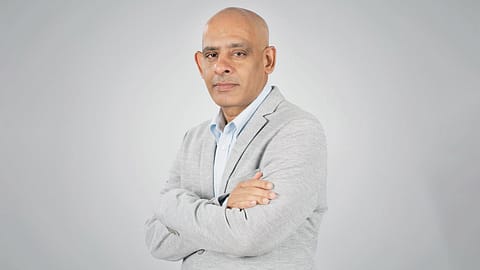
Kaynes Semicon CEO Raghu Panicker talks about revenue generation, receiving incentive support, entering India Semiconductor Mission (ISM) 2.0., and more.
Kaynes Semicon aims for $60 million in revenue this year, says CEO Raghu Panicker
Kaynes Semicon has launched an advanced OSAT facility in Sanand, Gujarat, India’s second major semiconductor plant, targeting $50-60 million in revenue this year after $9 million last year. With a ₹3,300-crore plant capable of over 2 billion units annually, it focuses on intelligent power modules for EVs and industry, with 80% of its pipeline export-driven.
This summary is AI-generated, and Fortune India is not responsible for its content or any associated copyright issues.
Kaynes Semicon, a subsidiary of Kaynes Technology, becomes the first Indian company to establish an OSAT facility in the country and commence production.
Kaynes Semicon CEO Raghu Panicker talks about revenue generation, receiving incentive support, entering India Semiconductor Mission (ISM) 2.0., and more.
India inaugurated its second semiconductor plant on March 31. Following the opening of Micron Technology’s semiconductor assembly, test, marking, and packaging (ATMP) facility at Gujarat’s Sanand in February, Kaynes Semicon has launched an advanced outsourced semiconductor assembly and test (OSAT) facility at the same location. The facility will supply intelligent power modules used in electric vehicles and industrial applications, with a large share of its output already booked for export. The ₹3,300-crore plant has the capacity to produce over 2 billion units annually.
In an interview with Fortune India, Kaynes Semicon CEO Raghu Panicker talks about revenue generation, receiving incentive support, entering India Semiconductor Mission (ISM) 2.0 once it's launched, and more. Edited excerpts:
Q. What’s your current customer base and production capacity at the Sanand facility?
We currently have a pipeline of 22 customers, with six signed off, utilising 30-35% of our production capacity. Once we convert the others, we’ll likely exceed capacity, considering Unit 2 and upcoming Unit 3. Our order pipeline is gratifying, focussing on power MOSFETs and modules for automotive EVs, home appliances, energy, railway, outer space, and satellites. We’re also setting up a silicon microphone line with Infineon for Indian customers, expanding into consumer segments. Regarding our pipeline, about 80% is export and 20% India-based. In India, we’re working with two automotive companies. Others are in brushless DC motors, silicon microphones, and smart cars.
Q. Where is Kaynes Semicon sourcing raw materials and equipment from, and is the current geopolitical situation impacting business?
We source raw materials and equipment mainly from Japan, Malaysia, Singapore, Taiwan, and Korea—avoiding neighbouring countries. So far, [there has been] no impact from the Middle East situation on our business, as our key interactions are with Japan, Korea, and Malaysia.
Q. How did Kaynes Semicon achieve a quick turnaround in just 18 months, from government approval for setting up a plant to production?
In September 2024, Kaynes Semicon received approval to set up an OSAT plant in Sanand, Gujarat using ISM 1.0. We broke ground in December, set up the clean room by April-May 2025, and started accepting equipment. We shipped our first parts to Alpha Omega Semiconductors in October 2025, and after qualification, we started production in March 2026. We’ve beaten the international industry average by almost a year in setting up the plant and two years in qualification. We’re producing a complex Intelligent Power Module, a multi-chip module for energy, white goods, and consumer products. Our investment is around ₹600 crore in Unit 1, and Unit 2 is coming up. We’ve built a team of 150, with experts from the Philippines, Malaysia, Japan, and India, plus freshers. We’ve also built an ecosystem of tech partners, customers, suppliers, and logistics.
Q. Has Kaynes Semicon availed the government incentive schemes at state and central levels, and how’s the support?
Yes, we’ve availed the incentives. Our fiscal support agreement was signed in January. The government has reimbursed expenses, and claims for April-June are approved. We get quarterly payouts. This covers both ISM and state schemes. Support has been smooth.
Q. When can we expect Kaynes Semicon to start generating revenues and turn profitable?
We did close to $9 million (₹83 crore) last year. This year, we are targeting $50-60 million (₹400-500 crore) overall.
{{#most-powerful-women-snapshot-individual.slug}} {{/most-powerful-women-snapshot-individual.slug}} {{^most-powerful-women-snapshot-individual.slug}} {{/most-powerful-women-snapshot-individual.slug}} {{#showRanking}} {{current-rank}} {{/showRanking}} {{#photo.0.url}}
{{name}}
Q. Are current policies sufficient, or are amendments needed?
Current policies work for our scope. If we plan new investments, we’ll approach the government, likely under ISM 2.0. And yes, we can avail benefits from the second tranche even if we’re part of the first one.
Q. How is Kaynes Semicon addressing the skill gap in India’s semiconductor sector?
We’re partnering with universities in India and also hiring international talent. Many Indians abroad are keen to return, but matching US salaries is a challenge. We’re working on building local talent—more partnerships and efforts are needed.
Follow Fortune India
NEXT STORY