The FAQs are AI-generated, and Fortune India is not responsible for its content or any associated copyright issues.
'Memory is non-refundable': Why brands are moving from ads to experiences in India’s ₹13,000-crore live entertainment boom
/ 6 min read
In an interview with Fortune India, Samradha Tibrewala, Head – Partnerships and Revenue at BookMyShow, explains how concerts, comedy tours and immersive fandom experiences are reshaping brand-building, consumer engagement and cultural marketing in India.
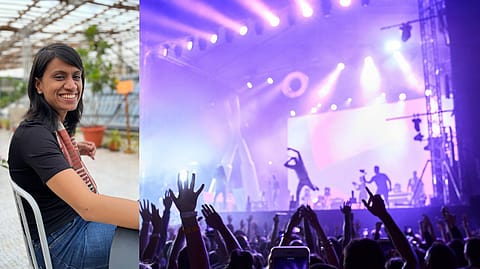
Samradha Tibrewala, Head – Partnerships and Revenue at BookMyShow.
India’s live entertainment industry is rapidly emerging as one of the country’s most powerful marketing and cultural platforms, as brands increasingly shift budgets from traditional advertising towards immersive experiences, fandom-led engagement and experiential storytelling.
With India’s experience economy projected to touch ₹13,000 crore, marketers are rethinking how they engage consumers, especially Gen Z and millennials, who are increasingly prioritising experiences over passive digital consumption. According to the latest FICCI-EY Media & Entertainment report, India’s live events segment grew 44% in 2025 to ₹145 billion, making it the fastest-growing category within the country’s media and entertainment industry.
In an interview with Fortune India, Samradha Tibrewala, Head – Partnerships and Revenue at BookMyShow, discusses how experiential marketing is evolving, why brands are embedding themselves into culture rather than advertising around it, and how live entertainment is becoming a high-intent engagement platform. Edited excerpts:
What is driving brands to shift budgets from traditional advertising towards live entertainment and experiential marketing?
How many of us can recall the last three ads we saw online? But most of us clearly remember the last concert, comedy show or festival we attended with friends. That difference is exactly what is driving this shift.
We are living in a world of fragmented attention and growing digital fatigue, especially among Gen Z and younger millennials who increasingly tune out interruptive advertising formats. At the same time, consumers are actively prioritising experiences that feel personal, collective and emotionally memorable.
From where we sit at BookMyShow, the signals are impossible to ignore. Anirudh Ravichander sold out rapidly across markets. Zakir Khan continues to fill shows across 40-plus cities. Even homegrown productions like Humare Ram have scaled to over 500 shows including international markets.
This is not a trend anymore. It is a structural consumer behaviour shift. We are witnessing an entire generation choosing, with limited time, hard-earned money and deep intent, the value of being somewhere real, together and fully present.
For brands, that changes the equation completely. In a world where most advertising interrupts, live entertainment invites participation. It creates emotion, memory and community in ways passive formats struggle to replicate.
The shift today is from reach and impressions to memory and participation. Experiential marketing is no longer being viewed as a tactical activation layer. It is increasingly becoming a full-funnel growth engine that drives awareness, engagement, affinity and advocacy simultaneously.
How have brand partnerships at live events evolved, and what makes live entertainment such a high-intent environment for marketers?
{{#most-powerful-women-snapshot-individual.slug}} {{/most-powerful-women-snapshot-individual.slug}} {{^most-powerful-women-snapshot-individual.slug}} {{/most-powerful-women-snapshot-individual.slug}} {{#showRanking}} {{current-rank}} {{/showRanking}} {{#photo.0.url}}
{{name}}
The old definition of success was simple: how many eyeballs saw the logo. That definition is dead.
Today, the most successful brand partnerships are the ones that genuinely improve the fan experience. At BookMyShow, our brand conversations rarely begin with visibility anymore. They begin with the consumer.
We work backwards from questions like: What is the audience feeling? What friction points exist in their journey? How can a brand enhance fandom, discovery, comfort, access or participation in a way that feels natural to the environment?
A festival today is not just a two-day event. It is often a six-to-eight-month consumer journey. Engagement starts long before the first song is played. Fans are planning ticket drops, travel, outfits, rituals and memories.
That has opened up space for much deeper integrations. We are seeing brands move into immersive fan zones, artist interactions, comfort-led experiences, frictionless ecosystems, interactive digital touchpoints and exclusive access moments that audiences actively want to engage with rather than simply observe.
The result is that brands stop feeling like sponsors and start feeling like part of the cultural ecosystem itself.
Live entertainment is also one of the few remaining environments that commands undivided attention at scale. People are emotionally participating in these experiences. What you attend, who you attend with and what you share afterwards all become extensions of personal culture.
Measurement has evolved far beyond visibility metrics. Reach and impressions are now hygiene metrics — table stakes. Brands increasingly want to understand engagement depth, dwell time, participation, sentiment, creator-led conversations, recall and long-term brand affinity.
In our report Beyond Attention. Into Immersion. with EY-Parthenon, 59% of attendees recalled brands they engaged with on-ground during live experiences.
Our post-event studies also showed that 63% of attendees said brands enhanced their event experience, while 81% felt the integration was a natural fit for the event.
The strongest ROI often comes from emotional resonance and memory creation. A fan meaningfully interacting with an experience and organically advocating for it within their community can be far more valuable than passive mass reach.
How are brands leveraging concerts, festivals and comedy tours differently from traditional digital campaigns?
Gen Z has fundamentally rewritten the relationship between brands and consumers. They do not want to be spoken at — they want brands to belong to their world.
Unlike traditional digital campaigns where audiences may encounter content passively while multitasking, live entertainment creates emotional immersion and cultural participation.
The most effective brands today are designing experiences audiences actively want to engage with rather than simply delivering messaging. We are seeing a clear move towards participatory and utility-led engagement through experiential installations, creator-led storytelling, fandom-driven moments and exclusive access experiences.
Importantly, these conversations extend beyond the venue itself. The cultural conversation now starts before the event and continues long after through creators, fan communities and social storytelling.
A strong example was Airbnb’s association with Lollapalooza India. Instead of traditional branding, they designed experiences around how fans discover and experience the city and festival itself, from curated Mumbai city experiences with Siddhant Chaturvedi to backstage artist moments.
It was rooted in access, discovery and memory-making rather than visibility.
What are some of the strongest examples of brands becoming part of the live entertainment experience rather than just advertisers?
The most successful integrations are the ones audiences stop perceiving as advertising altogether.
One of the strongest examples has been H&M’s Sound of Style at Lollapalooza India. Over multiple editions, the brand built a layered participation strategy connecting fashion, music and culture through co-branded merchandise, immersive experiences, elevated viewing decks and member-exclusive access.
We are also seeing brands succeed when they create relevance through familiarity and emotion. NIC Ice Creams and Vicks collaborating with Zakir Khan’s Papa Yaar tour worked because the partnership felt rooted in shared audience sensibilities and cultural relatability.
RuPay’s long-term partnerships across multiple music IPs have also worked particularly well because they solve genuine fan friction points. Their approach starts from the moment tickets go live, with exclusive pre-sales, priority access and curated experiences like RuPay Amplified Access offering premium viewing and hospitality.
Similarly, Budweiser 0.0 has consistently approached live entertainment through cultural participation rather than visibility alone, from Road to Lolla pre-parties to immersive fan experiences.
What matters to us internally is repeat partnership rate. When brands deepen their investment year after year, it signals that live entertainment is driving meaningful business outcomes, not just visibility.
How important are data, technology and personalisation in designing live experiences today?
Data and technology are now central to how live experiences are designed, measured and personalised.
Scale and personalisation are no longer mutually exclusive. Our first-party audience ecosystem allows us to understand fan behaviour, affinities, spending patterns and engagement journeys in much deeper ways than traditional advertising environments often can.
Pre-event, brands can target audiences with greater precision based on genre preferences, booking behaviour or spend tiers. During the event, technology enables real-time interaction and personalised engagement journeys.
A strong example was Lenovo’s activation at Lollapalooza India, where attendees created personalised AI-generated posters inspired by artists and music selections. Every interaction felt unique despite happening within a large-scale festival environment.
Measurement has also evolved significantly. CMOs today care deeply about brand-health outcomes, not just media valuation.
The conversation today is no longer “How many people saw this?” It is “How meaningfully did they engage with it?”
What differentiates successful experiential marketing from activations that fail to resonate?
Audiences today are extremely intuitive. They can instantly tell when a brand is forcing relevance versus genuinely understanding the culture around the event.
The activations that work are the ones that feel native to the environment rather than inserted into it.
Successful experiential marketing starts with audience understanding, not visibility targets. Brands that succeed are usually solving for participation, utility or emotional value in a way that feels authentic to who they are.
The strongest brands are consistently showing up within communities and building familiarity over time rather than treating live events as isolated marketing moments.
Fans do not want advertising layered onto culture. They want brands that contribute meaningfully to the experience itself.
Beyond music festivals, which live entertainment formats are emerging as strong opportunities for advertisers? And how do you see the ecosystem evolving over the next five years?
We are seeing strong momentum across multiple formats beyond music.
Comedy has emerged as an incredibly powerful space because of its relatability, intimacy and strong youth connect. It creates highly engaged communities and offers brands opportunities to integrate organically through humour and storytelling.
There is also growing appetite for immersive formats like Van Gogh 360, The Messi Experience and Jung Kook Exhibition “GOLDEN: The Moments”.
Regional music is growing rapidly. We have seen artists like Aditya Gadhvi and Anirudh Ravichander drive massive demand. Plays like Humare Ram are also seeing strong traction because of immersive storytelling.
There is also significant growth beyond metro markets. Tier-II and Tier-III audiences are increasingly participating in live entertainment at scale, creating opportunities for more localised and culturally nuanced engagement.
Looking ahead, live entertainment will evolve from being an engagement channel into a cultural infrastructure layer for brands.
In a world of AI-generated content and digital fatigue, live entertainment is one of the few genuinely human experiences left. You cannot algorithmically replicate the feeling of thousands of people singing the same song together in one moment.
Partnerships will become more integrated and utility-led. The strongest brands will not just show up at events — they will improve access, convenience, discovery and belonging across the fan journey.
Memory is non-refundable. Brands need to show up where culture is created. The brands that will win are the ones that understand culture today is increasingly being built in shared spaces where people come together to feel something collectively.
Frequently Asked Questions
NEXT STORY