Sebi's Tuhin Kanta Pandey: The Pragmatic Reformer
/ 5 min read
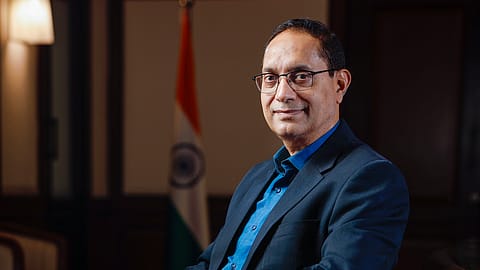
Sebi Chairman Tuhin Kanta Pandey | Credits: Nishikant Gamre
Sebi's Tuhin Kanta Pandey: The Pragmatic Reformer
Tuhin Kanta Pandey, the 11th chairman of Sebi, has revitalized the institution with a focus on investor protection and market development. His pragmatic approach, emphasizing trust, transparency, teamwork, and technology, has restored credibility and accelerated reforms, particularly in fraud prevention and regulatory consultation, making Sebi more inclusive and effective.
This summary is AI-generated, and Fortune India is not responsible for its content or any associated copyright issues.
The hallmark of Sebi chairman’s one year in office has been rebuilding institutional integrity and investor empowerment
Sebi Chairman Tuhin Kanta Pandey | Credits: Nishikant Gamre
Regulators have a tough job when at the helm: damned if they do, damned if they don’t. Yet, the reality is that regulators must wear the crown of thorns, especially so for those on whose shoulders rest the biggest responsibility of investor protection and market development. It’s no different at the Securities and Exchange Board of India (Sebi) whose preamble states: “...to protect the interests of investors in securities and to promote the development of, and to regulate the securities market and for matters connected therewith or incidental thereto.”
Against this backdrop, the 11th chairman of Sebi, Tuhin Kanta Pandey, has done a phenomenally outstanding job in his one year at office, after having taken charge in March 2025.
However, Pandey took on the role amid a turbulent phase. His predecessor, Madhabi Puri Buch, broke new ground as the first Sebi chief to be a woman, and also the first individual from the private sector to helm a regulatory position. Though her tenure was bold and reform-oriented, it was not without controversy over conflict of interest and, unusually, marked by public protests from the regulator’s own staff. It was an extraordinary moment in Sebi’s institutional history.
Just when it seemed institutional credibility was low, stepped in Pandey, a seasoned bureaucrat and a veteran of the finance ministry. An IAS officer, he held critical roles, including as the secretary in the Department of Investment and Public Asset Management, overseeing the important divestiture of Air India and the Life Insurance Corporation of India. One year on, the picture that emerges is not merely of an institution that has not just found its credibility but also added velocity to its reform agenda.
“The last year had been a challenging one and it was the year of reforms. As I mentioned in the beginning that we will work with 4Ts, that is, trust, transparency, teamwork and technology,” Pandey tells Fortune India.
Tech As Investor Shield
Investor protection, Pandey insists, has been central to his reform cycle.
“There have been many reforms carried out. However, I would like to highlight investor protection measures such as Sebi Check and UPI validation, in light of many investors falling prey to scams. Any investor can check within 30 seconds through Sebi Check whether he is dealing with a Sebi-registered entity. Also, the UPI ID of authorised entities will have ‘valid’ as part of their UPI ID,” says Pandey.
The twin initiatives aim squarely at fraud prevention. Investors can access these services free of cost through Sebi’s “Saa₹thi” app before transferring their hard-earned money.
Alongside this, the joint “SEBI vs SCAM” awareness campaign tackles impersonation, deepfakes and illegal trading apps, while digital platforms have been mandated to comply with disability access norms, reinforcing inclusion.
The approach reflects one of the Sebi chief’s 4Ts, technology, being deployed not merely for efficiency, but as a shield for retail investors.
{{#most-powerful-women-snapshot-individual.slug}} {{/most-powerful-women-snapshot-individual.slug}} {{^most-powerful-women-snapshot-individual.slug}} {{/most-powerful-women-snapshot-individual.slug}} {{#showRanking}} {{current-rank}} {{/showRanking}} {{#photo.0.url}}
{{name}}
Consultation With Purpose
While Pandey believes investor protection was the highlight of his first year at office, industry observers believe the Sebi chairman has brought a very distinct style to his role.
For instance, Nilesh Shah, managing director of Kotak Asset Management, points to continuity with improvement. “Sebi has always had an open-door policy but under Pandey, consultation has acquired deeper meaning. It is no longer merely procedural, but purposeful. Earlier the consultation was more for process than for purpose. Now the consultation is for process as well as purpose. This is very positive. You are not doing something just for the sake of doing it; you are genuinely interested in receiving feedback,” Shah tells Fortune India.
Decisions now weigh not just investor protection, but also market development, scalability and economic context. That concurrency of process and purpose, Shah says, has made regulation more durable and less disruptive. “A regulation that takes into account multiple objectives is always better than a single-purpose one. Under Mr. Pandey, this has really been brought to the fore,” adds Shah.
The change is also internal. Shah recalls that in the recent past, junior and even senior Sebi staff had publicly demonstrated against the chairperson, an extraordinary development. Today, he says, there is a visible sense of comfort and coordination within the institution
Manoj Shenoy, co-founder and CEO, BugleRock Capital, goes further. “It is not just that you are a regulator who comes with a regulation and says ‘do this’. His approach is more consultative and pragmatic — which measures are feasible to implement and good for governance,” Shenoy says, describing a regulator who is in constant touch with industry and government before finalising measures.
On the opinion that the industry has about him, Pandey says with characteristic quiet candour: “I can say that stakeholders have worked on all 4Ts, thereby facilitating ease of doing business and doing investment, enhancing investor protection and empowerment, strengthening the regulatory framework and fostering market development.”
Hard On Influencers
If consultation has defined the tone, enforcement has defined the edge.
One of the most consequential moves of the past year has been Sebi’s decisive action against unregulated finfluencers. Social media had become a parallel advice industry, where “free tips” often translated into costly losses for retail investors.
Under Pandey, Sebi tightened the framework, ensuring that only regulated entities and authorised persons can provide investment advice on social media. Shenoy calls it “a path-breaking thing” that addresses a real and growing retail risk
The message was unmistakable: retail participation may be welcome, but retail vulnerability will not be tolerated.
Similarly, in the high-profile Jane Street case, Sebi’s scrutiny of complex derivative strategies underscored its determination to safeguard market integrity. In parallel, reforms in equity derivatives: from rationalising the order-to-trade ratio framework to tightening oversight of algo trading, showed a regulator unwilling to let sophistication outpace investor protection.
In a market increasingly driven by technology and leverage, the steps have strengthened the guardrails.
Democratising Sophistication
But the first year has not only been about enforcement, but also about access.
A landmark initiative has been the introduction of the Specialised Investment Fund category within the mutual fund ecosystem, a structural shift that opens up differentiated strategies to a broader investor base.
"What was once the preserve of high networth investors and family offices is now being democratised within a regulated structure for retail investors," says Shenoy.
The broader mutual fund overhaul has simplified compliance while strengthening transparency, expense ratio clarity and governance
Shah believes the alignment of speed and direction has improved markedly. Industry may not get everything it asks for, he says, but there is now confidence that views are heard before decisions are taken, not after.
Another underappreciated gain has been regulatory coordination. Having worked closely with the finance ministry and fellow regulators such as the RBI, IRDAI and PFRDA. Shah believes this shared background enables smoother inter-regulatory alignment.
Miles to Go
If there is a structural challenge, Shah hints at it candidly: India’s ecosystem has little tolerance for failure. Innovation, in such an environment, must pass through layers of scrutiny. The regulator is blamed when experiments falter, which makes risk-taking harder
“The regulator has to set its own agenda and then hear feedback from market participants to ensure that agenda is accepted by all. This is where Sebi has done wonderful work. At the end of the day, the industry and the regulator’s objectives are similar. We don't want to take investors for a ride, we want to grow the industry, and we don't want malpractices to flourish. Sebi shares all of those goals,” says Shah.
In an era of expanding retail participation, algorithmic complexity and global capital flows, the regulator’s mandate is broader than ever. But Sebi’s pragmatic reformer has found the right reform mantra: consultative, anchored, and quietly ambitious.
Follow Fortune India
NEXT STORY