Tata tussle now draws in Wall St’s Jamie Dimon, political heavyweight Sharad Pawar
/ 4 min read
JPMorgan chief backs Chandra and warns of investor concerns, while Pawar defends Tata Trusts’ ownership role in the escalating boardroom dispute.
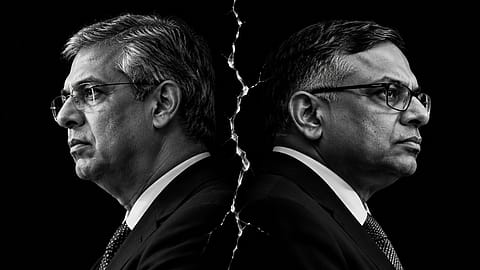
The Tata Sons board voted 4:1 on September 17 to give Chandrasekaran another five-year term as executive chairman, with Tata Trusts chairman Noel Tata voting against the resolution | Credits: Photo Illustration by Saurabh Singh
The escalating Tata Sons boardroom dispute over N Chandrasekaran’s reappointment has now drawn in two influential outside voices — JPMorgan Chase chairman and CEO Jamie Dimon and veteran politician Sharad Pawar — as the fight widens beyond the Tata Group’s leadership to questions over shareholder rights, corporate governance and the future of its trust-based ownership structure.
The Tata Sons board voted 4:1 on September 17 to give Chandrasekaran another five-year term as executive chairman, with Tata Trusts chairman Noel Tata voting against the resolution and Trusts nominee Venu Srinivasan voting in favour. Tata Trusts has challenged the validity of the decision, arguing that the company’s Articles of Association (AoA) require affirmative support from a majority of Trusts-nominated directors.
Dimon backs Chandra, flags governance questions
Dimon offered a broad perspective on the dispute in an interview with The Times of India, cautioning that the interests of a commercial company and those of a charitable trust can sometimes diverge.
“A company should be run properly, and the interests of a charitable trust could be very different from the interests of a company,” Dimon said.
“A company has got to be healthy and vibrant and have proper governance. A structure like that sometimes works against that,” he added.
Dimon was also unequivocal in his assessment of Chandrasekaran’s tenure.
“To be clear, I think the world of Chandra,” he said, adding that the Tata Sons chairman had done “an extraordinary job in creating value for the foundations”.
His comments bring an international investor perspective into a dispute that has so far largely been framed as an internal Tata governance battle.
Pawar backs Tata Trusts’ institutional role
Sharad Pawar, meanwhile, has stressed the historical purpose of Tata Trusts’ ownership of Tata Sons.
In a statement on Tuesday, the NCP (SP) president said the Trusts’ roughly 66% holding in Tata Sons was “deliberate, not incidental”, arguing that the structure was designed to ensure that wealth created by the group ultimately serves society.
“The current leadership issue should be resolved through due process, dialogue and adherence to the Articles of Association,” Pawar said.
{{#most-powerful-women-snapshot-individual.slug}} {{/most-powerful-women-snapshot-individual.slug}} {{^most-powerful-women-snapshot-individual.slug}} {{/most-powerful-women-snapshot-individual.slug}} {{#showRanking}} {{current-rank}} {{/showRanking}} {{#photo.0.url}}
{{name}}
He also said Tata Trusts’ institutional role and rights must be respected, and argued that protecting the Tata Group’s trust-based legacy was essential to preserving its contribution to India’s development.
Pawar’s intervention comes as Tata Trusts opposes Tata Sons’ proposed listing and seeks to preserve its role within the group’s governance structure.
Fight over Chandra is also a fight over the rulebook
At the heart of the dispute is the split between the two Tata Trusts-nominated directors and what that means under Tata Sons’ AoA.
Harish Salve, who has acknowledged advising Tata Sons, has argued in an interview with CNN-News18 that the 1:1 split between Noel Tata and Venu Srinivasan could not be allowed to paralyse the company.
“One director votes for, one director votes against. What do you do, paralyze the company?” Salve said.
He has argued that the AoA provides for a casting vote and that directors nominated by the Trusts owe fiduciary duties to Tata Sons rather than simply acting on shareholder instructions.
“They are not puppets,” Salve said, arguing that the interests of the company must come first.
Abhishek Manu Singhvi, representing the Tata Trusts, has taken the opposite position. In an interview with Hindustan Times, he argued that the fundamental rights of shareholders and owners cannot be nullified.
Singhvi has pointed to the provisions of Tata Sons’ AoA governing the chairman-selection process and the affirmative voting rights of Trust-nominated directors. With two Trust nominees on the board, he argues that both would effectively need to support the decision for the required majority among Trust nominees to be achieved.
The Trusts have separately argued that there was no deadlock at the September 17 meeting and that a chairman’s casting vote cannot override the affirmative-vote requirement in the AoA.
Listing adds another layer to the dispute
The leadership battle is unfolding alongside an equally consequential disagreement over whether Tata Sons should be listed.
The Reserve Bank of India has rejected Tata Sons’ application to surrender its registration as a Core Investment Company, keeping the listing issue alive. The Tata Sons board has moved towards complying with the regulatory framework, while Tata Trusts has opposed listing and asked that alternatives be explored.
Salve has argued that listing could strengthen transparency and governance.
“Tata Sons is not a charitable organisation,” he said in the interview, describing it as a commercial holding company whose dividends ultimately flow to the Trusts.
Asked whether listing itself could become the next major legal battle, Salve was blunt: “It will be. It will be.”
For Singhvi, however, the dispute goes deeper than listing or Chandrasekaran’s tenure. He has described the issue as concerning the Tata Group’s “100-year legacy” and the relationship between Tata Trusts and Tata Sons.
The result is a dispute that now stretches across leadership, shareholder rights, corporate governance and the future structure of one of India’s most distinctive business groups.
Salve has urged both sides to avoid another Cyrus Mistry-style court battle. “The worst settlement will be better than the best victory,” he said, adding: “If this goes into a dirty battle, India loses. If this is honorably resolved and we move ahead, India wins.”
Follow Fortune India
NEXT STORY