The Hartek story: A father, a son, and a ₹1,200-crore surge
/ 10 min read
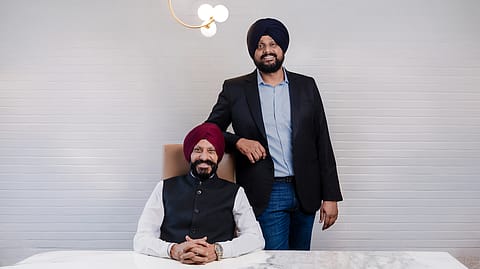
Hartek Singh (sitting), Chairman & MD, Hartek Group; and Simarpreet Singh, ED & CEO, Hartek Group.
The Hartek story: A father, a son, and a ₹1,200-crore surge
A detailed profile of Hartek’s transformation from a low-profile Mohali electrical trader into a ₹1,200-crore power and solar EPC group, driven by a generational clash over identity, a pivotal rebranding from Amtek to Hartek, bold geographic expansion, a bet and pivot in rooftop solar, and a disciplined, profit-first, low-burn approach to growth and capital.
This summary is AI-generated, and Fortune India is not responsible for its content or any associated copyright issues.
For two decades, Amtek ran quietly under the father. In 2012, Simarpreet Singh stepped in—with questions, friction, and bigger ambition. What followed: a name change, a fivefold surge in revenue, and Hartek’s rise to India’s third-largest solar EPC player.
Hartek Singh (sitting), Chairman & MD, Hartek Group; and Simarpreet Singh, ED & CEO, Hartek Group.
He had a problem with the name. Not the business. Not the numbers. But the name.
Every time Simarpreet Singh typed “Amtek Sales” into Google, something else showed up: Amtek Auto, a listed company that had no connection to him. He scrolled, tried variations, and changed keywords.
The result didn’t change. Page after page, the listed company dominated the screen. It was as if Amtek Sales didn’t exist—though it had, since 1991.
At first, it felt like a small miss. But it kept repeating. Every search brought the same absence. And the irritation stayed. Within a year of joining the family business in 2012, it had hardened into a question the second-generation entrepreneur couldn’t shake: what does it take to be seen?
Inside the company, though, that question didn’t exist. The business worked. Orders came in. Projects got delivered. For his father, the logic was simple—do the work, build relationships, and the rest would follow. It had, for two decades.
For the son, the problem sat right there on the screen: invisibility. He tried to fix it. Tweaked the name. Waited. Nothing moved. Eight months later, the results were the same. That’s when the thought settled: Scrap the name.
The first time he said it, his father flinched, then fired. “What are you talking about?” he shot back. “Do you even understand what you’re saying?”
The name came from the family itself—Amrik, his grandfather, and Hartek, his father. Stitched together, it became Amtek. It carried memory, trust, and history. And now his son, barely a year in, wanted to drop it.
What followed was a standoff.
The same argument, over and over, landing at the same place. His father saw risk. The son saw invisibility. The tension moved home. Meals no longer overlapped. Conversations shortened, and then stopped.
At some point, it stopped being about a name. It became about identity. The deadlock broke out of exhaustion. His father asked a simple question: what’s the new name? He didn’t have one.
{{#most-powerful-women-snapshot-individual.slug}} {{/most-powerful-women-snapshot-individual.slug}} {{^most-powerful-women-snapshot-individual.slug}} {{/most-powerful-women-snapshot-individual.slug}} {{#showRanking}} {{current-rank}} {{/showRanking}} {{#photo.0.url}}
{{name}}
For months, he had argued for change. Now he had to find the answer. He went back to the market—client meetings, site visits, conversations. And a pattern emerged. People didn’t remember the company. They remembered his father: Hartek. That was the recall, trust, and identity. It already existed. It just wasn’t on paper.
When the son proposed it, the reaction was immediate. “How can the company be under my name?” his father snapped. “You want me to sell my name?”
This had moved past branding. The fight had turned personal. It dragged on. It didn’t end in one conversation. It stretched and circled as they pushed and pulled. Then came a move that felt less like compromise and more like middle ground. “Test it first. Change one subsidiary. See what happens,” his father said.
And then—proof. It worked. Recognition improved, conversations opened differently, and the company began to carry a face. Within months, the shift was complete. In 2014, Amtek went, and Hartek stayed.
Built slowly. Then shifted deliberately
Years later, Simarpreet would call it his best decision. At the time, it felt like a risk that could have gone either way.
Today, Hartek is a ₹1,200-crore group.
Its flagship, Hartek Power, is on track to cross ₹1,000 crore. Over the past few years, the business has grown fivefold. Profit has scaled faster. In a fragmented, fiercely competitive sector, it has quietly moved into the top tier—now India’s third-largest solar EPC (engineering, procurement, and construction) player.
Though it looks like momentum, it was built through a series of decisions layered over time. For most of its life, this was a little-known company out of Mohali—low recall, no outsized bets and no visibility. Its biggest strength was execution—ruthless and consistent. Project after project, client after client, it grew under the father’s watch over two decades.
That’s why the shift is harder to explain. The company didn’t stumble into scale, lean on large capital, or chase visibility. It changed shape.
The name change was the first visible signal—not for what it altered overnight, but for what it declared. The company no longer wanted to stay behind the work. It wanted to be seen with it. Once identity moved, direction followed. Over the next decade, it did.
But it began with something simpler: a foundation.
There was no blueprint.
In 1991, when Simarpreet’s father started out trading electrical equipment, he didn’t have a grand thesis about energy, nor a sweeping ambition to build a large enterprise. He built a business the only way he knew—deliver the project, get paid, and earn trust. In an industry where credibility compounds over time, he chose the longer route. There were no shortcuts. Over two decades, that approach built something sturdy. Clients returned, work came through referrals, and execution became identity.
Quietly, the business grew.
By the time the son joined in 2012, the business was about ₹20 crore in size. It was stable, contained, and there was no urgency or pressure to reinvent. Why? Because the business was working. That’s precisely why what came next was harder. Disruption from outside is easier to process. From within, it isn’t.
On Simarpreet’s first day in the family business, there were no long inductions or detailed strategy sessions. Just three instructions.
His father walked him to his cabin, picked up a red marker, and turned to the whiteboard. He wrote a single word: Zero. “This is your zero,” he said. The business at the time was roughly ₹20 crore. “Now it’s up to you to add zeros to it. Just make sure you don’t make the overall value zero.” It was part instruction, part warning.
Then came the second—more a ‘do and don’t’: Don’t do what I do. It was followed by a third, more open-ended commandment: Find one thing. Just one. Something that creates impact and gives you an identity.
That was it. There was no roadmap or five-year plan. Just a boundary—and within that boundary, complete freedom. It sounds simple, in hindsight. At the time, it wasn’t. Why? Finding ‘one thing’ is harder than it sounds. It forces choice. And choice, in a running business, comes with consequences.
The son, the search, and the first real test
For the next few years, the son kept searching for that ‘one thing’. Where could he create impact? What wasn’t being done? Where was the gap?
The name change was the first answer. But a name, by itself, doesn’t build scale. It only resets direction. The real test lay elsewhere.
And the real test was finding that ‘one thing’ in a system that was not broken. That made his role harder.
There was nothing obviously wrong to fix. There was no crisis to respond to. And there was no immediate gap demanding intervention. This meant one thing. If he wanted to create impact, he would have to question things that were already working.
And that is rarely comfortable. So, he started with observation. He sat in sales, met clients, travelled with teams, and listened more than he spoke. And then he noticed something: limitation.
The business was strong but geographically narrow. It wasn’t underperforming but it was under-ambitious. That distinction changed how he thought about growth. If the business had to expand, the son needed to step out.
The opportunity came through a client—first in Rajasthan, then a larger one in Andhra Pradesh.
This wasn’t incremental. It meant stepping out of familiar ground—a company from North India entering a new market with a different language, different vendors, and a different way of working. There was no cushion. “The stakes were huge,” Simarpreet recalls. “If we failed, we wouldn’t get another opportunity.”
He moved.
For nearly a year, he worked out of Andhra Pradesh, staying close to the project as it unfolded. The adjustment wasn’t smooth. Language slowed communication, local dynamics changed how work got done, and vendor ecosystems behaved differently. Even routine decisions took longer than expected.
The pressure didn’t ease. This wasn’t just another project—it was a test of whether the company could operate beyond its home turf. There were no shortcuts available. The only way through was the one the business already knew—show up, solve, deliver.
Over time, the shift became visible.
Inside the organisation, the label changed. “I was not the promoter’s son anymore,” Simarpreet says. “I was somebody who had hustled, rolled up his sleeves, and delivered.”
Respect, earned like that, tends to travel on its own.
The Andhra stint did more than prove a point. It expanded the company’s imagination. If this could work here, it could work elsewhere. The business was no longer geographically bound.
By the mid-2010s, the contours of the power sector were beginning to change.
Solar was no longer peripheral. Policy signals were getting stronger. Targets were getting sharper. And within that, rooftop solar began to emerge as an early, visible opportunity.
For many, it looked like the future. For Simarpreet, it looked like his ‘one thing.’
It checked the boxes. It was different from what the company had traditionally done. It was early enough to enter before the market got crowded. And it carried the promise of scale—distributed demand, growing awareness, and regulatory push.
The bet, the break, and the pivot
In 2016, the company made a move.
Hartek Solar was set up with a clear focus: rooftop installations. The pitch was simple—plug-and-play solar kits that could work across homes, housing societies, small businesses, and institutions.
The timing helped. Cities like Chandigarh began mandating rooftop solar for certain categories of buildings. Policy nudged adoption, awareness followed, and demand picked up.
For a while, it felt like they had caught the wave early. Installations grew. The company built a strong presence in North India. Hartek Solar began to be seen as one of the leading rooftop players in the region.
Momentum builds quietly. And then it breaks.
Covid disrupted everything.
Projects slowed. Execution became difficult. Supply chains were uneven. And then, gradually, the economics of residential solar began to weaken. Subsidies faded and viability questions emerged. What had looked like a large, expanding market started to lose shape.
The result? Hartek stepped out from residential solar.
The focus shifted to commercial and industrial customers—where demand was steadier, and the economics clearer.
The pivot was quick. Within two years, they were among the top players in Punjab.
There was no attempt to romanticise the earlier bet. “If you define failure as not winning a project, I’ve failed many times,” says Simarpreet. “But I don’t get into regret. Wins don’t make me, and losses don’t define me.”
The philosophy is straightforward. You move or you get stuck.
The numbers, when they started moving, did so sharply. Revenue climbed from ₹214 crore in FY23 to an estimated ₹1,000 crore-plus in FY26. Profit, once modest, scaled disproportionately—crossing ₹50 crore.
The jump looks sharp on paper. But it came together over time. Each move sits on the previous one—the name, the expansion into Andhra, the solar entry, the exit from residential. Taken individually, none of them look outsized. Together, they change direction.
Scale, though, doesn’t explain everything. To understand the way the business has grown, you have to look at how it thinks.
Inside Hartek, the operating logic is straightforward. “Selling price minus cost price is profit. That’s it,” says Simarpreet.
There’s no attempt to dress it up. And in this business, there isn’t much room to. Margins are tight. Execution leaves little margin for error. Cash cycles stretch. You don’t get to lose money and recover later. “I don’t want to be in a business where I burn money,” he says.
That view extends to capital as well. Hartek didn’t raise venture capital or private equity—not because it wasn’t available, but because it wasn’t necessary. “I don’t want capital. I want smart capital,” he adds.
For Simarpreet, the distinction is practical. Money is accessible, especially through debt. What matters is what comes with it—capability, speed, engineering depth. Without that, capital is just capital. And banks can provide it.
That’s why he is equally clear about debt. “Debt is not bad,” he says. “If you don’t know how to use it, it will hurt you. If you use it well, it builds companies.” He treats it as a tool—useful when understood, risky when it isn’t. And yet, behind that clarity lies something less transactional. A foundation he didn’t build but inherited.
Built on trust. Tested by scale
For all his clarity on financial debt, there’s another kind Simarpreet doesn’t ignore. The one he owes his father. He didn’t inherit a blank slate. He inherited a business built over two decades—steady, disciplined, trusted. But more than that, he inherited something rarer: Space.
He got the freedom to question what already worked. He had the licence to push against decisions that had held for years. He had the liberty to argue, insist, and still be allowed to try.
His father didn’t impose a playbook. He set the guardrails and stepped back. “Find your one thing,” he had said. Everything that followed came from that space. While the discipline of the first two decades stayed, the direction changed. And somewhere between the two, the company found its next version.
That version would now be tested in a very different environment.
Scale, in this business, doesn’t arrive clean. Though the opportunity is large and India’s push towards renewable capacity has expanded the pipeline for EPC players, the strain shows up in working capital stretches.
Projects don’t pay immediately. Payments depend on government bodies and large counterparties, often with extended credit cycles. Cash gets locked in receivables and retention money tied to ongoing projects. Inventory builds up to keep execution moving.
By the end of a financial year, the pile-up is visible.
A recent report by Crisil points to this clearly. Working capital cycles in the EPC business can stretch well beyond four months, driven largely by receivables and retention money. Most of it does come in—but not always when you need it. This means one thing: You keep building, even when the cash hasn’t caught up.
The pressure doesn’t come from working capital alone.
The EPC space remains fragmented, with low entry barriers and multiple players chasing the same projects. Pricing power stays limited. Margins don’t expand easily. At the top end, larger players compete aggressively. At the other end, smaller firms undercut to win orders. In between, companies like Hartek have to hold their ground.
Then there’s the dependency on the sector itself.
The business is tied to the sector. Power systems and renewables dominate, and growth follows policy. Incentives, approvals and regulatory shifts shape demand—when policy moves, the business feels it.
Much of this strain doesn’t show up neatly in financial statements.
It plays out on the ground—land availability, right-of-way (RoW) disputes, clearances that can stretch for months, sometimes years. Even equipment can become a bottleneck, arriving later than it should. “The biggest challenge is land,” says Singh. “If land is not available, the project stops.”
He runs through the rest without emphasis—RoW issues, supply chain gaps in high-voltage equipment, and the need for stronger domestic manufacturing. None of it is new, though. All of it persists. That’s why execution continues to separate players.
Even so, the direction ahead is taking shape.
At some point, the company will take its next step—an IPO or external capital. There is no urgency in how he frames it. “We are at an inflection point,” says Simarpreet. “Over the next two years, we will take one of the routes.” But the timeline sits inside a longer horizon. “We are building this company for the next 100 years.”
What comes next takes the story further.
The ambition is clear: take Hartek into the Fortune 500, build scale that travels, and make the company visible in ways it once resisted.
But the deeper shift is personal. Simarpreet has a wish list. A simple one. Someday, when someone types his name into Google, “Simarpreet Singh” shouldn’t be enough. What should appear is something else: Simarpreet Singh Hartek. “I want to add ‘Hartek’ to my name. That would be my legacy,” he says, with a quiet smile.
Follow Fortune India
NEXT STORY