The FAQs are AI-generated, and Fortune India is not responsible for its content or any associated copyright issues.
Three years on, NMACC is emerging as a cultural engine
/ 4 min read
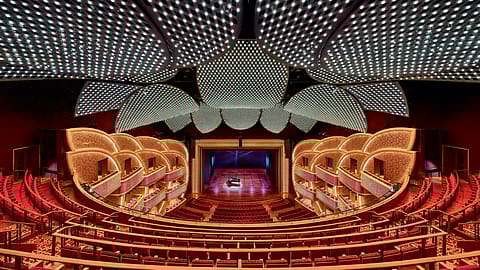
The centre has now hosted more than 3,500 shows, featured upwards of 10,500 artists, and drawn close to 2.5 million visitors. | Credits: The NMACC’s The Grand Theatre.
Three years on, NMACC is emerging as a cultural engine
Three years after its launch, the Nita Mukesh Ambani Cultural Centre has evolved from a glittering spectacle into a steady cultural engine. With over 3,500 shows, 10,500 artists and 2.5 million visitors, it now balances blockbuster global productions and Indian showcases, nurturing accessible, year-round programming that positions Mumbai as a serious player in the global cultural economy.
This summary is AI-generated, and Fortune India is not responsible for its content or any associated copyright issues.
When it opened in March 2023 inside Mumbai’s Bandra-Kurla Complex, the idea was expansive but clear — to create a space that could hold India’s artistic past and its global future in the same breath.
The centre has now hosted more than 3,500 shows, featured upwards of 10,500 artists, and drawn close to 2.5 million visitors. | Credits: The NMACC’s The Grand Theatre.
When I visited the Nita Mukesh Ambani Cultural Centre (NMACC) a year ago, it felt like a spectacle - grandiose, gleaming, almost improbable in a country where cultural infrastructure has historically lagged ambition. Three years on, the space has settled into something more interesting: the haven for cultural immersion.
When it opened in March 2023 inside Mumbai’s Bandra-Kurla Complex, the idea was expansive but clear — to create a space that could hold India’s artistic past and its global future in the same breath. The architecture itself made that argument: a 2,000-seat Grand Theatre built for scale, smaller experimental spaces, and an art house designed to keep conversations going beyond performances.
NMACC wasn’t subtle about its ambition: it wanted to do two things at once; firstly bring global productions to India and give Indian work a stage that could travel.
In year one, that translated into spectacle. Big-ticket shows, high-profile openings, a sense of arrival. The opening production, The Great Indian Musical: Civilisation to Nation, set the tone by being big, layered, unapologetically ambitious.
By year three, the story is more operational.
The centre has now hosted more than 3,500 shows, featured upwards of 10,500 artists, and drawn close to 2.5 million visitors. This is up from 114 active shows in 2024, and 7,000 artists and 2 million visitors in March 2025.
The programming has settled into a rhythm where something is always on: theatre runs, music, dance, exhibitions. It’s less about headline moments now and more about throughput.
Recommended Stories
“Today, Nita Mukesh Ambani Cultural Centre completes three glorious years, and in our culture, the number three is very auspicious... When we started the Nita Mukesh Ambani Cultural Centre, we made a promise to bring the best of India to the world and to get the best of the world to India, and we are trying our best to live up to that promise and shine the spotlight on our Indian artists and artisans on the global stage,” said the NMACC founder, Nita Ambani whose vision has been to make arts accessible to everyone.
From destination to ecosystem
The most visible shift is in programming depth. Early productions leaned heavily on scale - The Great Indian Musical as a flagship, followed by touring Broadway titles like West Side Story. That pipeline has since widened.
Over the past year, global productions have become longer runs rather than one-off arrivals. The Phantom of the Opera, staged in 2025, ran for 32 shows and drew over 55,000 viewers, making it the centre’s most successful international musical so far.
The centre has delivered on its “promise of bringing the best of India and the world” with now marking its tenth international showcase with Andrew Lloyd Webber’s CATS, which has captivated audiences for over four decades.
RANK
COMPANY NAME
REVENUE
(INR CR)
(INR CR)
{{#current-rank}} {{current-rank}} {{/current-rank}} {{^current-rank}} {{rank}} {{/current-rank}} {{name}} {{#revenue}} {{revenue}} {{/revenue}} {{^revenue}} {{noi}} {{/revenue}}
Other celebrated productions over the years like The Nutcracker, The Sound of Music, MAMMA MIA!, Life of Pi, Wicked The Musical and Matilda arriving in Mumbai, and finding audiences, signal a shift that would have felt unlikely even five years ago.
But just as important is the reverse flow. In 2025, NMACC took Indian performances to New York’s Lincoln Center, an outward movement that reframed the institution not just as a venue, but as a cultural exporter.
Away from the resplendence of The Grand Theatre are two smaller spaces — The Cube and The Studio Theatre. The smaller venues were always meant to work differently with the aim to build an audience. At the Studio Theatre, an intimate space with roughly 200–250 seats, and the even more compact Cube, which accommodates around 100–125 people, the idea was to create access.
In the early days, tickets here were kept deliberately low, often in the ₹250–₹500 range. But even now, you can still walk in for a stand-up set, a classical recital, or an indie gig at ₹450 or ₹750.
Alongside, there’s been a steady layering of Indian programming - classical performances, regional language theatre, fashion exhibitions, and craft-led exhibitions. The centre hasn’t abandoned scale, but it has started balancing it with volume and variety.
What it means beyond Mumbai
The larger question, though, is what NMACC represents in India’s cultural economy.
For decades, Indian artists have worked around the absence of world-class infrastructure. Touring globally was often the only way to access certain kinds of stages, funding, and audiences. What this centre has done is collapse some of that distance.
It is maybe most aptly described by director and playwright Feroz Abbas Khan. “The NMACC is a response to an urgent need for an urban cultural centre that promotes excellence, and is inclusive and democratic in its disposition,” he said.
The centre has created a space where international productions can arrive without compromise, and where Indian productions can be mounted at a scale that travels.
That matters for soft power on a global dais.