US solar import tariffs to rewrite India’s export playbook
/ 4 min read
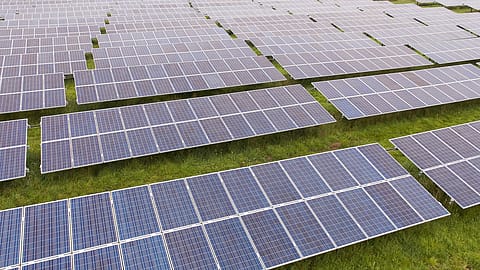
India exported cells and modules worth about ₹34,000 crore to the US between April 2023 and November 2025, supported by the lower cost of Indian modules compared to those made in the US — even when both relied on imported cells. | Credits: Getty Images
US solar import tariffs to rewrite India’s export playbook
The US has imposed a preliminary countervailing duty of 126% on solar imports from India, prompting Indian exporters to reassess their strategies. With nearly 97% of their solar exports going to the US, companies are exploring new markets and focusing on domestic growth to mitigate the impact of these tariffs, which could increase further with potential anti-dumping duties.
This summary is AI-generated, and Fortune India is not responsible for its content or any associated copyright issues.
Companies are evaluating overseas manufacturing bases, diversifying into new geographies, and sharpening focus on India’s fast-growing domestic market to protect volumes and margins.
India exported cells and modules worth about ₹34,000 crore to the US between April 2023 and November 2025, supported by the lower cost of Indian modules compared to those made in the US — even when both relied on imported cells. | Credits: Getty Images
As the US intensifies efforts to curb imports and build a self-sufficient domestic solar manufacturing ecosystem, Indian exporters — who send nearly 97% of their total solar exports to the US — are recalibrating their strategy. Companies are evaluating overseas manufacturing bases, diversifying into new geographies, and sharpening focus on India’s fast-growing domestic market to protect volumes and margins.
On February 24, the United States Department of Commerce (DoC) announced a preliminary countervailing duty (CVD) of 126% on solar imports from India. It also set initial CVDs ranging from 86% to 143% on imports from Indonesia and 81% on shipments from Laos. The preliminary CVD may be followed by a possible anti-dumping duty ruling next month, which could raise total tariffs further. A final combined duty decision is expected around July this year.
However, the applicability of the 126% duty hinges on the country of origin of the solar cells used in modules supplied to the US. As of now, the tariff applies only if the solar modules exported to the US contain solar cells manufactured in India, which limits the immediate impact for some manufacturers using diversified cell sourcing.
Limited near-term hit for large players
India’s leading exporters such as Waaree Energies (WEL), Premier Energies (PEL), Vikram Solar, and Adani Solar are expected to face a short-term issue but a contained impact under the current preliminary norms, say analysts.
“The preliminary countervailing duties announced by the United States Commerce Department on solar cells and modules imports from India will have a negative impact on export-focused manufacturers,” says Sehul Bhatt, Director at Crisil Intelligence.
India exported cells and modules worth about ₹34,000 crore to the US between April 2023 and November 2025, supported by the lower cost of Indian modules compared to those made in the US — even when both relied on imported cells. That price advantage may now narrow significantly. Bhatt adds that the duties could create volatile trade patterns until final determinations are made, forcing companies to navigate limited market windows amid fresh capacity additions.
Analysts at Motilal Oswal Financial Services note that Waaree Energies, which derives roughly one-third of its revenue from the US, does not use India-made cells for its US supplies. Therefore, the preliminary 126% CVD is unlikely to materially affect its earnings. Similarly, Premier Energies has limited export exposure, with overseas markets contributing only around 1% of revenue.
“The recent U.S. preliminary AD/CVD duties apply specifically to Indian-origin cells. Our U.S. order strategy was not structured around sourcing Indian cells, and we already operate with a diversified supply chain for that market,” says Gyanesh Chaudhary, CMD of Vikram Solar. “As a result, the direct financial impact on us is limited, and our growth strategy continues to be firmly anchored in India.”
Experts add that exporters should accelerate de-risking efforts by expanding into Africa, the EU and the Middle East to reduce dependence on a single market.
Domestic opportunity expands
India’s solar manufacturing ecosystem continues to scale. Operational module manufacturing capacity stands at around 144 GW and is projected to rise to 180 GW by FY30. However, solar cell capacity is just about 23–27 GW, even as annual installations touch 45–50 GW. Module supply already exceeds domestic demand by roughly 10–15 GW, underlining the need for stronger backward integration into wafers, ingots and polysilicon.
Motilal Oswal analysts point out that India’s cell manufacturing capacity under ALMM-II is still in ramp-up mode and largely oriented toward meeting domestic demand. “The current trajectory suggests limited surplus availability to meaningfully support exports, at least until FY28,” they note.
{{#most-powerful-women-snapshot-individual.slug}} {{/most-powerful-women-snapshot-individual.slug}} {{^most-powerful-women-snapshot-individual.slug}} {{/most-powerful-women-snapshot-individual.slug}} {{#showRanking}} {{current-rank}} {{/showRanking}} {{#photo.0.url}}
{{name}}
Chaudhary adds that with the Cabinet’s decision to ease evacuation infrastructure bottlenecks, installation momentum will accelerate further. He also highlights rising structural demand from AI-driven data centres and industrial expansion, positioning clean energy as a backbone of economic growth. Vikram Solar recently secured a 378.75 MW module order from Indian Oil–NTPC Green Energy for a large-scale project in Gujarat, he notes.
A changing US landscape
In FY24, Indian manufacturers shipped roughly $2 billion worth of PV modules overseas, with nearly 97% heading to the US. Export value surged more than twentyfold between FY22 and FY24. In the first nine months of 2025 alone, India exported an estimated 10.4 GW of modules to the US, capturing about 11% market share — up from under 3% in 2022.
Yet the US market itself is transforming. As of February, it has around 65 GW of module manufacturing capacity, with another 30 GW under construction — theoretically enough to meet near-term demand. In 2024, the US installed nearly 50 GW of solar capacity, a record, with solar accounting for more than half of new electricity additions. According to the Solar Energy Industries Association, total US solar capacity exceeds 266 GW, and nearly 250 GW of additional installations are forecast between 2025 and 2030.
This revival has been catalysed by the Inflation Reduction Act, which incentivises domestic clean-energy manufacturing across the value chain — from polysilicon to finished modules. After years of trade friction with Chinese suppliers, the US strategy has shifted decisively toward building indigenous industrial capacity rather than relying on imports routed through third countries.
For Indian exporters, the levies signal a structural shift. While the near-term financial impact may be manageable for diversified players, the broader message is clear: tariff-led arbitrage will not be a sustainable export model. The next phase for India’s solar industry will hinge on deeper upstream integration, geographic diversification, and stronger alignment with domestic demand — even as the US market transitions from import dependence to industrial self-reliance.
NEXT STORY