The FAQs are AI-generated, and Fortune India is not responsible for its content or any associated copyright issues.
‘We are not trying to build another GPT’: Kishore Lulla on why Eros is betting big on sovereign AI
/ 4 min read
As Eros returns to profitability in FY25, founder & chairman Kishore Lulla outlines the company’s sovereign AI play across cultural intelligence, creator monetisation, healthcare and education.
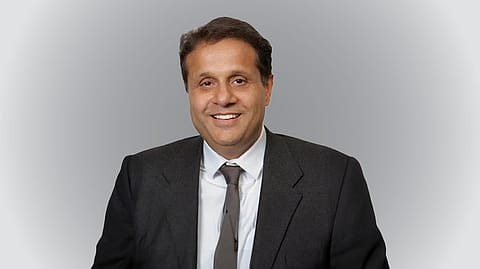
Kishore Lulla
Eros Innovation is seeking to redefine itself beyond its legacy entertainment business and position itself at the intersection of artificial intelligence, culture and public infrastructure.
The transition comes as the company pursues recovery while accelerating its push into AI-led businesses. Backed by approximately $150 million in fresh capital and strategic transactions, Eros Innovation is positioning itself as a $2 billion AI-media platform.
The company recorded $42 million in revenue and $34 million in EBITDA for December 2025 and is targeting more than $100 million in revenue by December 2026, with an EBITDA margin of 70%.
Its expansion is supported by over $1 billion in assets, a zero external debt balance sheet, and positive free cash flow, alongside investments in AI infrastructure, content IP and immersive entertainment.
The AI strategy has already moved into execution. Earlier this year, Eros Innovation unveiled its Cultural AI Platform at the IndiaAI Impact Summit 2026, introducing what it describes as a new category of “Cultural AI” across 34 languages, built on rights-cleared datasets spanning more than 11,000 films and 100,000 characters.
Against this backdrop, chairman and founder Kishore Lulla says Eros Innovation’s next phase of growth will come from sovereign AI—an ecosystem built around rights-cleared cultural models, preventive healthcare, AI-led education and creator monetisation.
In an exclusive interview with Fortune India, Lulla spoke about how the company plans to monetise AI, why culture may become the next competitive layer in artificial intelligence, and whether sovereign AI can emerge as India’s next export opportunity. Edited excerpts:
How does Eros Innovation plan to monetise its sovereign AI model beyond entertainment and content creation?
The way we look at artificial intelligence is through specialisation. Just as people choose different professions, AI too will evolve into specialised categories, and our focus is on cultural intelligence.
The first monetisation layer is the creator economy. We see an opportunity to combine AI tools with intellectual property so that creators can not only produce content but also monetise it inside the same ecosystem. A user should be able to become a singer, filmmaker, performer or creator and earn through that participation.
The second layer is healthcare. We have already deployed preventive healthcare AI through initiatives such as the primary healthcare centre model in Gandhinagar. The objective is to reduce operational costs for governments, improve doctor productivity and increase access to care. There will be a basic offering available broadly, while premium services will drive monetisation.
The third vertical is education through AI Vidya. Traditional creative education models still teach filmmaking and production in conventional ways, but AI will fundamentally alter how creative industries function. Through partnerships with universities, we are introducing AI-enabled programmes that combine academic learning with practical industry participation.
{{#most-powerful-women-snapshot-individual.slug}} {{/most-powerful-women-snapshot-individual.slug}} {{^most-powerful-women-snapshot-individual.slug}} {{/most-powerful-women-snapshot-individual.slug}} {{#showRanking}} {{current-rank}} {{/showRanking}} {{#photo.0.url}}
{{name}}
Across all of these businesses, the commercial framework remains a combination of B2C, B2B and B2G models.
What competitive advantage does rights-cleared cultural data give Eros compared to global AI companies facing copyright litigation?
That is the central idea behind our business model.
Most AI systems globally have been built using large volumes of publicly available internet data. Our view was that long-term value would come from building on authenticated and rights-cleared datasets rather than relying on scraped information.
We have developed cultural models trained on approximately 1.5 trillion tokens of curated content. The purpose is not simply language translation but cultural interpretation.
A phrase or dialogue can carry entirely different meanings depending on social context, geography and emotion. Language models may interpret words correctly but still miss intent. Cultural models are designed to preserve that meaning.
For a country like India, where language and context shift dramatically across regions, we see that becoming an important differentiator.
How scalable is Eros Large Cultural Model (LCM) across India’s multiple languages, regional cultures and storytelling traditions?
India itself offers enormous scale because culture here operates across hundreds of contexts and traditions.
But our ambition extends beyond films and entertainment.
We are building applications across education, healthcare, spirituality and immersive cultural experiences. The larger opportunity is not simply translating content into multiple languages but enabling AI to understand cultural behaviour.
This approach can travel internationally as well. That is why we are developing similar cultural frameworks in markets such as the UK and UAE, where local context and identity matter just as much.
What role is the Indian government expected to play in supporting sovereign AI infrastructure and adoption?
Government participation becomes increasingly important as AI moves from consumer tools into public infrastructure.
India’s diversity creates a strong case for sovereign AI because local language and cultural understanding matter deeply in healthcare, education and citizen services.
Support for indigenous AI development and regional applications can help accelerate adoption and make these systems more relevant to local users.
How does Eros Innovation plan to compete with heavily funded AI giants from the US and China in terms of compute, talent and distribution?
We are not trying to compete with trillion-dollar balance sheets. That is not our objective. We are not building another GPT or attempting to replicate large foundational models.
Our strategy is to become an intelligence layer that sits on top of broader AI infrastructure and adds cultural understanding. In fact, the more successful the foundational AI companies become, the larger the opportunity becomes for contextual and specialised AI businesses.
The focus for us is sustainability and creating a differentiated ecosystem rather than chasing scale.
Can sovereign AI become a commercially viable export opportunity for India, similar to IT services and software?
I believe it can. Countries increasingly want greater control over their data, more transparency around how information is used and stronger ownership of cultural assets. That creates opportunities for sovereign AI infrastructure and cultural exchange models.
Just as India became a global software and IT services powerhouse, there is potential for the country to build leadership in exporting culturally contextual intelligence systems.
The next phase of technology exports may be defined not only by compute and infrastructure but by trust, ownership and local relevance.
What are Eros Innovation’s long-term plans for expanding its sovereign AI ecosystem across sectors such as education, gaming, advertising and enterprise applications?
Execution has already started. Healthcare deployments are underway. Creator economy products are being launched. Education partnerships are active and cultural applications are expanding.
The next stage is international expansion and extending the same framework across additional sectors and geographies.
The larger ambition is to create an integrated ecosystem where AI becomes embedded across content, education, public services and digital experiences rather than existing as a standalone technology layer.
Frequently Asked Questions
NEXT STORY