We need more women making the decisions as capital allocators: Mary Ellen Iskenderian, Women’s World Banking
/ 7 min read
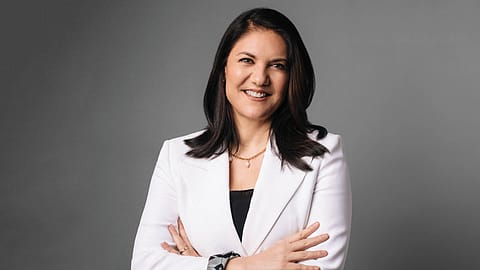
Mary Ellen Iskenderian, President & CEO, Women’s World Banking
We need more women making the decisions as capital allocators: Mary Ellen Iskenderian, Women’s World Banking
Mary Ellen Iskenderian emphasizes the need for more women in decision-making roles as capital allocators to enhance financial inclusion. Despite progress in account ownership, women face challenges in accessing funds during emergencies. Women's World Banking advocates for comprehensive financial education and product access to empower women globally, highlighting the economic opportunity for financial institutions to support women-led businesses.
This summary is AI-generated, and Fortune India is not responsible for its content or any associated copyright issues.
There is a 60% higher chance of a woman being a client of a bank for five years after she first joins. She will have savings and will enroll other family members too. So, from the point of view of a business case alone, she makes so much sense for any financial institution.
Mary Ellen Iskenderian, President & CEO, Women’s World Banking
Financial inclusion of women is undoubtedly seeing an upward trajectory across the globe. More and more women are having bank accounts and are also setting up micro enterprises. In India, women's financial inclusion reached record levels last year, with over 55% of PMJDY accounts being held by women and 68% of MUDRA loans going to female entrepreneurs.
A recent report by Women’s World Banking says 79% of adults have access to an account at a bank or a similar financial institution. The 2025 Global Findex attributes much of this progress to increased access to mobile technology, including mobile phone ownership and internet use, with 86% of adults globally now owning a mobile phone.
But opening a bank account or owning a mobile phone doesn’t necessarily mean that financial inclusion, especially of women at the last mile, has actually been achieved, says Mary Ellen Iskenderian, President & CEO, Women’s World Banking. She cites the example of Kenya, which, despite being the birthplace of digital financial services, reported high levels of inclusion but lower levels of financial health.
“People were feeling that in case of an emergency health expense or any emergency purchase, getting access to funds would be difficult. They felt financially vulnerable, despite the fact that they were technically included in the formal system.”
In India, though the Pradhan Mantri Jan Dhan Yojana made huge inroads into inclusion, it had high dormancy rates.
“Within three years of the product coming online, 55% of accounts held by women were not being used. We were brought on board to help increase usage by women and men.”
During a recent visit to Mumbai, Iskenderian, in an interview with Fortune India, talked about how financial inclusion of women needs to be looked at through a different lens. While getting women to open bank accounts and use various digital banking modes is indeed a good thing, it is equally important to educate them about how they can use various financial products to their advantage.
Can you tell us how Women’s World Banking has been trying to move the needle on financial inclusion across the globe?
We will be celebrating our 47th anniversary this year. Our mission has always been to ensure that all women have access to the full range of financial products and services. The “full range” piece is becoming more important today.
It became clear to me that this was the way we were going to reach the last mile and get more financial service providers to offer services at a lower price point. We are now working with a broad range of financial service providers — fintech companies, insurance firms, and mobile network operators.
Financial inclusion had a silver lining coming out of the COVID-19 pandemic because we saw a dramatic increase in digital accounts. I tell the story of India all over the world — the first COVID relief funds from the Indian government were transferred only to women and only through digital accounts.
You had 25 million bank accounts opened in a matter of weeks. That was remarkable — how the crisis helped move things forward. Today, on the traditional measure of financial inclusion — having a bank account or digital account in one’s own name — we have seen the number of excluded people fall dramatically.
{{#most-powerful-women-snapshot-individual.slug}} {{/most-powerful-women-snapshot-individual.slug}} {{^most-powerful-women-snapshot-individual.slug}} {{/most-powerful-women-snapshot-individual.slug}} {{#showRanking}} {{current-rank}} {{/showRanking}} {{#photo.0.url}}
{{name}}
We also realised that just having an account is not enough. How are you using that account? Are you comfortable navigating your phone to take advantage of the products and services available to you?
Our work was initially savings-oriented, and we quickly saw that savings combined with access to an emergency line of credit on a regular basis was a very powerful tool.
For instance, when Jan Dhan reported a high rate of dormancy, we were brought on board to help increase usage. A combination of savings and access to an emergency line of credit made tremendous strides in improving account usage. We also saw significant cross-selling into insurance and other products once customers were engaged with the bank.
How are you making this narrative of access to multiple financial products effective for grassroots women? Also, how did you convince financial service providers to join this bandwagon?
There is $1.7 trillion in entrepreneurial credit demand that could be immediately utilised by women-led businesses across the globe, but this financing isn’t available.
Women are perceived to be higher credit risks by financial service providers. When programmes are introduced, banks or microfinance institutions often provide smaller loan amounts to women-led enterprises than to male-led businesses of comparable size.
However, women are more efficient in repayments. Once they become a client of a financial institution, they tend to stay. There is a 60% higher chance of a woman remaining a client of a bank for five years after she first joins. She will build savings and enroll other family members too.
So, from a pure business case perspective, she makes tremendous sense for any financial institution. We helped them understand this economic opportunity.
Unfortunately, financial service providers are still slow to recognise this opportunity. They often prefer lending to men or higher-income customers. However, digital platforms are making it more affordable for institutions to serve this segment.
We are focusing a lot on building resilience — ensuring people have access to financial tools in terms of literacy, products, and services so that they can bounce back and prepare for emergencies.
Climate change is becoming a risk multiplier for many other risks. So, when designing products and services, we are no longer thinking in terms of meeting a single need. We encourage solutions that take climate, health, and resilience into consideration.
Educating women is crucial. I have met women who told me, “My husband didn’t die this year, so can I have my insurance premium back?” They didn’t understand how the product worked.
But once you explain it, they understand that paying a small insurance premium every month is far better than going into debt, especially with moneylenders, when emergencies arise.
Can you give examples of financial inclusion programmes where you bundled multiple services?
The World Bank designed a livestock insurance product for nomadic herders in Africa, about 56% of whom were women. There was huge uptake in the first year, but demand collapsed in the second year.
When we spoke to the women, they explained: “Yes, livestock is my livelihood, so I was happy to insure it. But I had to sell my goat to get my sick child to the clinic.”
What they needed alongside livestock insurance was health insurance for their families. So we bundled the two.
Another issue was that transporting livestock to the nearest town clinic was extremely expensive, so we ensured that transportation costs were also covered under the product.
In Cambodia, we designed a product for women factory workers who would spend over an hour in banks collecting their cash pay packets. They would deposit some of the money and send the rest to their families.
When the system shifted to digital payments, we invested heavily in financial literacy. Within a short period, there were dramatic improvements. Women began transferring money digitally, had greater confidence that it would reach their families, and their savings rates increased.
Interestingly, many women reported that the number one reason for saving was to start their own businesses. Men often get funding from friends and family, but women typically have to save first before launching a business.
Are there softer elements that also need to be considered?
Women’s businesses need financial support, but they also need non-financial support. They must learn how to prepare budgets, manage accounts, and run a business.
A business truly begins to take shape when a woman separates business finances from household finances and begins drawing a salary. Business development is just as essential as access to credit.
In India, we created a network of BC (Business Correspondent) Sakhis, who proved extremely effective in increasing usage of Jan Dhan accounts. These women were members of the local community and were seen as peers.
They achieved higher sign-up rates, better conversion into active accounts, higher balances, stronger repayment rates, and more cross-selling of products. Interestingly, even male clients trusted the BC Sakhis.
We realised that BC Sakhis themselves were becoming entrepreneurs and needed support in managing their own businesses.
One part of the BC Sakhi story that I loved is that the RBI initially set a target of 10% women in the financial sector workforce by 2030. After seeing the success of this programme, the target was raised to 30% by 2030.
You mentioned that women-led grassroots businesses struggle to access credit. The same seems true for women-led startups.
I agree. Apparently 2025 was a record year in absolute dollar terms for venture capital going to women-led startups, but it still accounted for less than 3% of global VC funding.
Data shows that if even one woman sits on an investment committee, the chances of a woman founder receiving funding rise exponentially.
Many women-led startups also focus on women-specific products, such as femtech (period health, menopause products). Male investors often say they cannot fully understand these markets.
Having women on investment committees is therefore critical.
One of the most depressing pieces of research I have read shows that women entrepreneurs who receive the majority of their first-round funding from women raise significantly less capital over the lifetime of their companies, because their success is often attributed to gender bias rather than business merit.
There is still a great deal of patriarchy in funding decisions, and it is deeply irrational.
We need more women making the decisions as capital allocators. There is a lot of discussion about the $40 trillion intergenerational wealth transfer that will occur in the coming decades.
The World Economic Forum is leading thinking on how to ensure that women are not only earning wealth, but also participating in decision-making and asset allocation, so that wealth is distributed more equitably.
Follow Fortune India
NEXT STORY