We want to position India as a global manufacturing hub, says Hettich India head
/ 4 min read
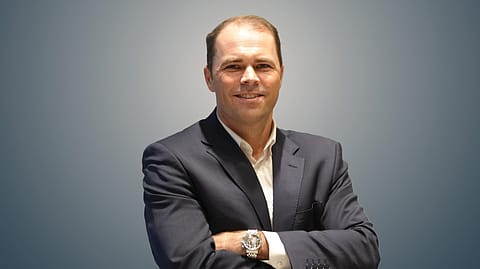
Andre Eckholt, MD, Hettich India, SAARC, Middle East & Africa.
We want to position India as a global manufacturing hub, says Hettich India head
German furniture fittings major Hettich is betting big on India, inaugurating a fully automated Indore plant within its large manufacturing campus as part of a ₹2,000 crore investment in five factories. The company aims to make India a global manufacturing hub and expects it to overtake Germany as its largest market, driven by local production, exports and rising demand.
This summary is AI-generated, and Fortune India is not responsible for its content or any associated copyright issues.
Andre Eckholt, MD, Hettich India, SAARC, Middle East & Africa, says the furniture fittings maker plans to add new factories every two to three years.
Andre Eckholt, MD, Hettich India, SAARC, Middle East & Africa.
German furniture fittings maker Hettich recently inaugurated its 25,700 sq. metre automated plant, located within the company’s 103,039 sq. m Indore facility. The €1.4-billion group is looking to position India as a key global manufacturing hub, and expects the country to surpass Germany as the company's biggest market in the next few years, Andre Eckholt, MD, Hettich India, SAARC, Middle East & Africa, tells Fortune India. Edited excerpts.
How would you describe Hettich’s journey in India?
We are in the 25th year of doing business in India. Around 2013, we started investing in manufacturing. At that time, we set up a facility in Vadodara as a pilot project to understand how things would evolve beyond just sales and marketing.
The idea was to be as close as possible to the needs of the market and customers. The approach has only become stronger with time. Even though we were already No. 1 in our market, we believe [that] to sustain leadership and grow further in a fast-growing environment, we needed a local manufacturing setup.
Another motivation was to de-risk our supply chain, along with achieving economies of scale by reducing logistics and import costs.
Since then, we have invested around Rs 2,000 crore in five factories—three in Vadodara and two in Indore. Our latest facility in Indore produces the quadro drawer system, which we describe as the ‘engine’ of the drawer system.
The Indore plant is said to have advanced technological features…
Hettich is a 138-year-old, family-owned company, now in its fourth generation. All generations have had strong engineering backgrounds, which reflect in our approach.
At our Indore plant, we don’t just design and manufacture products—we also design and build the machines that produce them. These high-tech machines are developed in Germany by Hettich. The production process is fully automated. Raw material goes in, and finished products come out with minimal human intervention. Everything is standardised, and quality is ensured through process control rather than manual inspection.
What is the production capacity of the Indore plant?
The Indore plant produces two main products—hinges, with an installed capacity of 60 million units annually (expandable by 2030), and quadro drawer systems, with a capacity of 5 million sets annually.
{{#most-powerful-women-snapshot-individual.slug}} {{/most-powerful-women-snapshot-individual.slug}} {{^most-powerful-women-snapshot-individual.slug}} {{/most-powerful-women-snapshot-individual.slug}} {{#showRanking}} {{current-rank}} {{/showRanking}} {{#photo.0.url}}
{{name}}
Although the primary focus remains the fast-growing Indian market, the plant is also strategically positioned to support exports.
What about the company’s other manufacturing facilities in India?
In Vadodara, we produce telescopic slides, which cater more to the mass market. These are like entry-level solutions compared to premium systems like quadro. Our initial plant in Vadodara focussed on wire baskets, which remain an important and high-volume product category.
What share does India contribute to the company’s global revenues?
India contributes about 15-20% of our global revenues. However, currency depreciation can impact this when converted into euros.
Sustainability is a key global focus. How are Hettich’s India operations aligned with the same?
Sustainability is part of our DNA. Our goal is to achieve carbon neutrality in India by 2030. In Vadodara, around 70% of our energy consumption already comes from renewable sources like solar and wind. We also follow zero-discharge practices by reusing wastewater.
Beyond environmental sustainability, we focus on social impact. We employ around 2,000 people directly and a significantly higher number indirectly. Through our woodworking institutes in Mumbai and Delhi, we have upskilled over 50,000 carpenters in the last seven to eight years.
How do you attract and develop local talent?
We are a well-recognised brand in the industry, which helps attract talent. Being a market leader naturally draws interest. We also engage with students early by partnering with schools, technical institutes, and universities. Indore, in particular, offers a strong talent pool due to its industrial ecosystem and educational institutions.
We provide a modern work environment with advanced technology, which appeals to engineers and skilled workers. We’ve also seen employees return after leaving, which reflects positively on our work culture.
What is the gender diversity like in your workforce?
A few years ago, we had almost no women in the workforce. Today, women make up over 10%, including roles on the shop floor, in quality, and engineering.
How are global challenges like currency fluctuations affecting your business?
Depreciation of the rupee increases the cost of imports from Germany, which affects margins. However, we do not immediately pass on all cost increases to customers. Our strong local manufacturing footprint helps reduce dependency on imports and provides stability against global disruptions.
What key trends have shaped India’s home interiors market in the last decade?
Two major trends stand out:
Modularisation: With urbanisation and standardised housing, furniture and interiors have become more modular and structured.
Customisation and space transformation: Consumers now seek personalised solutions. Especially in smaller urban homes, there is a growing demand for flexible, multi-functional furniture.
How does Hettich differentiate itself in this competitive landscape?
We have always positioned ourselves as a first mover—whether in entering India, setting up experience centres, or investing in manufacturing when others relied on imports. Our strategy is to stay ahead through innovation, customer engagement, and local presence.
How do Indian and European markets differ?
European markets are more standardised, with catalogue-based purchases. In contrast, Indian consumers prefer customisation, experimentation, and unique designs.
Are there plans for further expansion in India?
We plan to continue expanding our manufacturing footprint, potentially adding new factories every two to three years. We are also increasing our presence in Tier II and III cities through showrooms and experience centres.
How are Tier II and III cities contributing to Hettich’s growth?
Earlier, metro cities contributed 80-90% of our revenue. However, Tier II and III cities are growing rapidly. Consumers in these regions often have higher disposable income for interiors due to lower real estate costs, making them increasingly important for us.
What is your long-term vision for Hettich India?
We aim to expand manufacturing and market presence, strengthen our ecosystem of suppliers and skilled workers, support the industry’s transition from unorganised to organised, [and] position India as a global manufacturing hub.
Follow Fortune India
NEXT STORY