The FAQs are AI-generated, and Fortune India is not responsible for its content or any associated copyright issues.
West Asia conflict may lift aluminium profitability to decade-high levels: Crisil
/ 3 min read
The rating agency said the supply disruption could drive EBITDA for domestic producers to a decadal high of more than $1,450 per tonne in fiscal 2027, supported by strong realisations and relatively stable production costs.
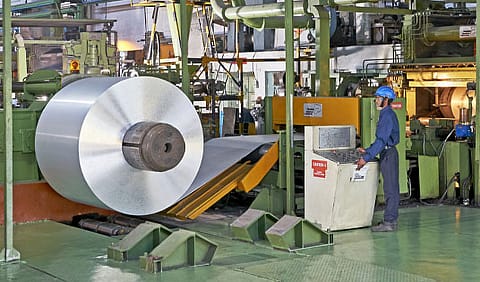
The global aluminium market has been hit by production curtailments across the GCC region, which accounted for 8.3% of global aluminium output in calendar year 2025.
A global aluminium supply deficit triggered by the ongoing conflict in West Asia is expected to push aluminium prices to record highs, significantly boosting the profitability of Indian primary aluminium producers, according to a report by Crisil Ratings.
The rating agency said the supply disruption could drive earnings before interest, taxes, depreciation, and amortisation (EBITDA) for domestic producers to a decadal high of more than $1,450 per tonne in fiscal 2027, supported by strong realisations and relatively stable production costs.
The assessment is based on an analysis of three major domestic primary aluminium producers, which together account for about 90% of India's installed aluminium production capacity of 4.6 million tonnes.
Supply disruptions widen global deficit
According to Crisil, the global aluminium market has been hit by production curtailments across the Gulf Cooperation Council (GCC) region, which accounted for 8.3% of global aluminium output in calendar year 2025.
Strikes on critical smelting infrastructure and gas supply shortages have disrupted 40-50% of aluminium production in the region, potentially widening the global supply deficit to 1.5-2 million tonnes this year, the highest level in a decade.
The supply shock has already translated into a sharp rise in aluminium prices. London Metal Exchange (LME) aluminium prices have averaged above $3,500 per tonne since the onset of the conflict in February 2026, marking the highest levels seen in a decade. "Disruption caused by the West Asia conflict is significant, considering the global supply deficit averaged below 0.5 million tonnes over the past five years," said Ankit Hakhu, Director, Crisil Ratings.
He said that with global smelting capacities already operating at more than 90% utilisation and China's production nearing its 45-million-tonne cap, there is limited scope to offset the GCC supply shortfall. "Even if the conflict is resolved over the next one to two quarters, the deficit is likely to keep aluminium prices elevated in the range of $3,200-3,300 per tonne through fiscal 2027," Hakhu added.
Indian producers positioned to benefit
Indian aluminium producers are expected to be among the biggest beneficiaries of the rally, as their selling prices are linked to LME benchmarks while production costs remain among the lowest globally.
Most domestic smelting facilities operate within the first quartile of the global cost curve, giving them a significant competitive advantage.
Crisil said Indian producers benefit from extensive backward integration, including captive coal-based power plants, alumina refineries and bauxite mines. These integrated operations help shield them from global energy and raw material price volatility.
Power costs account for 40-45% of aluminium production costs. Unlike many global producers that rely heavily on gas-based power, Indian companies use captive coal-based generation, benefiting from stable domestic coal prices and co-located power infrastructure.
{{#most-powerful-women-snapshot-individual.slug}} {{/most-powerful-women-snapshot-individual.slug}} {{^most-powerful-women-snapshot-individual.slug}} {{/most-powerful-women-snapshot-individual.slug}} {{#showRanking}} {{current-rank}} {{/showRanking}} {{#photo.0.url}}
{{name}}
Similarly, India has abundant domestic bauxite reserves and high levels of alumina integration, enabling producers to meet 85-90% of their raw material requirements internally.
As a result, production costs for integrated Indian aluminium producers are expected to remain relatively stable at $1,900-1,950 per tonne in fiscal 2027, compared with around $1,865 per tonne in fiscal 2026.
Margins, cash flows seen hitting record highs
"The key advantage Indian producers hold is their self-sufficiency in key raw materials," said Ankush Tyagi, Director, Crisil Ratings. "Unlike GCC smelters, Indian players rely primarily on domestically sourced coal and bauxite. As a result, higher aluminium prices are expected to lift operating margins to $1,400-1,500 per tonne this fiscal, significantly above the decadal average of about $560 per tonne," he added.
The margin expansion comes as domestic aluminium producers have recently expanded capacity to cater to rising demand.
Domestic aluminium demand is projected to grow 7-9% this fiscal, driven by increasing electrification, infrastructure development and growing adoption of electric vehicles (EVs).
Export opportunities are also expected to improve as buyers in Europe, Japan and the US look for alternative suppliers amid disruptions in the GCC region. These factors are expected to keep capacity utilisation levels healthy at 85-90%, supporting strong cash generation and balance sheets.
Crisil expects operating cash accruals to reach a decade-high level in fiscal 2027, with net leverage remaining below 2 times, reflecting strong credit profiles across the sector. However, the agency cautioned that a faster-than-expected restoration of GCC production capacity and a sharp correction in global aluminium prices remain key risks to its outlook.
Follow Fortune India
Frequently Asked Questions
NEXT STORY