West Asia tensions yet to dent travel demand, says Hyatt; India growth momentum intact
/ 4 min read
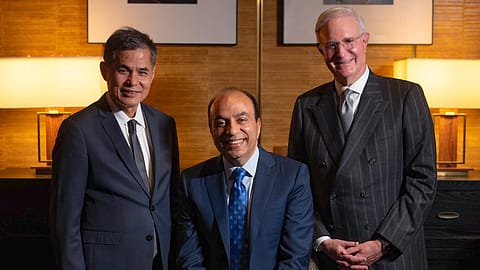
Hyatt Leadership (L-R) - Stephen Ho, Vikas Chawla & David Udell | Credits: Hyatt
West Asia tensions yet to dent travel demand, says Hyatt; India growth momentum intact
Hyatt says West Asia tensions have not materially hit travel demand, calling tourism “amazingly durable” despite geopolitical volatility. The group remains strongly bullish on India, where sentiment is robust and growth seen as sustainable. With nearly 100 hotels in its active India pipeline, Hyatt is betting on quality-led expansion and premium positioning rather than a race for scale.
This summary is AI-generated, and Fortune India is not responsible for its content or any associated copyright issues.
The hotel chain, which currently operates 55 hotels across nine brands in India and Southwest Asia with over 10,500 keys, expects the next few years to see accelerated openings as projects already under construction come online.
Hyatt Leadership (L-R) - Stephen Ho, Vikas Chawla & David Udell | Credits: Hyatt
The ongoing conflict in West Asia, have not materially dented travel demand, with Hyatt’s leadership calling the sector “durable” even amid volatility and maintaining a bullish outlook on India.
“We’re used to dealing with geopolitical issues,” said David Udell, group president, Asia Pacific at Hyatt told Fortune India. “The most important thing is the safety and security of our colleagues and guests. But travel is an amazingly durable thing. There is an inherent desire in all of us to go out and see something different.”
While acknowledging that travel flows may shift depending on global developments, Udell said demand tends to rebalance rather than disappear. “It’s an ebb and flow. You may see some travellers choosing different destinations, but overall it remains very positive,” he said.
On India specifically, Hyatt does not see any immediate impact on sentiment. “Right now, it’s a very positive environment. There’s a lot of interest in India and we see it as sustainable, not something that is here today and gone tomorrow,” he added.
Hyatt leadership noted that while short-term disruptions are possible, they do not alter the long-term trajectory. “We may see short-term blips, but overall we are very bullish on India and the growth possibilities,” said Vikas Chawla, president, India and Southwest Asia.
India pipeline nears 100 hotels
Hyatt is doubling down on India as a long-term growth engine, with a pipeline of nearly 100 hotels and a clear pivot towards what its leadership calls “quality-led, intent-driven expansion” rather than a race for scale.
The hotel chain, which currently operates 55 hotels across nine brands in India and Southwest Asia with over 10,500 keys, expects the next few years to see accelerated openings as projects already under construction come online. The broader Asia Pacific region, including Greater China, now accounts for 370 hotels across 17 brands, representing about 90,000 keys, with a pipeline of over 400 hotels.
Recommended Stories
“We continue to see strong, sustained confidence in the India market,” Stephen Ho, president, Greater China and Growth, Asia Pacific. “We expect to build on this momentum and accelerate growth.”
The company signed around 5,000 keys in India last year and is set to open about five hotels this year, with further activations lined up as developments progress.
“There is a renewed appetite for Indians to explore their own country,” Ho said. “We are looking at both key cities like Mumbai, Delhi and Bengaluru, and resort destinations.”
Upcoming openings in 2026 include Bhopal, Bengaluru, Jaipur and Lansdowne, along with the debut of the Destination by Hyatt brand in Jaipur.
RANK
COMPANY NAME
REVENUE
(INR CR)
(INR CR)
{{#current-rank}} {{current-rank}} {{/current-rank}} {{^current-rank}} {{rank}} {{/current-rank}} {{name}} {{#revenue}} {{revenue}} {{/revenue}} {{^revenue}} {{noi}} {{/revenue}}
Importantly, the executives emphasised that the pipeline is active. “These are projects where construction has started and they are moving. That gives us confidence that growth will come through in the next few years,” Ho added.
Quality over scale
Even as competition intensifies, Hyatt is consciously steering away from a scale-driven strategy.
“It’s not about quantity. It’s about quality growth,” Udell said. “We want to build hotels where our World of Hyatt members want to go. That’s where the value creation is.”
The company’s loyalty programme has expanded eightfold since 2017, with around 40% of business in India now coming through World of Hyatt channels.
Hyatt’s broader strategy for 2030 rests on three pillars: elevating brands, talent and technology. The company is also doubling down on its premium and luxury positioning. Around 60% of its Asia Pacific portfolio sits in the luxury, lifestyle and upper upscale segments.
India, executives say, has significant headroom for such offerings. “There is a lot of aspiration and demand for differentiated, experience-led hospitality,” Udell said.
Interestingly, food and beverage is a significant contributor - a trend, they have observed, across the Asia-Pacific region. It accounts for about 40% of revenues in India, including meetings, incentives, conferences and exhibitions (MICE).
“People make decisions based on what their stomach tells them,” Udell said lightheartedly.
At the same time, the rise of standalone restaurants and evolving consumer tastes are pushing hotel chains to innovate faster. “We need to be more creative and responsive. The market is changing quickly,” he added.
Structural tailwinds, but execution challenges remain
Hyatt’s bullishness on India is tied to broader structural shifts including infrastructure upgrades, rising disposable incomes and stronger domestic tourism. “We are seeing very, very positive sentiments because of significant improvements in infrastructure and so forth, and we see it as something that's sustainable,” Ho said.
Despite avoiding hard targets, Hyatt’s leadership is clear on one point. India is set to play a central role in its global growth story.
“Over time, India will be a very significant contributor to Hyatt’s growth globally,” Chawla added.
The company is also investing in building local leadership and talent, with a sharper focus on creating a more entrepreneurial organisation in the market.
However, bottlenecks remain, particularly around regulatory complexity. Opening a hotel in India still involves multiple approvals, though the government has begun streamlining processes by reducing the number of departments involved.
“There is also a need to market India better as a global destination,” Chawla suggests, pointing to the country’s relatively modest annual inbound tourist numbers despite its scale.
Globally, Hyatt reported steady operating performance for 2025, with comparable system-wide RevPAR rising 4% in the fourth quarter and 2.9% for the full year. Gross fees grew 4.5% year-on-year to $307 million in the quarter and 9% to $1.2 billion for the full year, while adjusted EBITDA rose 14.6% to $292 million in the quarter and 5.8% to $1.16 billion for 2025.
The company posted an adjusted net income of $126 million in the fourth quarter and $209 million for the full year, even as reported net income stood at a loss of $20 million for the quarter and $52 million for the year. Meanwhile, Hyatt continued to expand its footprint, with net rooms growth of 7.3% in 2025 and a development pipeline of around 148,000 rooms, up 7% year-on-year.
Udell summed it up, “We don’t want to be the biggest. In the segments we operate in, we want to be the best.”