What Budget 2026 left out and why industry isn’t too worried
/ 3 min read
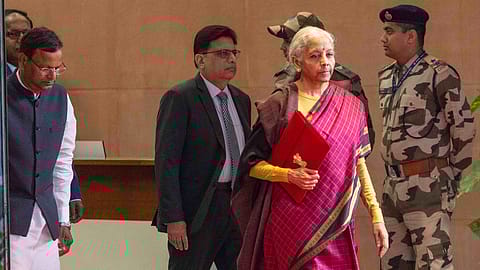
Union Finance Minister Nirmala Sitharaman
What Budget 2026 left out and why industry isn’t too worried
The Union Budget 2026 emphasized continuity and public investment but left out key industry expectations like tax reforms and affordable housing. Despite this, industry leaders remain optimistic about the macroeconomic push and future reforms, particularly in manufacturing and MSMEs, while acknowledging the budget's focus on long-term economic capacity building.
This summary is AI-generated, and Fortune India is not responsible for its content or any associated copyright issues.
On the manufacturing front, expectations around a renewed production-linked incentive (PLI) push also remained unmet.
Union Finance Minister Nirmala Sitharaman
While the Union Budget 2026 set the tone for continuity and higher public investment, several industry leaders said key expectations—particularly around tax reforms, affordable housing, and sector-specific incentives—were left unaddressed, even as they acknowledged the broader macro push behind the proposals.
Chandrajit Banerjee, director general of the Confederation of Indian Industry (CII), said the budget missed an opportunity to push states harder on reforms while acknowledging that everything cannot not and should be in the budget. But going forward, I would like to see that we are able to really encourage and incentivise the states of India to go on the course of reform,” he said, adding that while some states have moved ahead, others still lag behind.
On the manufacturing front, expectations around a renewed production-linked incentive (PLI) push also remained unmet. B. Thiagarajan, managing director of Blue Star, said industry was hoping for another round of PLI support for select sectors, especially where import dependence remains high. “There are quite a bit of component ecosystems that are still dependent on imports, and that is one mission that we have to complete,” he said. However, he added that the government appears to be moving away from PLI-led incentives and leaving more responsibility with industry. Thiagarajan also downplayed the idea that all reforms must come through the budget, noting that GST changes, divestment and sectoral reforms often happen outside it.
MSMEs, despite being repeatedly highlighted as a growth engine, also flagged gaps. Ashok Saigal, managing director of Frontier Technologies Pvt Ltd, said two key demands were left unaddressed. “We were hoping for some kind of intervention in the interest rate being charged by banks to MSMEs, and some kind of subvention so that the gap between large corporates and MSMEs would be reduced,” he said, adding that the lack of technical support was another missed opportunity.
Affordable housing emerged as another area of disappointment. Anshuman Magazine, chairman and CEO for India, South-East Asia, Middle East and Africa at CBRE, said the budget offered no fresh incentives either for developers or buyers. “There were no incentives for developers to go into affordable housing, or for consumers to get any tax benefit,” he said. He also noted that income tax relief, while not widely expected, was entirely absent. That said, Magazine pointed to the broader picture, highlighting a 9–10% increase in capital expenditure. “All that money moving into infrastructure, manufacturing and services will make a big difference to the economy,” he said.
Some business leaders also flagged the lack of visible tax process reforms. Piruz Khambatta, group chairman of Rasna Pvt Ltd, said he expected movement on mechanisms such as mediation councils or alternate dispute resolution. “My understanding is a lot of that is in the fine print. So let us wait for the fine print to really get it,” he said.
Industry flags long-term gains over short-term relief
However, industry bodies offered a more measured assessment of the budget. CII president Rajiv Memani said most of the industry’s key asks had been addressed. He highlighted increased allocations for MSMEs, high-speed rail, incremental capex, and strategic sectors such as biopharma, semiconductors and electronics manufacturing, which received an incremental allocation of about Rs 40,000 crore. “Tax and customs issues have been sorted, and benefits for data centres are very positive,” he said.
Shashwat Goenka, vice chairman, RP-Sanjiv Goenka Group, echoed that view, calling the budget holistic and growth-oriented. “If you ask me what the budget left out, I don’t think it left out anything. It built on reforms already enabled, and over the next 365 days, the government will build further on what was announced,” he said while adding that the Budget covered all relevant sectors from an economy's growth standpoint, and all segments of society, right from the farmer to the industrialist.
{{#most-powerful-women-snapshot-individual.slug}} {{/most-powerful-women-snapshot-individual.slug}} {{^most-powerful-women-snapshot-individual.slug}} {{/most-powerful-women-snapshot-individual.slug}} {{#showRanking}} {{current-rank}} {{/showRanking}} {{#photo.0.url}}
{{name}}
Chandra Prakash Pandey, advisor to the board at Patanjali, admitted that while common citizens typically expect tax reliefs to boost household savings - something that was absent this year - the focus this time is on creating future economic capacity. “The historic allocation of Rs 12.2 lakh crore for capital expenditure, setting up infrastructure for content creation as part of the Orange Economy, Rs 40,000 crore for ISM 2.0 to make India self-sufficient in semiconductors where China dominates globally, critical mineral mining and new corridors backed by research to strengthen the backbone of semiconductor manufacturing, and Rs 10,000 crore each for MSMEs and biopharma are some of the major steps taken in this budget to prepare the country for the future,” Pandey said.
Follow Fortune India
NEXT STORY