Why the Adani Group’s purchase of IntelliSmart could be a game-changer
/ 3 min read
The acquisition of EESL-NIIF backed IntelliSmart, which operates over 2.2 crore smart meters, comes amid India’s push to instal 25 crore prepaid smart meters under the ₹1.35 lakh crore RDSS scheme by 2027.
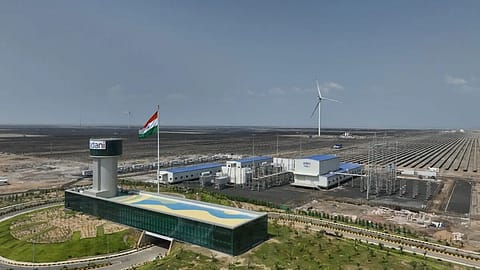
Adani Energy Solutions is expanding its presence across transmission, distribution and smart metering businesses as utilities accelerate digitalisation efforts | Credits: Adani Energy
Adani Energy Solutions Limited has acquired IntelliSmart, the smart metering arm of the debt-laden public sector company Energy Efficiency Services Limited (EESL).
That Adani, GMR Smart Electricity Distribution, GIC-backed Genus Power Infrastructures and Swiss fund Partners Group were frontrunners was no secret. The Gautam Adani-led company spent a little over ₹3,000 crore to acquire IntelliSmart's entire equity share capital. In the process, AESL will also become India's largest smart metering platform with a portfolio of more than 4.7 crore smart meters.
IntelliSmart is among the top three smart metering players in the country, with a portfolio of more than 2.2 crore smart meters across Uttar Pradesh, Gujarat, Madhya Pradesh, Bihar and Assam. The company is owned 51% by India's sovereign wealth fund, the National Investment and Infrastructure Fund (NIIF), and 49% by debt-laden Energy Efficiency Services Ltd. EESL was once the poster boy of the Indian government’s ambitious energy-saving program. EESL had put IntelliSmart on the block as part of its attempt to reduce debt.
Adani’s purchase of IntelliSmart comes at a time when the Indian government, through the Revamped Distribution Sector Scheme (RDSS), is looking to install 25 crore prepaid smart meters by 2027. The broader rollout will have government support of ₹1.35 lakh crore running through 2035, in an attempt to curb power distribution losses.
Manufacturers of smart electric meters would have seen their revenue grow by around 20% last fiscal, reaching ₹9,000 crore, according to ratings agency Crisil. “The key catalyst here is the resolution of initial implementation constraints seen under the Smart Meter National Program (SMNP) through which the Government of India aims to replace 25 crore conventional electricity meters with prepaid smart electric meters,” Crisil reckons.
EESL is also reportedly planning to exit three other joint ventures: NEESL, a JV with Neev International APS; Energy Efficiency Services Co Ltd, Thailand; and Energy Efficiency Services LLC (UAE) to streamline operations.
“Smart Meter penetration in India, currently at 5-6%, lags behind developed nations like Japan (100%) and the USA (73%), as well as the global average of around 43%, highlighting an urgent need to bridge this gap and enhance energy efficiency,” ratings agency Care Edge had said in a statement. “Now, India is making significant strides with its ambitious plan to install 25 crore smart meters over five years, from FY22 to FY26, presenting a $20-25 billion opportunity for the energy sector under the Revamped Distribution Sector Scheme (RDSS), which was launched in 2017.”
“The acquisition is in line with AESL’s strategy to pursue value-accretive growth through both organic and inorganic opportunities,” Adani Energy Solutions said at the time of the acquisition. “The acquisition is expected to deliver synergies through economies of scale, optimization of operations and maintenance costs, and integration with AESL’s broader energy and infrastructure platform.”
The Indian government’s push towards smart meters is in line with its attempt to curb distribution losses. Within two to three years of the RDSS announcement in June 2021, discoms began to see a reduction in Aggregate Technical and Commercial (AT&C) losses, according to CareEdge ratings.
“However, challenges persist due to variations across states,” the ratings agency noted. “The AT&C losses for power distribution companies (discoms) have consistently decreased from 20.73% in FY20 to 17.6% in FY24, primarily driven by improvements in collection efficiency. Billing efficiency increased from 82.5% in FY23 to 83.6% in FY24, while collection efficiency rose from 96.1% to 96.4%. CARE Edge Ratings anticipates further reductions in AT&C losses as the scheme progresses, along with a narrowing of the ACS-ARR gap. However, achieving a zero-loss scenario remains a long-term objective.”
While smart meters could bring additional revenue potential of around ₹400,000 crore over the next seven years, their implementation has also been tardy. “Should billing and collection efficiencies improve substantially, the financial gains could exceed initial projections, further bolstering the financial health of the power sector,” CareEdge says.
{{#most-powerful-women-snapshot-individual.slug}} {{/most-powerful-women-snapshot-individual.slug}} {{^most-powerful-women-snapshot-individual.slug}} {{/most-powerful-women-snapshot-individual.slug}} {{#showRanking}} {{current-rank}} {{/showRanking}} {{#photo.0.url}}
{{name}}
Under RDSS, smart metering works have been sanctioned for 45 distribution utilities across 28 States/UTs. This covers smart metering of 19.79 Cr. consumers, 52.53 Lakh Distribution Transformers and 2.05 Lakh feeders. As on 31st December 2025, 3.90 Cr smart meters have been installed under the scheme. In addition, smart meters have been installed by States under their State plans/ other schemes. Overall, 5.28 crore smart meters have been installed across the country under various schemes as on 31st December 2025.
The government has been pushing for smart meters largely because they provide consumers with near-real-time visibility into consumption through mobile applications, enabling budgeting and monitoring. Now, with the purchase of IntelliSmart, the Adani juggernaut marches on, once again emerging as the largest player in a sector.
NEXT STORY