Will Noel Tata take charge as Tata Sons chairman?
/ 2 min read
N. Chandrasekaran, who has stepped down as chairman, will continue till the end of his term in February 2027; he is not expected to seek reappointment, say sources.
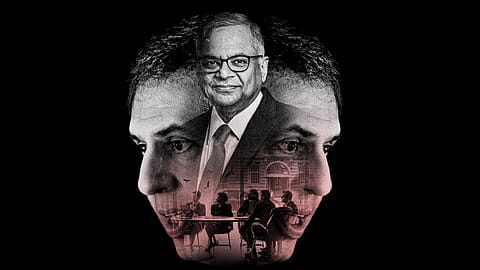
Tata Sons | Credits: Anirban Ghosh
Noel Tata may seek to reconstitute the Tata Sons board and take charge as chairman if the Reserve Bank of India (RBI) ultimately insists that the holding company go for an IPO, as the he weighs how to protect the Tata family’s influence over the $170-billion group, said sources in the know.
The issue has acquired urgency after the RBI retained Tata Sons on its upper-layer NBFC (NBFC-UL) list for 2026-27. The regulator, however, said the classification is without prejudice to Tata Sons’ pending application to surrender its core investment company registration. The RBI has not yet decided on Tata Sons’ request to exit the NBFC-UL framework. The regulatory uncertainty leaves open the possibility of a listing if the application is rejected.
For Noel Tata, the chairman of Tata Trusts, the stakes go beyond an IPO. Tata Trusts owns about 66% of Tata Sons, but its ability to influence the holding company is embedded in the existing governance structure, including the nomination of directors. Noel Tata and Venu Srinivasan are the nominees of Tata Trusts on the Tata Sons board at present, and they hold veto power over crucial decisions. A listed Tata Sons would bring public shareholders, greater disclosure and regulatory scrutiny—and could potentially dilute the Trusts’ and Tata family’s ability to shape the group’s strategy through the holding company.
Noel Tata has already opposed the prospect of a Tata Sons listing. His argument is that keeping the holding company private allows the Trusts to retain greater influence over capital allocation and long-term group strategy while preserving the philanthropic objectives attached to their ownership.
A source familiar with the thinking said the concern is that a listing could gradually make Tata Sons more independent of the Tata Trusts, despite their dominant shareholding. The Tata family itself influences the group’s decisions through the Trusts. “Eventually, the Tata family will become irrelevant to the Tata ecosystem if it goes for listing,” the source said.
This makes the composition of the Tata Sons board critical. If the RBI closes the route to remaining unlisted, Noel Tata could seek stronger Trust-aligned representation on the board before the company enters a new regulatory regime. The objective would not necessarily be to control day-to-day operations, but to ensure that the principal shareholder retains strategic influence as Tata Sons becomes subject to public-market governance, said sources.
The leadership question has made the situation more fluid. N. Chandrasekaran has stepped down as Tata Sons chairman ahead of the August 18 shareholder meeting, amid uncertainty over his reappointment as a director. He will continue till the end of his term as a director in February 2027.
Tensions within Tata Sons had surfaced around the performance and capital allocation of newer businesses, including Air India, Tata Digital and Tata Electronics. Noel Tata had sought greater clarity from Chandrasekaran on the performance of loss-making businesses, as these could force Tata Sons to borrow and make it qualify as an NBFC-UL.
In short, Chandrasekaran’s exit could give Noel Tata an opportunity to reset the board rather than simply appoint another chairman, said a source in the Tata Group.
NEXT STORY